Pearson Edexcel · GCSE · Music
Course version: 1MU0 · Version from Sept 2016
Composing - Brief 1: Instrumental Music 1700–1820: They should practise…
Full specification wording
Component 2: Composing - Brief 1: Instrumental Music 1700–1820: They should practise harmonising and developing given melodies using the techniques of repetition, variation, extension and motivic working to sustain a piece with a varied and creative musical outcome.
This criterion asks you to rehearse two linked skills on short given melodies: harmonising them (choosing chords that fit the melody and support its phrasing) and developing them so the material…
- Point 2 of 2
- 4 key terms
Study notes
From the teaching notes for this specification point.
The idea
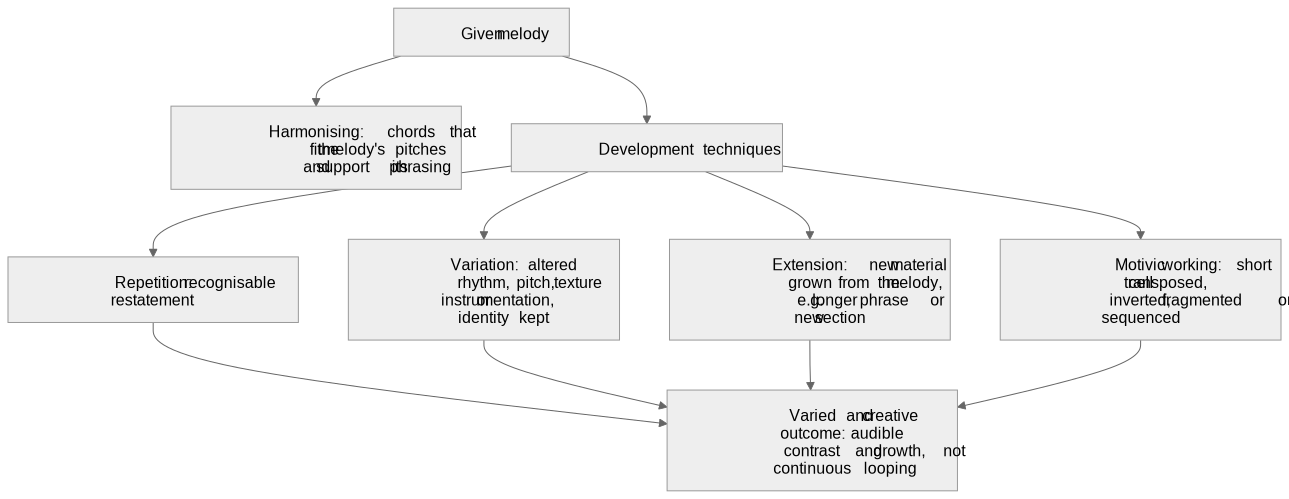
This criterion asks you to rehearse two linked skills on short given melodies: harmonising them (choosing chords that fit the melody and support its phrasing) and developing them so the material sustains a whole piece. Development here means working the melody through repetition (restating it recognisably), variation (altering rhythm, pitch, texture or instrumentation while keeping identity), extension (adding new material that grows from the melody, such as a longer phrase or a new section) and motivic working (taking a short cell and transposing, inverting, fragmenting or sequencing it). A varied and creative outcome means the piece does not simply loop the same tune; contrast and growth are audible. Practise on several given melodies so the techniques become habits rather than one-off tricks.
What earns the marks
- Explains harmonising as choosing chords that fit the given melody's pitches and support its phrase structure.
- Distinguishes repetition (recognisable restatement) from variation (altered rhythm, pitch, texture or instrumentation that keeps the melody's identity).
- Describes extension as adding new material grown from the melody, such as a lengthened phrase or a new contrasting section.
- Explains motivic working as developing a short cell through devices such as transposition, inversion, fragmentation or sequencing.
- Recognises that a varied and creative outcome requires audible contrast and growth across the piece, not continuous looping of the original tune.
- Applies the techniques to a specific given melody rather than describing them only in the abstract.
Common mistakes and how to put them right
Treating repetition and variation as the same thing.
Put it right: Repetition restates the melody recognisably, whereas variation changes rhythm, pitch, texture or instrumentation while preserving identity.
Assuming harmonising means adding any chords.
Put it right: The chords must fit the melody's pitches and support its phrasing.
Confusing extension with motivic working.
Put it right: Extension adds new material grown from the melody, while motivic working develops a short cell through devices such as transposition or fragmentation.
Believing a varied outcome means constant change.
Put it right: Contrast must be balanced with recognisable return so the piece coheres.
Exam tips
- Name the technique you are using and point to the exact bar or phrase where it happens.
- Check each chord against the melody note sounding at that point before committing to it.
- Plan contrast deliberately: decide where repetition returns and where variation or extension takes over.
- Test the outcome by listening: can you still hear the original melody's identity inside the development?
Try the lesson
The start of the Component 2: Composing - Brief 1: Instrumental Music 1700–1820: They should practise harmonising and developing given melodies using the techniques of repetition, variation, extension and motivic working to sustain a piece with a varied and creative musical outcome. lesson, made from teaching notes for this specification point.
Have a go first
A student is developing a melody and wants to create a sense of unity while adding variety. Which technique involves restating the original melody but with changes to rhythm, pitch, or harmony?
Listen
This criterion asks you to rehearse two linked skills on short given melodies: harmonising them (choosing chords that fit the melody and support its phrasing) and developing them so the material sustains a whole piece. Development here means working the melody through repetition (restating it recognisably), variation (altering rhythm, pitch, texture or instrumentation while keeping identity), extension (adding new material that grows from the melody, such as a longer phrase or a new section) and motivic working (taking a short cell and transposing, inverting, fragmenting or sequencing it). A varied and creative outcome means the piece does not simply loop the same tune; contrast and growth are audible. Practise on several given melodies so the techniques become habits rather than one-off tricks. A strong answer earns marks for these points. Explains harmonising as choosing chords that fit the given melody's pitches and support its phrase structure. Distinguishes repetition (recognisable restatement) from variation (altered rhythm, pitch, texture or instrumentation that keeps the melody's identity). Describes extension as adding new material grown from the melody, such as a lengthened phrase or a new contrasting section. Explains motivic working as developing a short cell through devices such as transposition, inversion, fragmentation or sequencing. Exam tip: Name the technique you are using and point to the exact bar or phrase where it happens.
See it
Key words
Say what each word means before you turn the card.
Harmonising a given melody
Try answering aloud or in your head before turning the card.
Repetition and variation
Try answering aloud or in your head before turning the card.
Extension of melodic material
Try answering aloud or in your head before turning the card.
Motivic working
Try answering aloud or in your head before turning the card.
See every definition
- Harmonising a given melody
- Choosing chords that fit the melody's pitches and support its phrasing.
- Repetition and variation
- Restating the melody recognisably, or altering rhythm, pitch, texture or instrumentation while keeping its identity.
- Extension of melodic material
- Adding new material that grows from the melody, such as a longer phrase or a new section.
- Motivic working
- Taking a short cell and transposing, inverting, fragmenting or sequencing it.
Label the diagram
Some boxes have lost their names. Pick the right name for each number.
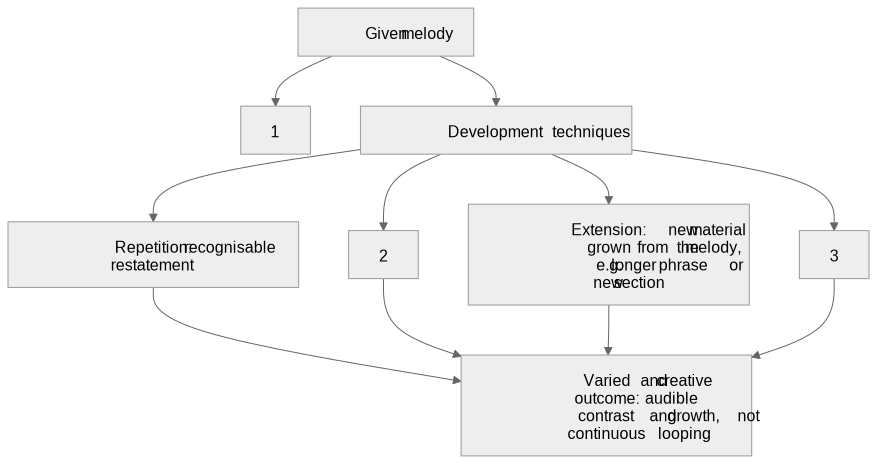
1Box 1
2Box 2
3Box 3
There is more to this lesson
The full lesson goes on to check your understanding and help you earn the marks. Create a free account to carry on, with your progress saved.
A week of Premium from your first lesson · Then the free plan continues · No card, no charge
Test your understanding of Component 2: Composing - Brief 1: Instrumental Music 1700–1820: They should practise harmonising and developing given melodies using the techniques of repetition, variation, extension and motivic working to sustain a piece with a varied and creative musical outcome.
Active recall beats re-reading. Take an instant quiz now to test what you’ve learned and lock it into long-term memory.
A week of Premium from your first lesson · Then the free plan continues · No card, no charge