Pearson Edexcel · GCSE · Music
Course version: 1MU0 · Version from Sept 2016
Appraising - Detailed application of musical elements: harmony and chord…
Full specification wording
Component 3: Appraising - Detailed application of musical elements: harmony and chord patterns are used in the music
Harmony describes how chords combine and follow one another; a chord pattern is the ordered succession of chords, such as a repeated four-chord loop.
- Point 8 of 9
- 3 key terms
Study notes
From the teaching notes for this specification point.
The idea
Harmony describes how chords combine and follow one another; a chord pattern is the ordered succession of chords, such as a repeated four-chord loop. To appraise harmony, identify whether the music is consonant or dissonant, whether chords are major, minor or diminished, and whether the pattern repeats. Notice cadences: a perfect cadence moves from chord V to chord I and sounds finished, while an imperfect cadence ends on chord V and sounds unfinished. A plagal cadence moves from chord IV to chord I. Also listen for a tonic pedal or a repeated chord loop that anchors the harmony. Naming the chord pattern and its effect on mood or structure earns credit.
What earns the marks
- Identifies the harmony as consonant or dissonant and links this to the mood or tension in the extract.
- Recognises chord qualities such as major, minor or diminished and describes their effect.
- Describes a chord pattern or loop, noting whether it repeats and how it supports the structure.
- Identifies a cadence type, such as perfect (V–I), imperfect (ending on V) or plagal (IV–I), and its effect of closure or openness.
- Explains how the harmony or chord pattern interacts with melody, bass or texture.
Common mistakes and how to put them right
Confusing a perfect cadence with an imperfect cadence.
Put it right: Perfect moves V–I and closes, imperfect ends on V and stays open.
Describing a chord pattern only as 'repeated' without naming the chords or their effect on mood and structure.
Treating all dissonance as a mistake.
Put it right: Dissonance is a deliberate device that creates tension.
Mixing up major and minor qualities when describing the effect on mood.
Exam tips
- Name the cadence type and its chord movement, then state whether it sounds finished or unfinished.
- Describe the chord pattern's repetition and how it shapes sections of the music.
- Link each harmonic feature to a musical effect such as tension, calm or closure.
Try the lesson
The start of the Component 3: Appraising - Detailed application of musical elements: harmony and chord patterns are used in the music lesson, made from teaching notes for this specification point.
Have a go first
Which of the following is the standard chord sequence for a 12-bar blues in the key of C, shown as the chord on each bar of the first four bars?
Listen
Harmony describes how chords combine and follow one another; a chord pattern is the ordered succession of chords, such as a repeated four-chord loop. To appraise harmony, identify whether the music is consonant or dissonant, whether chords are major, minor or diminished, and whether the pattern repeats. Notice cadences: a perfect cadence moves from chord V to chord I and sounds finished, while an imperfect cadence ends on chord V and sounds unfinished. A plagal cadence moves from chord IV to chord I. Also listen for a tonic pedal or a repeated chord loop that anchors the harmony. Naming the chord pattern and its effect on mood or structure earns credit. A strong answer earns marks for these points. Identifies the harmony as consonant or dissonant and links this to the mood or tension in the extract. Recognises chord qualities such as major, minor or diminished and describes their effect. Describes a chord pattern or loop, noting whether it repeats and how it supports the structure. Identifies a cadence type, such as perfect (V–I), imperfect (ending on V) or plagal (IV–I), and its effect of closure or openness. Exam tip: Name the cadence type and its chord movement, then state whether it sounds finished or unfinished.
See it
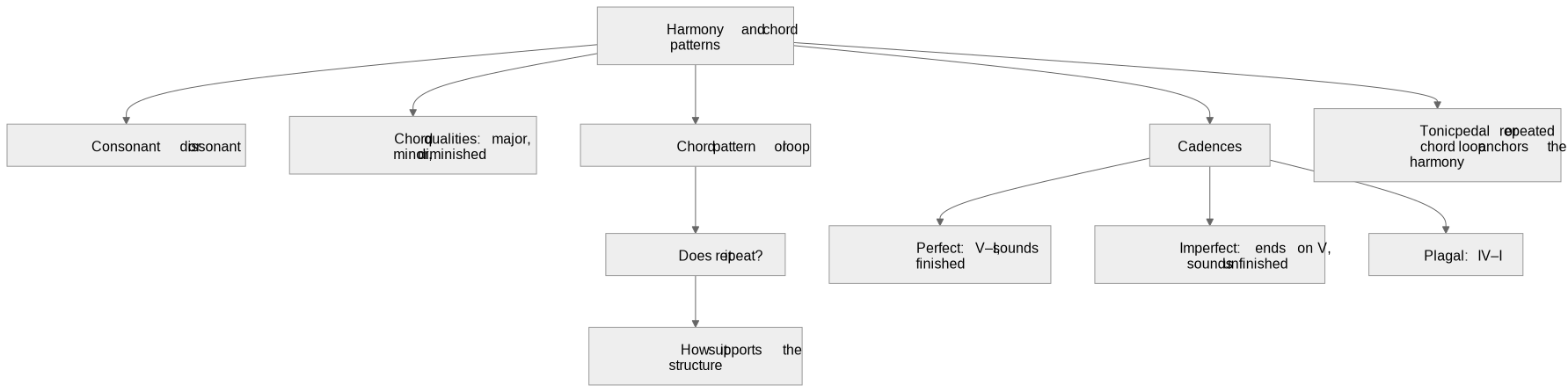
Key words
Say what each word means before you turn the card.
Chord qualities and patterns
Try answering aloud or in your head before turning the card.
Cadences and closure
Try answering aloud or in your head before turning the card.
Harmony's interaction with melody and texture
Try answering aloud or in your head before turning the card.
See every definition
- Chord qualities and patterns
- Chords may be major, minor or diminished, and a chord pattern is the ordered succession of chords, such as a repeated four-chord loop.
- Cadences and closure
- A perfect cadence moves from chord V to chord I and sounds finished, an imperfect cadence ends on chord V and sounds unfinished, and a plagal cadence moves from chord IV to chord I.
- Harmony's interaction with melody and texture
- Harmony or a chord pattern can interact with melody, bass or texture, and a tonic pedal or repeated chord loop can anchor the harmony.
Label the diagram
Some boxes have lost their names. Pick the right name for each number.
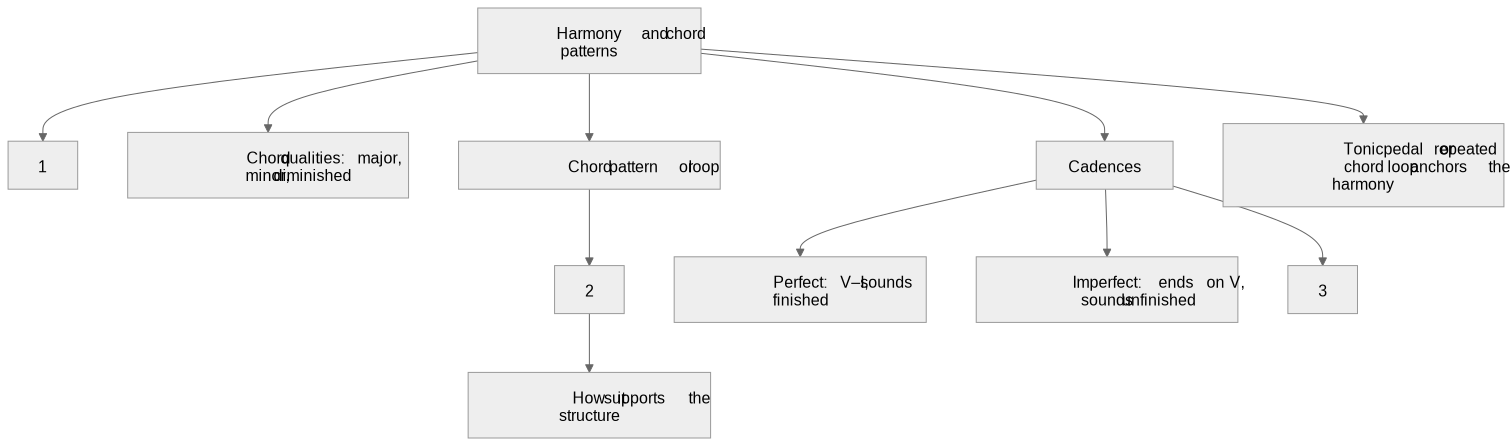
1Box 1
2Box 2
3Box 3
There is more to this lesson
The full lesson goes on to check your understanding and help you earn the marks. Create a free account to carry on, with your progress saved.
A week of Premium from your first lesson · Then the free plan continues · No card, no charge
Test your understanding of Component 3: Appraising - Detailed application of musical elements: harmony and chord patterns are used in the music
Active recall beats re-reading. Take an instant quiz now to test what you’ve learned and lock it into long-term memory.
A week of Premium from your first lesson · Then the free plan continues · No card, no charge