Pearson Edexcel · GCSE · Music
Course version: 1MU0 · Version from Sept 2016
Appraising - Detailed application of musical elements: the effects of…
Full specification wording
Component 3: Appraising - Detailed application of musical elements: the effects of music (e.g wah wah, flanger, continuo – see Appendix 3 for more examples).
This element asks you to recognise and describe effects used to shape music, and to explain their impact on the sound.
- Point 9 of 9
- 4 key terms
Study notes
From the teaching notes for this specification point.
The idea
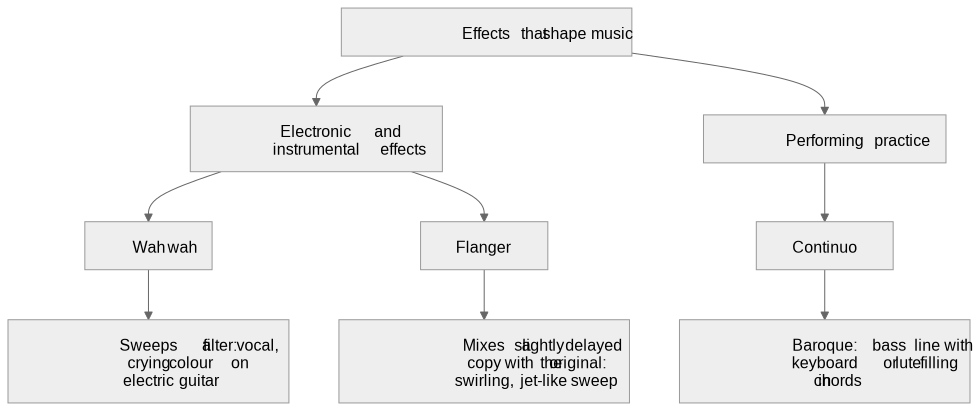
This element asks you to recognise and describe effects used to shape music, and to explain their impact on the sound. Effects fall into two broad families. Electronic and instrumental effects alter timbre or pitch: a wah wah pedal sweeps a filter to give a vocal, crying colour to an electric guitar; a flanger mixes a slightly delayed copy of a signal with the original, producing a swirling, jet-like sweep. Continuo is not a pedal effect but a performing practice: a bass line (often figured) played by a bass instrument with a keyboard or lute filling in chords, central to Baroque music. Appendix 3 lists further examples, so learn to identify effects by ear and link each to genre, era and intended mood.
What earns the marks
- Identifies wah wah as a filter-based pedal effect producing a vocal, sweeping tone colour, typically on electric guitar.
- Identifies flanger as an effect created by combining a signal with a short, modulated delay, giving a swirling or jet-like sweep.
- Recognises continuo as a Baroque performing practice in which a bass line is realised with chords by a keyboard or plucked instrument.
- Distinguishes electronic/instrumental effects (wah wah, flanger) from a performing practice (continuo).
- Links a named effect to an appropriate genre, era or intended expressive purpose.
- Uses Appendix 3 examples to extend recognition beyond the two named effects.
Common mistakes and how to put them right
Confusing flanger with a simple echo or reverb.
Put it right: Flanger combines the original with a very short, modulated delay to create a sweeping comb effect, not a distinct repeat.
Treating continuo as an electronic pedal effect.
Put it right: Continuo is a Baroque accompaniment practice, not a signal-processing device.
Assuming wah wah changes pitch of the whole note.
Put it right: It sweeps a filter to change tone colour, not the fundamental pitch.
Ignoring the Appendix 3 list and revising only the two named effects.
Put it right: The specification points to further examples that may be tested.
Exam tips
- Read the whole stem for a description of the sound before looking at options, then match that description to one named effect.
- Eliminate options that belong to a different family (a performing practice versus a pedal effect).
- Revise Appendix 3 examples alongside wah wah and flanger so unfamiliar names can still be recognised.
- Where an option names a genre or era, check it fits the effect described rather than choosing on name alone.
Try the lesson
The start of the Component 3: Appraising - Detailed application of musical elements: the effects of music (e.g wah wah, flanger, continuo – see Appendix 3 for more examples). lesson, made from teaching notes for this specification point.
Have a go first
Which of the following describes the sound produced by a wah-wah pedal on an electric guitar?
See it
Key words
Say what each word means before you turn the card.
Timbre and tone colour
Try answering aloud or in your head before turning the card.
Electronic and instrumental effects
Try answering aloud or in your head before turning the card.
Baroque performing practice (continuo)
Try answering aloud or in your head before turning the card.
Matching sound description to named effect
Try answering aloud or in your head before turning the card.
See every definition
- Timbre and tone colour
- The quality of a sound that effects can alter, as a wah wah pedal gives a vocal, crying colour to an electric guitar.
- Electronic and instrumental effects
- Devices that alter timbre or pitch, such as a wah wah pedal sweeping a filter or a flanger producing a swirling, jet-like sweep.
- Baroque performing practice (continuo)
- A bass line, often figured, played by a bass instrument with a keyboard or lute filling in chords, central to Baroque music.
- Matching sound description to named effect
- In an MCQ, linking the description of the sound to the correct named effect and ruling out options describing a different device.
Label the diagram
Some boxes have lost their names. Pick the right name for each number.
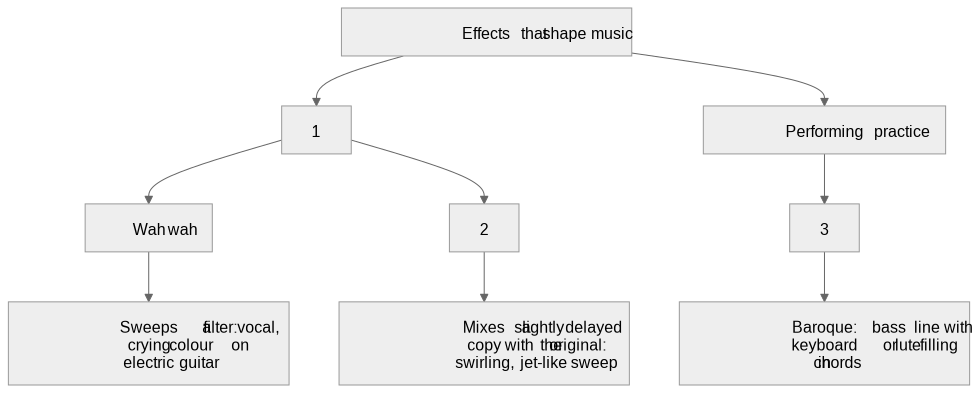
1Box 1
2Box 2
3Box 3
There is more to this lesson
The full lesson goes on to check your understanding and help you earn the marks. Create a free account to carry on, with your progress saved.
A week of Premium from your first lesson · Then the free plan continues · No card, no charge
Test your understanding of Component 3: Appraising - Detailed application of musical elements: the effects of music (e.g wah wah, flanger, continuo – see Appendix 3 for more examples).
Active recall beats re-reading. Take an instant quiz now to test what you’ve learned and lock it into long-term memory.
A week of Premium from your first lesson · Then the free plan continues · No card, no charge