Pearson Edexcel · GCSE · Music
Course version: 1MU0 · Version from Sept 2016
Appraising - Detailed application of musical elements: texture is used,…
Full specification wording
Component 3: Appraising - Detailed application of musical elements: texture is used, including how the music exploits textural contrasts with reference to monophony, homophony, polyphony, heterophony etc
Texture describes how musical lines combine and how many layers are heard.
- Point 6 of 9
- 4 key terms
Study notes
From the teaching notes for this specification point.
The idea
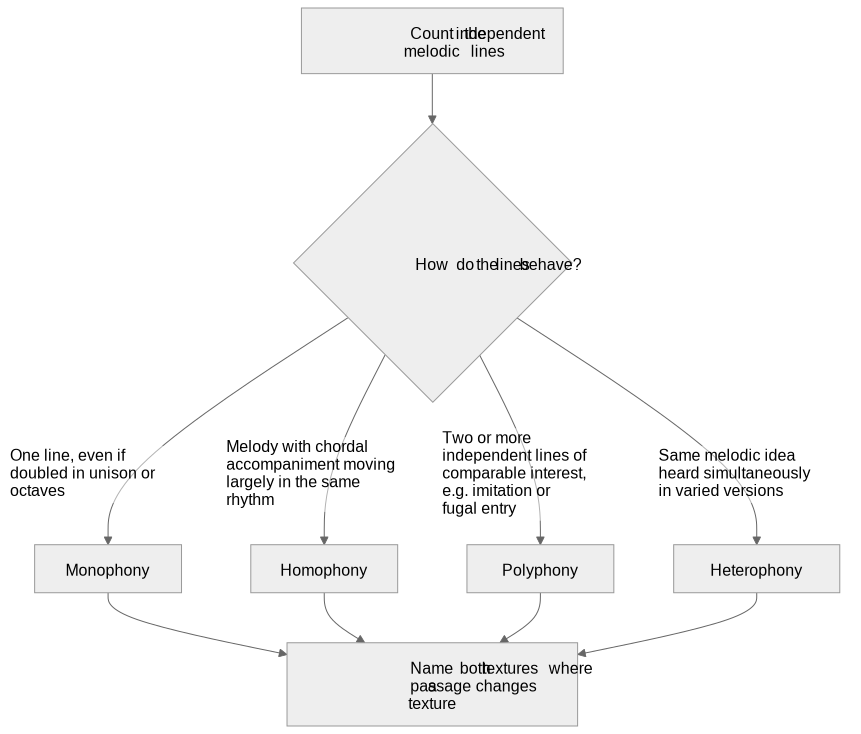
Texture describes how musical lines combine and how many layers are heard. Monophony is a single melodic line, whether one performer or several in unison or octaves. Homophony sets a melody against chordal accompaniment, so the parts move largely together in rhythm. Polyphony combines independent melodic lines of equal interest, as in imitation or a fugal entry. Heterophony presents the same melodic idea simultaneously in varied versions, common in some folk traditions. Music often changes texture, and questions ask how contrasts are exploited: a solo opening giving way to full homophonic scoring, or a monophonic statement answered by imitative polyphony. In a multiple-choice question, count the independent lines and decide whether they move together or separately, then match that description to the correct term.
What earns the marks
- Defines monophony as a single melodic line, including unison or octave doubling of one line.
- Defines homophony as a melody with chordal accompaniment whose parts move largely in the same rhythm.
- Defines polyphony as two or more independent melodic lines of comparable interest, including imitative entries.
- Defines heterophony as simultaneous varied versions of the same melodic line.
- Explains how a passage exploits textural contrast, for example a monophonic opening followed by homophonic or polyphonic scoring.
- Selects the correct term by counting independent lines and judging whether they move together or separately.
Common mistakes and how to put them right
Calling any accompanied melody polyphonic.
Put it right: If the accompaniment is chordal and moves with the melody, the texture is homophonic.
Treating unison or octave doubling as polyphony.
Put it right: A single line doubled is still monophonic.
Confusing heterophony with polyphony.
Put it right: Heterophony varies one shared melody, whereas polyphony combines distinct melodic lines.
Describing a texture change without naming the terms.
Put it right: State the before and after textures explicitly.
Exam tips
- Count the independent melodic lines first, then decide whether they move together or separately.
- Listen for entries: imitation and staggered entries point to polyphony, while block chords point to homophony.
- When a question asks about contrast, name both textures and say where the change occurs.
Try the lesson
The start of the Component 3: Appraising - Detailed application of musical elements: texture is used, including how the music exploits textural contrasts with reference to monophony, homophony, polyphony, heterophony etc lesson, made from teaching notes for this specification point.
Have a go first
Which term describes a musical texture where all performers play or sing the same melodic line at the same time, with no additional harmony or independent parts?
Listen
Texture describes how musical lines combine and how many layers are heard. Monophony is a single melodic line, whether one performer or several in unison or octaves. Homophony sets a melody against chordal accompaniment, so the parts move largely together in rhythm. Polyphony combines independent melodic lines of equal interest, as in imitation or a fugal entry. Heterophony presents the same melodic idea simultaneously in varied versions, common in some folk traditions. Music often changes texture, and questions ask how contrasts are exploited: a solo opening giving way to full homophonic scoring, or a monophonic statement answered by imitative polyphony. In a multiple-choice question, count the independent lines and decide whether they move together or separately, then match that description to the correct term. A strong answer earns marks for these points. Defines monophony as a single melodic line, including unison or octave doubling of one line. Defines homophony as a melody with chordal accompaniment whose parts move largely in the same rhythm. Defines polyphony as two or more independent melodic lines of comparable interest, including imitative entries. Defines heterophony as simultaneous varied versions of the same melodic line. Exam tip: Count the independent melodic lines first, then decide whether they move together or separately.
See it
Key words
Say what each word means before you turn the card.
Monophony
Try answering aloud or in your head before turning the card.
Homophony
Try answering aloud or in your head before turning the card.
Polyphony
Try answering aloud or in your head before turning the card.
Heterophony
Try answering aloud or in your head before turning the card.
See every definition
- Monophony
- A single melodic line, whether performed by one performer or several in unison or octaves.
- Homophony
- A melody set against chordal accompaniment, so the parts move largely together in rhythm.
- Polyphony
- Two or more independent melodic lines of equal interest combined, as in imitation or a fugal entry.
- Heterophony
- The same melodic idea presented simultaneously in varied versions, common in some folk traditions.
There is more to this lesson
The full lesson goes on to check your understanding and help you earn the marks. Create a free account to carry on, with your progress saved.
A week of Premium from your first lesson · Then the free plan continues · No card, no charge
Test your understanding of Component 3: Appraising - Detailed application of musical elements: texture is used, including how the music exploits textural contrasts with reference to monophony, homophony, polyphony, heterophony etc
Active recall beats re-reading. Take an instant quiz now to test what you’ve learned and lock it into long-term memory.
A week of Premium from your first lesson · Then the free plan continues · No card, no charge