Pearson Edexcel · GCSE · Music
Course version: 1MU0 · Version from Sept 2016
Appraising - Detailed application of musical elements: to identify and…
Full specification wording
Component 3: Appraising - Detailed application of musical elements: to identify and discriminate between major, minor, modal, pentatonic, and chromatic tonalities
Tonal identification is an aural skill: you hear a passage and decide which tonal system governs it.
- Point 5 of 9
- 4 key terms
Study notes
From the teaching notes for this specification point.
The idea
Tonal identification is an aural skill: you hear a passage and decide which tonal system governs it. Major and minor are the familiar key systems, distinguished by the third degree and by the pattern of whole and half steps; minor also commonly shows a raised leading note in cadences. Modal music stays within a diatonic set but centres on a mode such as Dorian or Mixolydian, giving a different colour from major or minor. Pentatonic music uses a five-note set, often the major pentatonic (scale degrees 1, 2, 3, 5, 6), so it lacks semitone tension. Chromatic music uses notes outside the prevailing diatonic set, producing dense semitone movement or a weakened sense of key. In a multiple-choice question, listen for the cadence, the third, and any notes foreign to the key before selecting the single best option.
What earns the marks
- Identifies major tonality from a stable tonic triad with a major third and a conventional perfect or imperfect cadence.
- Identifies minor tonality from a minor third and, where present, a raised leading note creating a semitone step to the tonic.
- Recognises modal writing where the music is diatonic but centred on a mode rather than major or minor, for example a Dorian centre.
- Recognises pentatonic writing from a five-note set with no semitone steps, often heard in folk-derived melodies.
- Recognises chromatic writing from notes foreign to the prevailing diatonic set or from dense semitone movement.
- Discriminates between close options by citing the specific feature heard, such as the third or a chromatic passing note.
Common mistakes and how to put them right
Assuming any piece with a minor-sounding mood is minor.
Put it right: Check the third and the cadence rather than the mood alone.
Confusing modal with chromatic.
Put it right: Modal music stays diatonic to a mode, whereas chromatic music introduces notes outside the diatonic set.
Treating pentatonic as simply a short major scale.
Put it right: Pentatonic omits scale degrees 4 and 7, removing semitone tension.
Ignoring the raised leading note in minor.
Put it right: Its presence supports a minor reading rather than contradicting it.
Exam tips
- Listen to the final cadence first; the closing chord and its third often settle the tonality quickly.
- Hum the tonic and test the third above it to decide major or minor before considering modal or pentatonic options.
- Eliminate options by naming the feature that rules each one out, then choose the single best remaining answer.
Try the lesson
The start of the Component 3: Appraising - Detailed application of musical elements: to identify and discriminate between major, minor, modal, pentatonic, and chromatic tonalities lesson, made from teaching notes for this specification point.
Listen
Tonal identification is an aural skill: you hear a passage and decide which tonal system governs it. Major and minor are the familiar key systems, distinguished by the third degree and by the pattern of whole and half steps; minor also commonly shows a raised leading note in cadences. Modal music stays within a diatonic set but centres on a mode such as Dorian or Mixolydian, giving a different colour from major or minor. Pentatonic music uses a five-note set, often the major pentatonic (scale degrees 1, 2, 3, 5, 6), so it lacks semitone tension. Chromatic music uses notes outside the prevailing diatonic set, producing dense semitone movement or a weakened sense of key. In a multiple-choice question, listen for the cadence, the third, and any notes foreign to the key before selecting the single best option. A strong answer earns marks for these points. Identifies major tonality from a stable tonic triad with a major third and a conventional perfect or imperfect cadence. Identifies minor tonality from a minor third and, where present, a raised leading note creating a semitone step to the tonic. Recognises modal writing where the music is diatonic but centred on a mode rather than major or minor, for example a Dorian centre. Recognises pentatonic writing from a five-note set with no semitone steps, often heard in folk-derived melodies. Exam tip: Listen to the final cadence first; the closing chord and its third often settle the tonality quickly.
See it
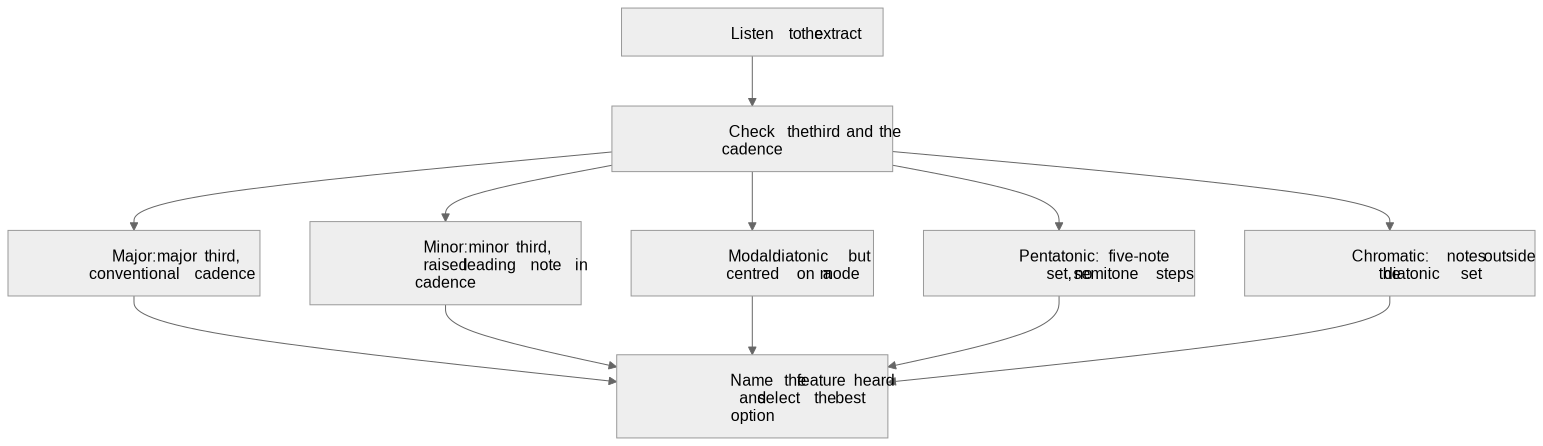
Key words
Say what each word means before you turn the card.
Major and minor key systems
Try answering aloud or in your head before turning the card.
Modal centres and diatonic modes
Try answering aloud or in your head before turning the card.
Pentatonic note sets
Try answering aloud or in your head before turning the card.
Chromatic alteration and weakened tonality
Try answering aloud or in your head before turning the card.
See every definition
- Major and minor key systems
- Familiar key systems distinguished by the third degree and by the pattern of whole and half steps, with minor commonly showing a raised leading note in cadences.
- Modal centres and diatonic modes
- Music that stays within a diatonic set but centres on a mode such as Dorian or Mixolydian, giving a different colour from major or minor.
- Pentatonic note sets
- A five-note set, often the major pentatonic using scale degrees 1, 2, 3, 5 and 6, so it lacks semitone tension.
- Chromatic alteration and weakened tonality
- Use of notes outside the prevailing diatonic set, producing dense semitone movement or a weakened sense of key.
Label the diagram
Some boxes have lost their names. Pick the right name for each number.
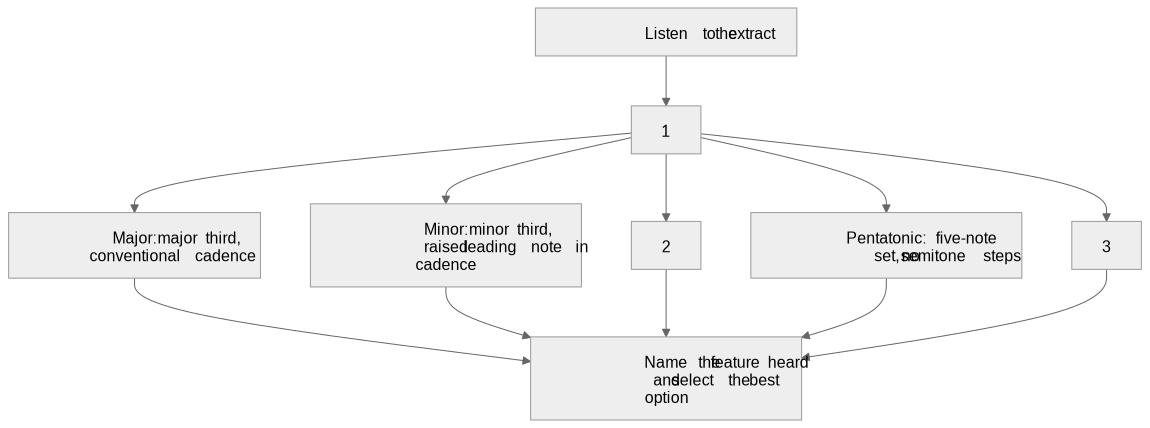
1Box 1
2Box 2
3Box 3
There is more to this lesson
The full lesson goes on to check your understanding and help you earn the marks. Create a free account to carry on, with your progress saved.
A week of Premium from your first lesson · Then the free plan continues · No card, no charge
Test your understanding of Component 3: Appraising - Detailed application of musical elements: to identify and discriminate between major, minor, modal, pentatonic, and chromatic tonalities
Active recall beats re-reading. Take an instant quiz now to test what you’ve learned and lock it into long-term memory.
A week of Premium from your first lesson · Then the free plan continues · No card, no charge