Pearson Edexcel · GCSE · Music
Course version: 1MU0 · Version from Sept 2016
Appraising - Detailed application of musical elements: to identify how…
Full specification wording
Component 3: Appraising - Detailed application of musical elements: to identify how instrumentation is used in different combinations (identifying instruments and groups of instruments)
This skill is aural and analytical: you hear a passage and name the instruments you can pick out, then describe how they are combined.
- Point 1 of 9
- 4 key terms
Study notes
From the teaching notes for this specification point.
The idea
This skill is aural and analytical: you hear a passage and name the instruments you can pick out, then describe how they are combined. Start by classifying each sound by family (strings, woodwind, brass, percussion, keyboards, voices, electric instruments) and by how it is produced (bowed, plucked, blown, struck, sung). Then decide the grouping: solo instrument, duet, small ensemble such as a string quartet, section within an orchestra, full orchestra, choir, rock band or a mixed grouping. Listen for timbre, register and articulation to separate instruments that sound alike, and notice doubling, antiphonal placement and layered textures. In a multiple-choice question, eliminate options that name an instrument you cannot hear or that misdescribe the combination, then justify your choice from the evidence in the extract.
What earns the marks
- Correctly names individual instruments heard in the extract, using family and playing method to justify each identification.
- Correctly identifies the grouping or combination, for example solo, duet, small ensemble, orchestral section, full orchestra, choir or band.
- Distinguishes between instruments of similar timbre by referring to register, articulation or tone colour.
- Recognises how instruments are combined, such as doubling, layering, antiphonal contrast or accompaniment versus melody.
- Rejects a distractor option that names an instrument or grouping not supported by the extract.
Common mistakes and how to put them right
Naming an instrument from the family alone without checking timbre and register.
Put it right: Match the specific sound to the instrument's characteristic tone and playing method.
Confusing a solo passage with a full ensemble because other instruments are quiet.
Put it right: Listen for the sustained accompaniment underneath the melody.
Assuming a group is an orchestra when it is a smaller ensemble.
Put it right: Count the distinct instrumental lines and identify the grouping precisely.
Exam tips
- Listen to the extract more than once, first for the overall grouping and then for individual instruments.
- Use family and playing method as a checklist to confirm each instrument you name.
- Eliminate options that name instruments or combinations you cannot hear before choosing your answer.
Try the lesson
The start of the Component 3: Appraising - Detailed application of musical elements: to identify how instrumentation is used in different combinations (identifying instruments and groups of instruments) lesson, made from teaching notes for this specification point.
Have a go first
A composer writes a piece for a standard string quartet. Which instruments would be playing?
Listen
This skill is aural and analytical: you hear a passage and name the instruments you can pick out, then describe how they are combined. Start by classifying each sound by family (strings, woodwind, brass, percussion, keyboards, voices, electric instruments) and by how it is produced (bowed, plucked, blown, struck, sung). Then decide the grouping: solo instrument, duet, small ensemble such as a string quartet, section within an orchestra, full orchestra, choir, rock band or a mixed grouping. Listen for timbre, register and articulation to separate instruments that sound alike, and notice doubling, antiphonal placement and layered textures. In a multiple-choice question, eliminate options that name an instrument you cannot hear or that misdescribe the combination, then justify your choice from the evidence in the extract. A strong answer earns marks for these points. Correctly names individual instruments heard in the extract, using family and playing method to justify each identification. Correctly identifies the grouping or combination, for example solo, duet, small ensemble, orchestral section, full orchestra, choir or band. Distinguishes between instruments of similar timbre by referring to register, articulation or tone colour. Recognises how instruments are combined, such as doubling, layering, antiphonal contrast or accompaniment versus melody. A common slip: Naming an instrument from the family alone without checking timbre and register. Instead, match the specific sound to the instrument's characteristic tone and playing method. Exam tip: Listen to the extract more than once, first for the overall grouping and then for individual instruments.
See it
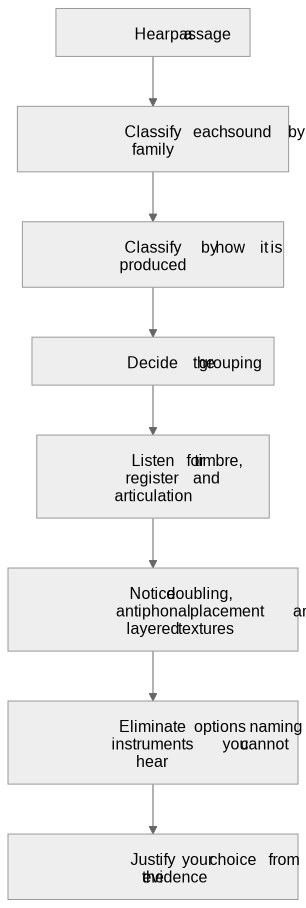
Put it in order
Put these steps in the order they happen.
- 1. Listen for timbre, register and articulation
- 2. Justify your choice from the evidence
- 3. Notice doubling, antiphonal placement and layered textures
- 4. Hear a passage
- 5. Classify each sound by family
- 6. Eliminate options naming instruments you cannot hear
- 7. Classify by how it is produced
- 8. Decide the grouping
Key words
Say what each word means before you turn the card.
Instrument families and timbres
Try answering aloud or in your head before turning the card.
Ensemble and grouping types
Try answering aloud or in your head before turning the card.
Aural identification skills
Try answering aloud or in your head before turning the card.
Texture and combination of instruments
Try answering aloud or in your head before turning the card.
See every definition
- Instrument families and timbres
- Sounds are classified by family and by how they are produced, and timbre, register and articulation help separate instruments that sound alike.
- Ensemble and grouping types
- The grouping may be a solo instrument, duet, small ensemble, orchestral section, full orchestra, choir, rock band or a mixed grouping.
- Aural identification skills
- Listening to a passage and naming the instruments you can pick out, then describing how they are combined.
- Texture and combination of instruments
- Recognising how instruments are combined, such as doubling, layering, antiphonal contrast or accompaniment versus melody.
Label the diagram
Some boxes have lost their names. Pick the right name for each number.
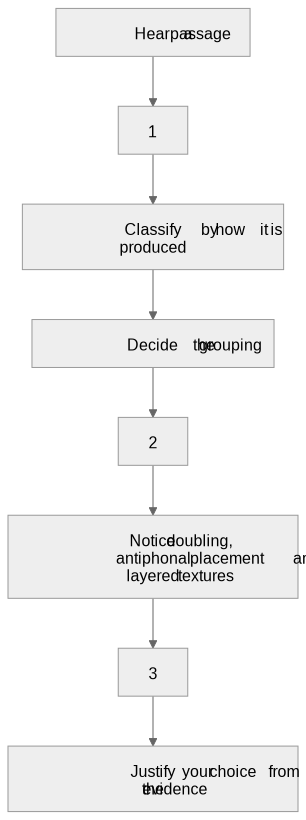
1Box 1
2Box 2
3Box 3
There is more to this lesson
The full lesson goes on to check your understanding and help you earn the marks. Create a free account to carry on, with your progress saved.
A week of Premium from your first lesson · Then the free plan continues · No card, no charge
Test your understanding of Component 3: Appraising - Detailed application of musical elements: to identify how instrumentation is used in different combinations (identifying instruments and groups of instruments)
Active recall beats re-reading. Take an instant quiz now to test what you’ve learned and lock it into long-term memory.
A week of Premium from your first lesson · Then the free plan continues · No card, no charge