Pearson Edexcel · GCSE · Music
Course version: 1MU0 · Version from Sept 2016
Appraising - Detailed application of musical elements: to identify…
Full specification wording
Component 3: Appraising - Detailed application of musical elements: to identify rhythmic devices and features (syncopation, swung rhythms, dotted rhythms and triplets)
This skill is aural recognition of rhythmic features.
- Point 4 of 9
- 4 key terms
Study notes
From the teaching notes for this specification point.
The idea
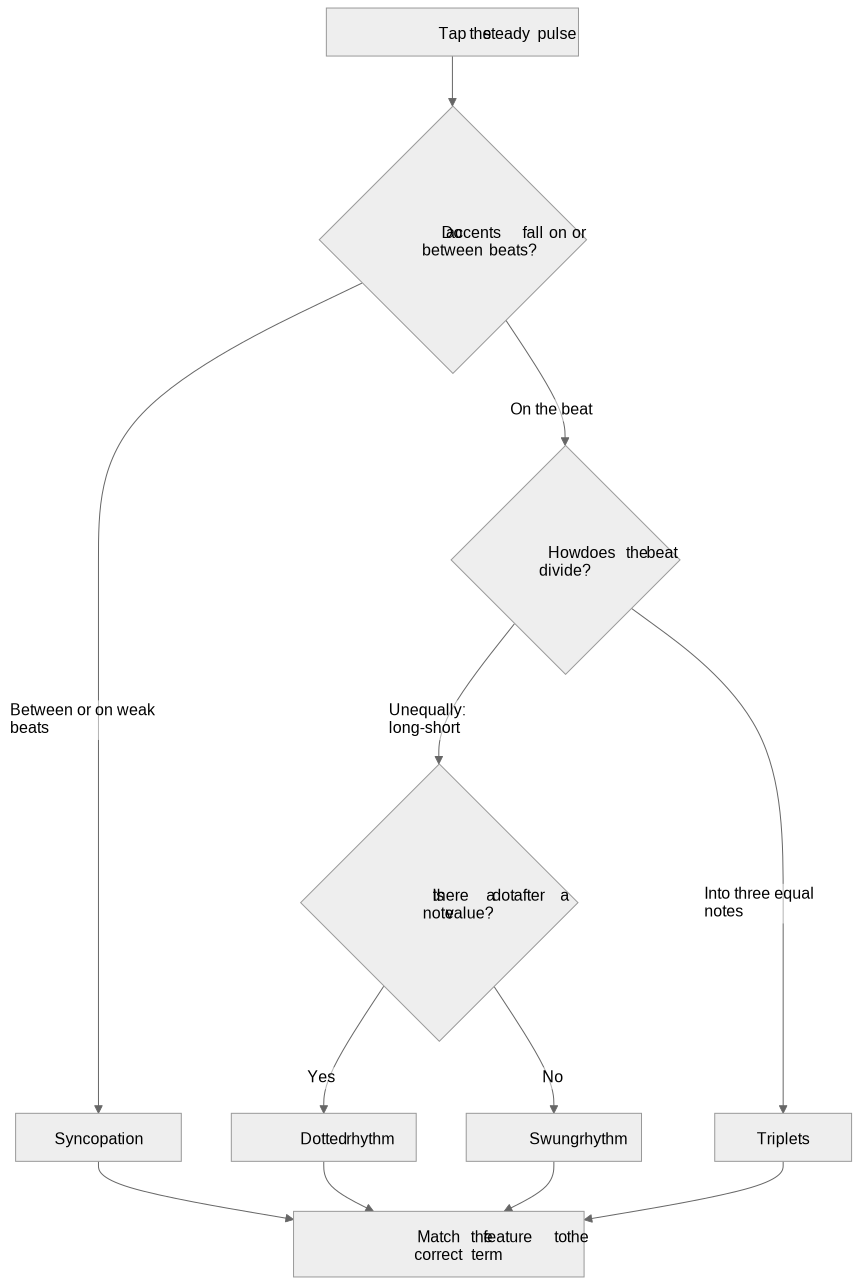
This skill is aural recognition of rhythmic features. Syncopation places emphasis on a weak beat or between beats, unsettling the expected pulse. Swung rhythms divide the beat unequally, giving a long-short lilt typical of jazz and blues. Dotted rhythms pair a dotted note with a shorter note, producing a long-short pattern within a regular metre. Triplets divide a beat into three equal notes where the metre would normally give two. To answer, tap the pulse, decide whether accents fall on or off the beat, whether the beat divides equally or unequally, and whether a group of three equal notes appears. Then match the heard feature to the correct term.
What earns the marks
- Identifies syncopation as emphasis placed on a weak beat or between beats, working against the expected pulse.
- Recognises swung rhythms as an unequal long-short division of the beat, giving a jazz or blues lilt.
- Identifies dotted rhythms as a long-short pattern created by a dotted note followed by a shorter note.
- Recognises triplets as three equal notes occupying the space normally taken by two.
- Distinguishes between unequal division (swing) and equal threefold division (triplets).
Common mistakes and how to put them right
Confusing swing with triplets.
Put it right: Swing divides the beat unequally (long-short), while triplets divide it into three equal notes.
Calling any off-beat accent a dotted rhythm.
Put it right: Dotted rhythms are a written long-short note pattern, not simply an accent.
Treating syncopation as a change of tempo.
Put it right: It is a shift of emphasis against the pulse, not a speed change.
Assuming a triplet always spans a whole bar.
Put it right: A triplet commonly divides a single beat into three.
Exam tips
- Tap the steady pulse first, then decide whether accents fall on or between beats to test for syncopation.
- Compare the two halves of a beat: equal thirds suggest triplets, a long-then-short feel suggests swing.
- Look for a dot after a note value to confirm a dotted rhythm rather than guessing from accent alone.
Try the lesson
The start of the Component 3: Appraising - Detailed application of musical elements: to identify rhythmic devices and features (syncopation, swung rhythms, dotted rhythms and triplets) lesson, made from teaching notes for this specification point.
Have a go first
A dotted rhythm consists of a dotted note followed by a note of the next shorter value. What is the rhythmic effect of this pattern?
Listen
This skill is aural recognition of rhythmic features. Syncopation places emphasis on a weak beat or between beats, unsettling the expected pulse. Swung rhythms divide the beat unequally, giving a long-short lilt typical of jazz and blues. Dotted rhythms pair a dotted note with a shorter note, producing a long-short pattern within a regular metre. Triplets divide a beat into three equal notes where the metre would normally give two. To answer, tap the pulse, decide whether accents fall on or off the beat, whether the beat divides equally or unequally, and whether a group of three equal notes appears. Then match the heard feature to the correct term. A strong answer earns marks for these points. Identifies syncopation as emphasis placed on a weak beat or between beats, working against the expected pulse. Recognises swung rhythms as an unequal long-short division of the beat, giving a jazz or blues lilt. Identifies dotted rhythms as a long-short pattern created by a dotted note followed by a shorter note. Recognises triplets as three equal notes occupying the space normally taken by two. Exam tip: Tap the steady pulse first, then decide whether accents fall on or between beats to test for syncopation.
See it
Key words
Say what each word means before you turn the card.
Syncopation
Try answering aloud or in your head before turning the card.
Swung rhythms
Try answering aloud or in your head before turning the card.
Dotted rhythms
Try answering aloud or in your head before turning the card.
Triplets
Try answering aloud or in your head before turning the card.
See every definition
- Syncopation
- Emphasis placed on a weak beat or between beats, unsettling the expected pulse.
- Swung rhythms
- An unequal long-short division of the beat, giving a lilt typical of jazz and blues.
- Dotted rhythms
- A long-short pattern within a regular metre, created by a dotted note followed by a shorter note.
- Triplets
- Three equal notes occupying the space where the metre would normally give two.
There is more to this lesson
The full lesson goes on to check your understanding and help you earn the marks. Create a free account to carry on, with your progress saved.
A week of Premium from your first lesson · Then the free plan continues · No card, no charge
Test your understanding of Component 3: Appraising - Detailed application of musical elements: to identify rhythmic devices and features (syncopation, swung rhythms, dotted rhythms and triplets)
Active recall beats re-reading. Take an instant quiz now to test what you’ve learned and lock it into long-term memory.
A week of Premium from your first lesson · Then the free plan continues · No card, no charge