Pearson Edexcel · GCSE · Music
Course version: 1MU0 · Version from Sept 2016
Appraising - Knowledge and understanding: conventions used in different…
Full specification wording
Component 3: Appraising - Knowledge and understanding: conventions used in different times and places
This target asks you to recognise the conventions that shape music in different times and places.
- Point 4 of 4
- 4 key terms
Study notes
From the teaching notes for this specification point.
The idea
This target asks you to recognise the conventions that shape music in different times and places. A convention is an accepted practice a composer or performer follows: for example, a Baroque continuo group, a Classical string quartet with balanced phrases, a gamelan ensemble with interlocking parts, or a blues progression with its characteristic chord pattern. In a multiple-choice question you match the convention described or heard to the time and place it belongs to. Read the stem carefully for the period or location clue, then test each option against that clue. A convention from one tradition is not automatically valid in another, so avoid choosing an option simply because it is familiar.
What earns the marks
- Names a convention accurately, such as a continuo group, balanced periodic phrasing, interlocking ensemble parts or a twelve-bar blues structure.
- Associates the convention with the correct time period or place, using the clue in the question.
- Explains briefly how the convention is heard or seen in the music, for example a repeated bass pattern or a call-and-response texture.
- Rejects options that apply a convention to the wrong tradition or era.
- Recognises that conventions change over time and differ between places, so context matters.
Common mistakes and how to put them right
Assuming a familiar convention belongs to every period.
Put it right by checking the time and place named in the question.
Mixing up conventions from different world traditions.
Put it right by linking each convention to its specific culture or region.
Ignoring the context clue in the stem.
Put it right by highlighting the period or place word before evaluating options.
Describing a convention vaguely without naming it.
Put it right by using the precise musical term.
Exam tips
- Highlight the time or place clue in the question before reading the options.
- Match each option to a specific tradition or era and discard mismatches.
- Check that your chosen convention can actually be heard or identified in the extract.
Try the lesson
The start of the Component 3: Appraising - Knowledge and understanding: conventions used in different times and places lesson, made from teaching notes for this specification point.
Have a go first
In Western classical music, the convention for tuning instruments has changed over time. Which of the following best describes the standard tuning reference used in most orchestras today?
Listen
This target asks you to recognise the conventions that shape music in different times and places. A convention is an accepted practice a composer or performer follows: for example, a Baroque continuo group, a Classical string quartet with balanced phrases, a gamelan ensemble with interlocking parts, or a blues progression with its characteristic chord pattern. In a multiple-choice question you match the convention described or heard to the time and place it belongs to. Read the stem carefully for the period or location clue, then test each option against that clue. A convention from one tradition is not automatically valid in another, so avoid choosing an option simply because it is familiar. A strong answer earns marks for these points. Names a convention accurately, such as a continuo group, balanced periodic phrasing, interlocking ensemble parts or a twelve-bar blues structure. Associates the convention with the correct time period or place, using the clue in the question. Explains briefly how the convention is heard or seen in the music, for example a repeated bass pattern or a call-and-response texture. Rejects options that apply a convention to the wrong tradition or era. A common slip: Assuming a familiar convention belongs to every period. Instead, checking the time and place named in the question. Exam tip: Highlight the time or place clue in the question before reading the options.
See it
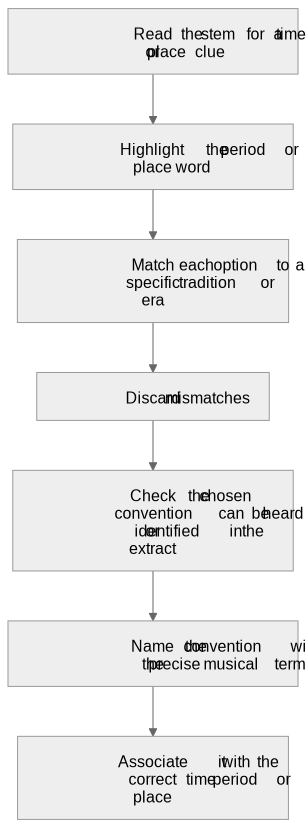
Put it in order
Put these steps in the order they happen.
- 1. Associate it with the correct time period or place
- 2. Name the convention with the precise musical term
- 3. Match each option to a specific tradition or era
- 4. Check the chosen convention can be heard or identified in the extract
- 5. Read the stem for a time or place clue
- 6. Highlight the period or place word
- 7. Discard mismatches
Key words
Say what each word means before you turn the card.
Musical conventions
Try answering aloud or in your head before turning the card.
Time and place context
Try answering aloud or in your head before turning the card.
World and historical traditions
Try answering aloud or in your head before turning the card.
Listening evidence
Try answering aloud or in your head before turning the card.
See every definition
- Musical conventions
- Accepted practices that composers or performers follow, which shape music in different times and places.
- Time and place context
- The period or location clue in a question, which a convention must be matched against.
- World and historical traditions
- Conventions change over time and differ between places, so a convention from one tradition is not automatically valid in another.
- Listening evidence
- Checking that the chosen convention can actually be heard or identified in the extract.
Label the diagram
Some boxes have lost their names. Pick the right name for each number.
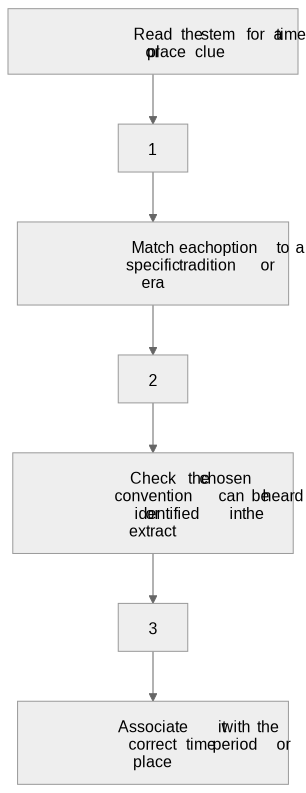
1Box 1
2Box 2
3Box 3
There is more to this lesson
The full lesson goes on to check your understanding and help you earn the marks. Create a free account to carry on, with your progress saved.
A week of Premium from your first lesson · Then the free plan continues · No card, no charge
Test your understanding of Component 3: Appraising - Knowledge and understanding: conventions used in different times and places
Active recall beats re-reading. Take an instant quiz now to test what you’ve learned and lock it into long-term memory.
A week of Premium from your first lesson · Then the free plan continues · No card, no charge