Pearson Edexcel · GCSE · Music
Course version: 1MU0 · Version from Sept 2016
Appraising - Knowledge and understanding: stylistic features of the music,…
Full specification wording
Component 3: Appraising - Knowledge and understanding: stylistic features of the music, for example the Baroque features to be found in the music
This knowledge target asks you to identify stylistic features in a piece of music and to recognise the Baroque ones when they occur.
- Point 3 of 4
- 4 key terms
Study notes
From the teaching notes for this specification point.
The idea
This knowledge target asks you to identify stylistic features in a piece of music and to recognise the Baroque ones when they occur. In practice you listen to the extract, name the feature you hear, and then justify it with musical evidence: a continuo part with figured bass, a terraced dynamic change, an ornament such as a trill, a fugal or imitative texture, a dance-derived binary movement, or a major/minor tonal scheme with a strong cadence. Baroque is a period label, so keep your examples inside the Baroque era rather than mixing in Classical or Romantic traits. In a multiple-choice question, read every option, discard those describing another period, and choose the option that matches both the feature and the evidence you can hear.
What earns the marks
- Identifies a named stylistic feature present in the extract, such as a basso continuo, ornamentation, terraced dynamics or imitative texture.
- Links the feature to the Baroque period rather than to another era, using the correct period label.
- Supports the choice with audible evidence, for example a sustained bass line under a melody or a sudden change from loud to soft.
- Rejects distractors that describe features of a different period, such as Alberti bass or a sonata-form exposition.
- Recognises that a single extract may combine several Baroque features and selects the option that fits the evidence best.
Common mistakes and how to put them right
Naming a feature without checking it belongs to the Baroque period.
Put it right by matching each feature to the era before choosing.
Confusing terraced dynamics with gradual crescendo.
Put it right by remembering that Baroque dynamics usually change in steps between blocks of sound.
Treating any ornament as automatically Baroque.
Put it right by checking the surrounding texture, harmony and instrumentation too.
Choosing an option because it sounds impressive rather than because it is audible in the extract.
Put it right by grounding every choice in what you actually hear.
Exam tips
- Listen once for the overall texture and instrumentation before reading the options.
- Underline the period word in the question so you do not answer about the wrong era.
- Eliminate options that name features of later periods, then confirm the remaining option against the recording.
Try the lesson
The start of the Component 3: Appraising - Knowledge and understanding: stylistic features of the music, for example the Baroque features to be found in the music lesson, made from teaching notes for this specification point.
Have a go first
Which of the following is a defining characteristic of Baroque music?
Listen
This knowledge target asks you to identify stylistic features in a piece of music and to recognise the Baroque ones when they occur. In practice you listen to the extract, name the feature you hear, and then justify it with musical evidence: a continuo part with figured bass, a terraced dynamic change, an ornament such as a trill, a fugal or imitative texture, a dance-derived binary movement, or a major/minor tonal scheme with a strong cadence. Baroque is a period label, so keep your examples inside the Baroque era rather than mixing in Classical or Romantic traits. In a multiple-choice question, read every option, discard those describing another period, and choose the option that matches both the feature and the evidence you can hear. A strong answer earns marks for these points. Identifies a named stylistic feature present in the extract, such as a basso continuo, ornamentation, terraced dynamics or imitative texture. Links the feature to the Baroque period rather than to another era, using the correct period label. Supports the choice with audible evidence, for example a sustained bass line under a melody or a sudden change from loud to soft. Rejects distractors that describe features of a different period, such as Alberti bass or a sonata-form exposition. A common slip: Naming a feature without checking it belongs to the Baroque period. Instead, matching each feature to the era before choosing. Exam tip: Listen once for the overall texture and instrumentation before reading the options.
See it
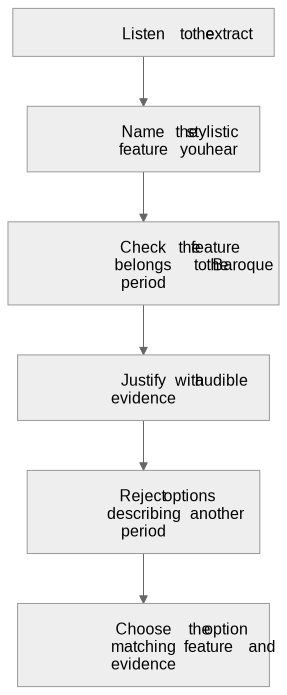
Put it in order
Put these steps in the order they happen.
- 1. Check the feature belongs to the Baroque period
- 2. Name the stylistic feature you hear
- 3. Listen to the extract
- 4. Choose the option matching feature and evidence
- 5. Reject options describing another period
- 6. Justify with audible evidence
Key words
Say what each word means before you turn the card.
Stylistic features
Try answering aloud or in your head before turning the card.
Baroque period characteristics
Try answering aloud or in your head before turning the card.
Listening evidence
Try answering aloud or in your head before turning the card.
Period recognition
Try answering aloud or in your head before turning the card.
See every definition
- Stylistic features
- Features of the music that you identify by listening to the extract and name when you hear them.
- Baroque period characteristics
- Features such as a continuo part with figured bass, terraced dynamics, an ornament such as a trill, a fugal or imitative texture, a dance-derived binary movement, or a major/minor tonal scheme with a strong cadence.
- Listening evidence
- Audible support for a feature choice, for example a sustained bass line under a melody or a sudden change from loud to soft.
- Period recognition
- Linking a feature to the Baroque period rather than to another era, using the correct period label and rejecting distractors that describe features of a different period.
Label the diagram
Some boxes have lost their names. Pick the right name for each number.
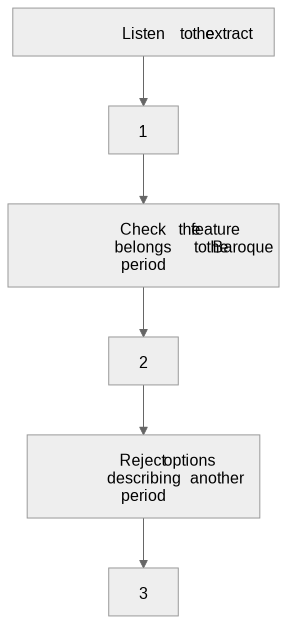
1Box 1
2Box 2
3Box 3
There is more to this lesson
The full lesson goes on to check your understanding and help you earn the marks. Create a free account to carry on, with your progress saved.
A week of Premium from your first lesson · Then the free plan continues · No card, no charge
Test your understanding of Component 3: Appraising - Knowledge and understanding: stylistic features of the music, for example the Baroque features to be found in the music
Active recall beats re-reading. Take an instant quiz now to test what you’ve learned and lock it into long-term memory.
A week of Premium from your first lesson · Then the free plan continues · No card, no charge