Pearson Edexcel · GCSE · Music
Course version: 1MU0 · Version from Sept 2016
Appraising - Knowledge and understanding: form and structure of the music
Full specification wording
Component 3: Appraising - Knowledge and understanding: form and structure of the music
Form and structure describe how a piece is organised in time: the sections it divides into, how those sections relate, and how repetition, contrast and variation shape the whole.
- Point 1 of 4
- 4 key terms
Study notes
From the teaching notes for this specification point.
The idea
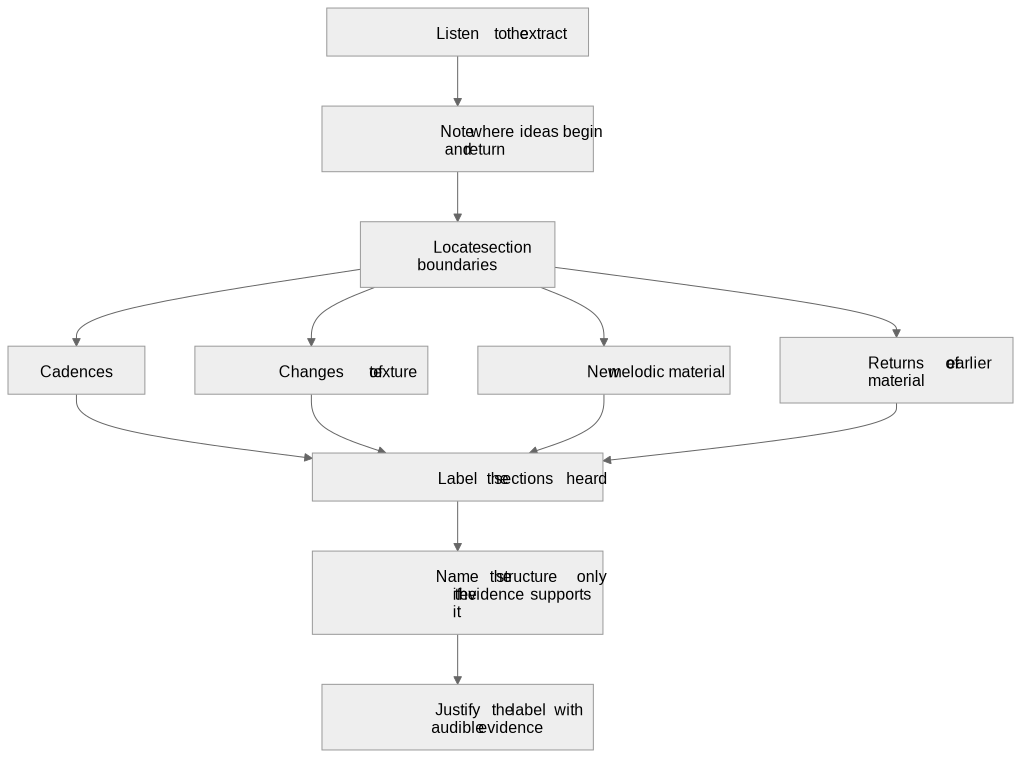
Form and structure describe how a piece is organised in time: the sections it divides into, how those sections relate, and how repetition, contrast and variation shape the whole. In the appraising examination you may be asked to identify a structure by name, or to describe where a section begins and ends and what changes. Work from the recording and the score extract: listen for clear cadences, changes of texture, new melodic ideas or returns of earlier material, then label the sections you hear. For example, a piece may present an opening idea, a contrasting middle idea, then a return of the opening idea, giving a ternary shape. Name the structure only when the musical evidence supports it, and justify your choice by referring to what you hear.
What earns the marks
- Identifies a plausible structural label (for example binary, ternary, rondo, strophic, verse and chorus, sonata form, theme and variations) that matches the musical evidence heard.
- Locates section boundaries by referring to audible features such as cadences, changes of texture, new melodic material or returns of earlier material.
- Explains how sections relate, for example through repetition, contrast or variation of a previous idea.
- Uses correct structural vocabulary and links each claim to a specific feature of the extract rather than guessing.
Common mistakes and how to put them right
Naming a structure from memory of the set work without checking the extract.
Put it right: Justify the label with audible evidence such as a return of the opening idea.
Confusing texture change with structural change.
Put it right: Look for cadences, new themes or returns, not just a thicker or thinner accompaniment.
Treating 'form' and 'structure' as unrelated ideas.
Put it right: See form as the overall plan and structure as the arrangement of its sections.
Assuming every piece has a named textbook form.
Put it right: Describe the sections you actually hear when no standard label fits.
Exam tips
- Listen to the extract at least twice before committing to a structural label, noting where ideas begin and return.
- Point to a specific moment (a cadence, a new theme, a return) to support each structural claim.
- Use precise vocabulary such as 'ternary', 'rondo' or 'verse and chorus' only when the evidence clearly supports it.
Try the lesson
The start of the Component 3: Appraising - Knowledge and understanding: form and structure of the music lesson, made from teaching notes for this specification point.
Have a go first
In sonata form, which section typically features the development of themes?
Listen
Form and structure describe how a piece is organised in time: the sections it divides into, how those sections relate, and how repetition, contrast and variation shape the whole. In the appraising examination you may be asked to identify a structure by name, or to describe where a section begins and ends and what changes. Work from the recording and the score extract: listen for clear cadences, changes of texture, new melodic ideas or returns of earlier material, then label the sections you hear. For example, a piece may present an opening idea, a contrasting middle idea, then a return of the opening idea, giving a ternary shape. Name the structure only when the musical evidence supports it, and justify your choice by referring to what you hear. A strong answer earns marks for these points. Identifies a plausible structural label (for example binary, ternary, rondo, strophic, verse and chorus, sonata form, theme and variations) that matches the musical evidence heard. Locates section boundaries by referring to audible features such as cadences, changes of texture, new melodic material or returns of earlier material. Explains how sections relate, for example through repetition, contrast or variation of a previous idea. Uses correct structural vocabulary and links each claim to a specific feature of the extract rather than guessing. A common slip: Naming a structure from memory of the set work without checking the extract. Instead, justify the label with audible evidence such as a return of the opening idea. Exam tip: Listen to the extract at least twice before committing to a structural label, noting where ideas begin and return.
See it
Key words
Say what each word means before you turn the card.
Overall form and named structures
Try answering aloud or in your head before turning the card.
Section boundaries and cadences
Try answering aloud or in your head before turning the card.
Repetition, contrast and variation
Try answering aloud or in your head before turning the card.
Relating structure to audible features
Try answering aloud or in your head before turning the card.
See every definition
- Overall form and named structures
- The overall plan of a piece, which may be identified by a standard label such as binary, ternary, rondo, strophic, verse and chorus, sonata form or theme and variations when the musical evidence supports it.
- Section boundaries and cadences
- The places where one section begins and ends, located by referring to audible features such as cadences, changes of texture, new melodic material or returns of earlier material.
- Repetition, contrast and variation
- The ways sections relate to one another, for example through repetition, contrast or variation of a previous idea, shaping the whole.
- Relating structure to audible features
- Linking each structural claim to a specific feature of the extract, such as a cadence, a new theme or a return, rather than guessing.
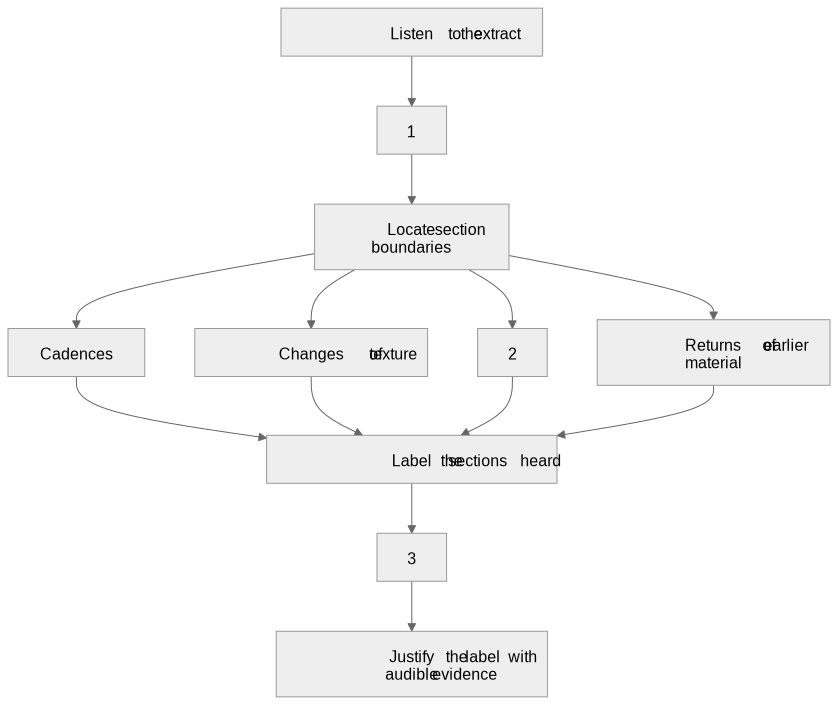
Label the diagram
Some boxes have lost their names. Pick the right name for each number.
1Box 1
2Box 2
3Box 3
There is more to this lesson
The full lesson goes on to check your understanding and help you earn the marks. Create a free account to carry on, with your progress saved.
A week of Premium from your first lesson · Then the free plan continues · No card, no charge
Test your understanding of Component 3: Appraising - Knowledge and understanding: form and structure of the music
Active recall beats re-reading. Take an instant quiz now to test what you’ve learned and lock it into long-term memory.
A week of Premium from your first lesson · Then the free plan continues · No card, no charge