Pearson Edexcel · GCSE · Music
Course version: 1MU0 · Version from Sept 2016
Appraising - Knowledge and understanding: appropriate musical vocabulary…
Full specification wording
Component 3: Appraising - Knowledge and understanding: appropriate musical vocabulary for each work
Each set work has its own musical character, and the appraising examination expects you to describe it using precise vocabulary rather than vague words.
- Point 2 of 4
- 4 key terms
Study notes
From the teaching notes for this specification point.
The idea
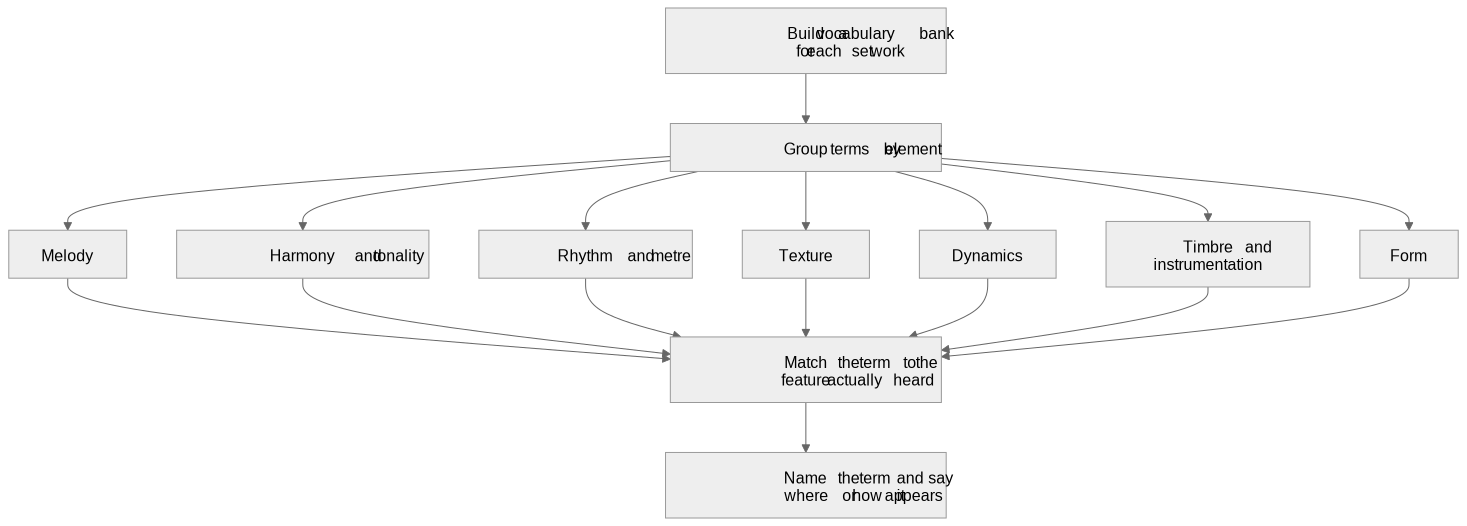
Each set work has its own musical character, and the appraising examination expects you to describe it using precise vocabulary rather than vague words. Build a vocabulary bank for each work covering the elements: melody, harmony and tonality, rhythm and metre, texture, dynamics, timbre and instrumentation, and form. Then practise applying the right term to the right feature. For example, describe a passage as 'homophonic' when the parts move together in chords, or 'polyphonic' when independent lines overlap, and say which instrument carries the melody. Match the term to what you actually hear in that work, and avoid using a term just because it sounds impressive. Precise, work-specific vocabulary earns credit; loose description does not.
What earns the marks
- Selects a musical term that accurately describes the feature heard in the specified work, for example naming the texture, tonality or instrumentation correctly.
- Applies vocabulary from the correct element (melody, harmony, rhythm, texture, dynamics, timbre, form) rather than mixing categories.
- Uses work-specific detail, such as naming the instrument or the harmonic device actually present, rather than generic description.
- Distinguishes between similar terms, for example homophonic and polyphonic, or major and minor, according to the evidence in the extract.
Common mistakes and how to put them right
Using vague words such as 'fast' or 'loud' instead of precise terms.
Put it right: Use 'allegro' or 'forte' and to say what is fast or loud.
Applying a term from the wrong element, for example calling texture a harmonic feature.
Put it right: Match each term to its element.
Using a term that does not fit the work, such as describing a monophonic passage as contrapuntal.
Put it right: Check the evidence in the extract.
Confusing similar terms such as homophonic and polyphonic.
Put it right: Learn the difference and apply it to what is heard.
Exam tips
- Build a vocabulary list for each set work, grouped by element, and revise it before the examination.
- When answering, name the term and then say where or how it appears in the work.
- Check that the term belongs to the element the question is asking about.
Try the lesson
The start of the Component 3: Appraising - Knowledge and understanding: appropriate musical vocabulary for each work lesson, made from teaching notes for this specification point.
Have a go first
Which term best describes the texture of a melody accompanied by sustained chords, as often found in the slow movement of a Classical symphony?
Listen
Each set work has its own musical character, and the appraising examination expects you to describe it using precise vocabulary rather than vague words. Build a vocabulary bank for each work covering the elements: melody, harmony and tonality, rhythm and metre, texture, dynamics, timbre and instrumentation, and form. Then practise applying the right term to the right feature. For example, describe a passage as 'homophonic' when the parts move together in chords, or 'polyphonic' when independent lines overlap, and say which instrument carries the melody. Match the term to what you actually hear in that work, and avoid using a term just because it sounds impressive. Precise, work-specific vocabulary earns credit; loose description does not. A strong answer earns marks for these points. Selects a musical term that accurately describes the feature heard in the specified work, for example naming the texture, tonality or instrumentation correctly. Applies vocabulary from the correct element (melody, harmony, rhythm, texture, dynamics, timbre, form) rather than mixing categories. Uses work-specific detail, such as naming the instrument or the harmonic device actually present, rather than generic description. Distinguishes between similar terms, for example homophonic and polyphonic, or major and minor, according to the evidence in the extract. A common slip: Using vague words such as 'fast' or 'loud' instead of precise terms. Instead, use 'allegro' or 'forte' and to say what is fast or loud. Exam tip: Build a vocabulary list for each set work, grouped by element, and revise it before the examination.
See it
Key words
Say what each word means before you turn the card.
Musical elements vocabulary
Try answering aloud or in your head before turning the card.
Work-specific description
Try answering aloud or in your head before turning the card.
Precise versus vague language
Try answering aloud or in your head before turning the card.
Matching terms to audible evidence
Try answering aloud or in your head before turning the card.
See every definition
- Musical elements vocabulary
- A vocabulary bank for each work covering melody, harmony and tonality, rhythm and metre, texture, dynamics, timbre and instrumentation, and form.
- Work-specific description
- Naming the instrument or the harmonic device actually present in a work rather than giving generic description.
- Precise versus vague language
- Using precise terms such as 'allegro' or 'forte' instead of vague words such as 'fast' or 'loud', and saying what is fast or loud.
- Matching terms to audible evidence
- Matching the term to what you actually hear in that work and avoiding a term just because it sounds impressive.
Label the diagram
Some boxes have lost their names. Pick the right name for each number.
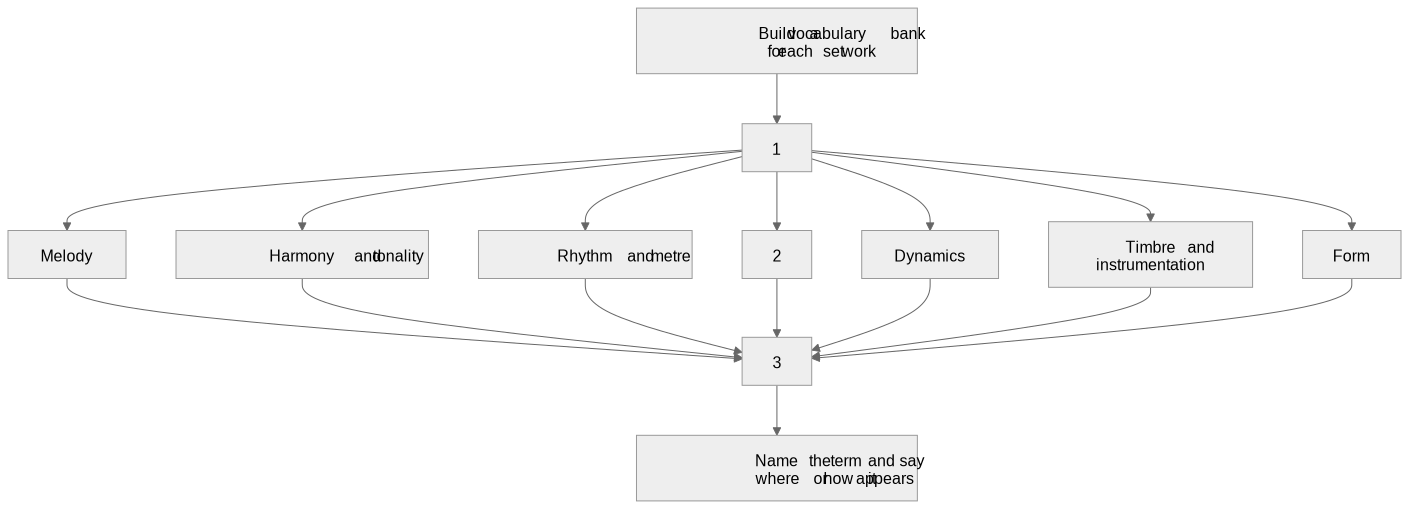
1Box 1
2Box 2
3Box 3
There is more to this lesson
The full lesson goes on to check your understanding and help you earn the marks. Create a free account to carry on, with your progress saved.
A week of Premium from your first lesson · Then the free plan continues · No card, no charge
Test your understanding of Component 3: Appraising - Knowledge and understanding: appropriate musical vocabulary for each work
Active recall beats re-reading. Take an instant quiz now to test what you’ve learned and lock it into long-term memory.
A week of Premium from your first lesson · Then the free plan continues · No card, no charge