Pearson Edexcel · GCSE · Music
Course version: 1MU0 · Version from Sept 2016
Appraising - Musical elements: dynamics; basic dynamic devices, for…
Full specification wording
Component 3: Appraising - Musical elements: dynamics; basic dynamic devices, for example crescendo and diminuendo.
Dynamics describe how loud or quiet music is, and dynamic devices are the ways a composer changes that level over time.
- Point 7 of 7
- 4 key terms
Study notes
From the teaching notes for this specification point.
The idea
Dynamics describe how loud or quiet music is, and dynamic devices are the ways a composer changes that level over time. A crescendo is a gradual increase in loudness; a diminuendo (also called a decrescendo) is a gradual decrease. These are gradual changes, so they differ from a sudden jump from one dynamic to another. In listening questions you may be asked to identify the device you hear, or to name the dynamic marking shown in a score excerpt. Learn the common markings from quietest to loudest: pp, p, mp, mf, f, ff, and recognise the hairpin shapes that show crescendo and diminuendo. Link what you hear to the term, and check whether the change is gradual or sudden before choosing an answer.
What earns the marks
- Identifies a crescendo as a gradual increase in loudness and a diminuendo as a gradual decrease.
- Distinguishes gradual dynamic change (crescendo/diminuendo) from a sudden change between two fixed dynamic levels.
- Recognises common dynamic markings (pp, p, mp, mf, f, ff) and their relative order from quiet to loud.
- Links the correct term to the aural or notated evidence, for example a hairpin sign widening for a crescendo.
Common mistakes and how to put them right
Confusing crescendo with diminuendo.
Put it right: Crescendo means getting louder and diminuendo means getting quieter.
Treating a sudden change from f to p as a crescendo or diminuendo.
Put it right: A gradual device needs a progressive change, so describe a sudden change as a sudden dynamic change instead.
Assuming a dynamic marking such as mf describes a change.
Put it right: A single marking sets a level, whereas a device such as a hairpin shows change over time.
Exam tips
- Read the question carefully to see whether it asks for a dynamic level or a dynamic device before answering.
- When listening, decide first whether the change is gradual or sudden, then match the term.
- Use the score excerpt if given: hairpins and the words cresc./dim. are direct visual clues.
Try the lesson
The start of the Component 3: Appraising - Musical elements: dynamics; basic dynamic devices, for example crescendo and diminuendo. lesson, made from teaching notes for this specification point.
Have a go first
A performer sees the marking 'cresc.' in a passage of music. What should they do?
Listen
Dynamics describe how loud or quiet music is, and dynamic devices are the ways a composer changes that level over time. A crescendo is a gradual increase in loudness; a diminuendo (also called a decrescendo) is a gradual decrease. These are gradual changes, so they differ from a sudden jump from one dynamic to another. In listening questions you may be asked to identify the device you hear, or to name the dynamic marking shown in a score excerpt. Learn the common markings from quietest to loudest: pp, p, mp, mf, f, ff, and recognise the hairpin shapes that show crescendo and diminuendo. Link what you hear to the term, and check whether the change is gradual or sudden before choosing an answer. A strong answer earns marks for these points. Identifies a crescendo as a gradual increase in loudness and a diminuendo as a gradual decrease. Distinguishes gradual dynamic change (crescendo/diminuendo) from a sudden change between two fixed dynamic levels. Recognises common dynamic markings (pp, p, mp, mf, f, ff) and their relative order from quiet to loud. Links the correct term to the aural or notated evidence, for example a hairpin sign widening for a crescendo. Exam tip: Read the question carefully to see whether it asks for a dynamic level or a dynamic device before answering.
See it
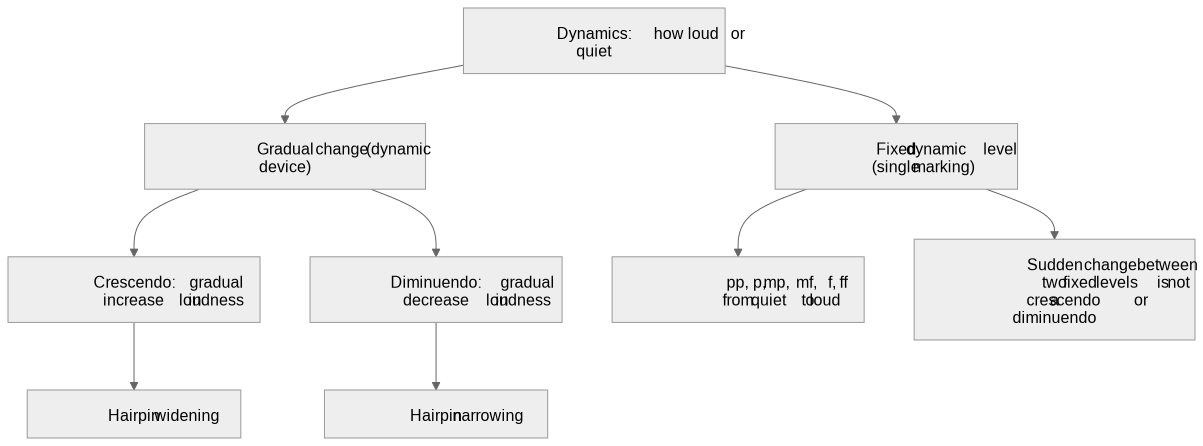
Key words
Say what each word means before you turn the card.
Crescendo
Try answering aloud or in your head before turning the card.
Diminuendo
Try answering aloud or in your head before turning the card.
Dynamic markings
Try answering aloud or in your head before turning the card.
Gradual dynamic change
Try answering aloud or in your head before turning the card.
See every definition
- Crescendo
- A gradual increase in loudness, shown by a hairpin sign widening or the word cresc.
- Diminuendo
- A gradual decrease in loudness, also called a decrescendo, shown by a hairpin sign or the word dim.
- Dynamic markings
- Common markings from quietest to loudest are pp, p, mp, mf, f and ff, and a single marking sets a level rather than a change.
- Gradual dynamic change
- A progressive change such as a crescendo or diminuendo, which differs from a sudden jump from one dynamic to another.
Label the diagram
Some boxes have lost their names. Pick the right name for each number.
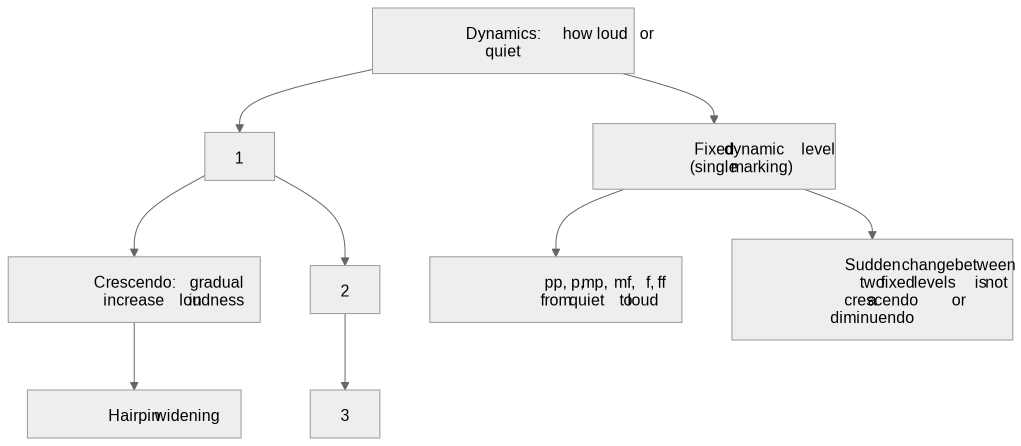
1Box 1
2Box 2
3Box 3
There is more to this lesson
The full lesson goes on to check your understanding and help you earn the marks. Create a free account to carry on, with your progress saved.
A week of Premium from your first lesson · Then the free plan continues · No card, no charge
Test your understanding of Component 3: Appraising - Musical elements: dynamics; basic dynamic devices, for example crescendo and diminuendo.
Active recall beats re-reading. Take an instant quiz now to test what you’ve learned and lock it into long-term memory.
A week of Premium from your first lesson · Then the free plan continues · No card, no charge