Pearson Edexcel · GCSE · Music
Course version: 1MU0 · Version from Sept 2016
Appraising - Musical elements: tempo, metre and rhythm, including pulse,…
Full specification wording
Component 3: Appraising - Musical elements: tempo, metre and rhythm, including pulse, simple time, compound time, and basic rhythmic devices, for example dotted rhythms
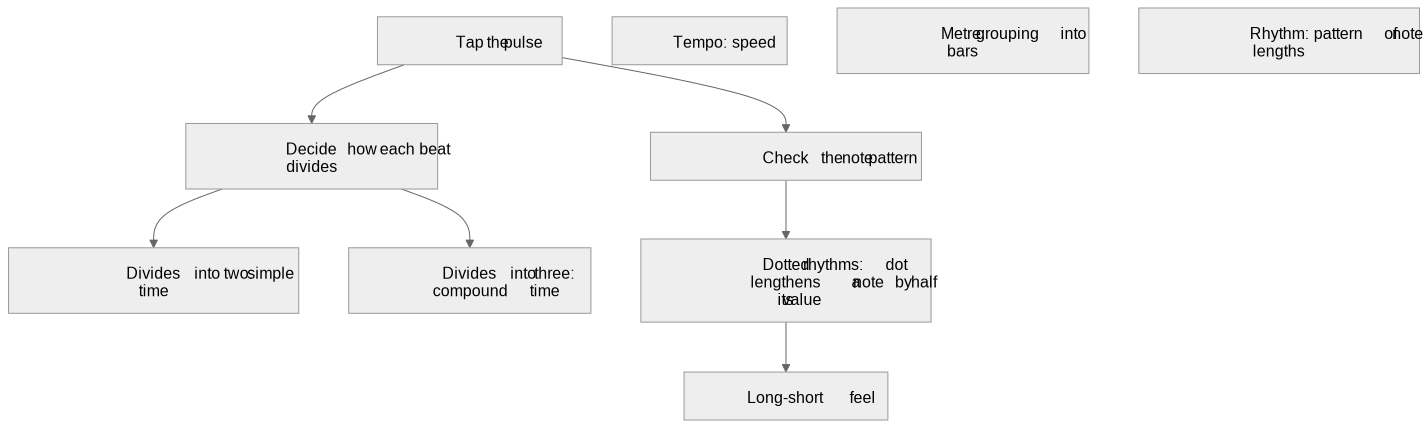
Tempo is the speed of the music; metre is how beats group into bars; rhythm is the pattern of note lengths.
- Point 6 of 7
- 4 key terms
Study notes
From the teaching notes for this specification point.
The idea
Tempo is the speed of the music; metre is how beats group into bars; rhythm is the pattern of note lengths. The pulse is the steady underlying beat you tap. In simple time each beat divides into two (for example 4/4 or 3/4); in compound time each beat divides into three (for example 6/8). Basic rhythmic devices include dotted rhythms, where a dot lengthens a note by half its value, creating a long-short feel. To answer, tap the pulse, decide whether each beat splits into two or three, then check the note pattern. Keep tempo, metre and rhythm separate: speed, grouping and pattern are different questions.
What earns the marks
- Defines tempo as speed and rhythm as the pattern of note lengths.
- Identifies the pulse as the steady underlying beat.
- Distinguishes simple time (beat divides into two) from compound time (beat divides into three).
- Recognises dotted rhythms as a basic rhythmic device lengthening a note by half its value.
- Keeps tempo, metre and rhythm as separate musical elements.
Common mistakes and how to put them right
Confusing tempo with rhythm.
Put it right by noting tempo is speed while rhythm is the pattern of durations.
Miscounting compound time as simple.
Put it right by checking whether each beat divides into three rather than two.
Ignoring the dot: correct by remembering a dot adds half the note's value, producing a long-short pattern.
Exam tips
- Tap the pulse first, then decide whether beats divide into two or three.
- Read the time signature to confirm simple or compound time.
- Separate questions about speed from questions about note patterns.
Try the lesson
The start of the Component 3: Appraising - Musical elements: tempo, metre and rhythm, including pulse, simple time, compound time, and basic rhythmic devices, for example dotted rhythms lesson, made from teaching notes for this specification point.
Have a go first
In a dotted rhythm, what is the effect of the dot on the note's duration?
Listen
Tempo is the speed of the music; metre is how beats group into bars; rhythm is the pattern of note lengths. The pulse is the steady underlying beat you tap. In simple time each beat divides into two (for example 4/4 or 3/4); in compound time each beat divides into three (for example 6/8). Basic rhythmic devices include dotted rhythms, where a dot lengthens a note by half its value, creating a long-short feel. To answer, tap the pulse, decide whether each beat splits into two or three, then check the note pattern. Keep tempo, metre and rhythm separate: speed, grouping and pattern are different questions. A strong answer earns marks for these points. Defines tempo as speed and rhythm as the pattern of note lengths. Identifies the pulse as the steady underlying beat. Distinguishes simple time (beat divides into two) from compound time (beat divides into three). Recognises dotted rhythms as a basic rhythmic device lengthening a note by half its value. A common slip: Confusing tempo with rhythm. Instead, noting tempo is speed while rhythm is the pattern of durations. Exam tip: Tap the pulse first, then decide whether beats divide into two or three.
See it
Key words
Say what each word means before you turn the card.
Tempo
Try answering aloud or in your head before turning the card.
Metre and pulse
Try answering aloud or in your head before turning the card.
Simple versus compound time
Try answering aloud or in your head before turning the card.
Dotted rhythms
Try answering aloud or in your head before turning the card.
See every definition
- Tempo
- The speed of the music, kept separate from metre and rhythm.
- Metre and pulse
- How beats group into bars, with the pulse being the steady underlying beat you tap.
- Simple versus compound time
- In simple time each beat divides into two, while in compound time each beat divides into three.
- Dotted rhythms
- A basic rhythmic device where a dot lengthens a note by half its value, creating a long-short feel.
Label the diagram
Some boxes have lost their names. Pick the right name for each number.
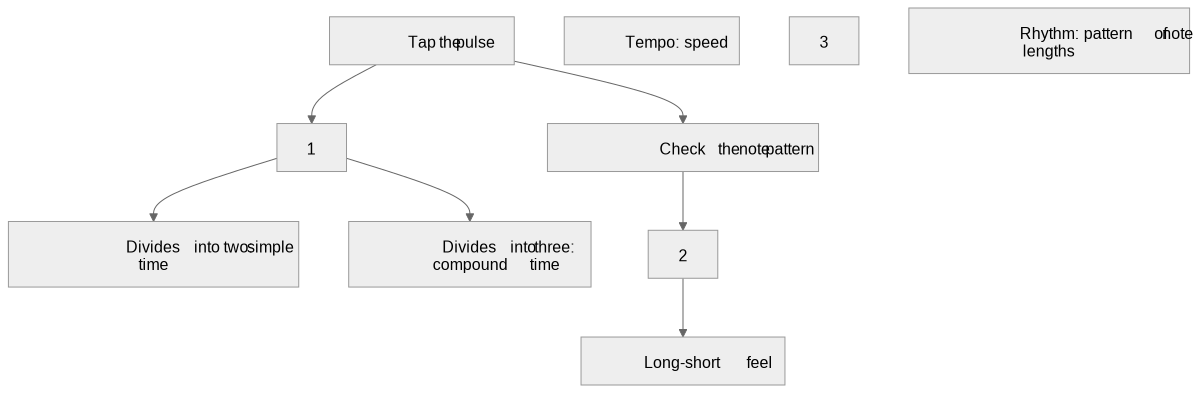
1Box 1
2Box 2
3Box 3
There is more to this lesson
The full lesson goes on to check your understanding and help you earn the marks. Create a free account to carry on, with your progress saved.
A week of Premium from your first lesson · Then the free plan continues · No card, no charge
Test your understanding of Component 3: Appraising - Musical elements: tempo, metre and rhythm, including pulse, simple time, compound time, and basic rhythmic devices, for example dotted rhythms
Active recall beats re-reading. Take an instant quiz now to test what you’ve learned and lock it into long-term memory.
A week of Premium from your first lesson · Then the free plan continues · No card, no charge