Pearson Edexcel · GCSE · Music
Course version: 1MU0 · Version from Sept 2016
Appraising - Musical elements: structure; organisation of musical…
Full specification wording
Component 3: Appraising - Musical elements: structure; organisation of musical material, including simple structure, for example verse and chorus, call and response, binary and theme and variations
Structure is how a piece organises its musical material over time.
- Point 3 of 7
- 4 key terms
Study notes
From the teaching notes for this specification point.
The idea
Structure is how a piece organises its musical material over time. In appraising questions you identify a named structure and justify it by pointing to what returns, what contrasts and what changes. Verse and chorus alternates a recurring chorus with verses whose words change; call and response sets a leading phrase against an answering phrase, often between soloist and group. Binary divides into two related sections, commonly heard as AB, where the second section may bring back material from the first. Theme and variations states a theme then presents altered versions, changing elements such as texture, tonality, rhythm or instrumentation while the theme stays recognisable. Listen for repetition, contrast and return, then match the pattern to the label.
What earns the marks
- Identifies verse and chorus by a recurring chorus returning between verses whose material changes.
- Identifies call and response by a lead phrase answered by a responding phrase, often solo against group.
- Identifies binary as two sections, commonly AB, with the second section often recalling the first.
- Identifies theme and variations by a stated theme followed by recognisable altered versions.
- Justifies a structure label by citing repetition, contrast or return of material heard in the extract.
Common mistakes and how to put them right
Confusing verse and chorus with binary.
Put it right: Is that verse and chorus has a recurring chorus, whereas binary is two sections.
Calling any repeated tune theme and variations.
Put it right: Is that variations must alter the theme while keeping it recognisable.
Assuming call and response needs two instruments.
Put it right: Is that it can be solo voice answered by a group.
Labelling structure from the title alone.
Put it right: Is to justify the label from what is actually heard.
Exam tips
- Listen first for what returns unchanged and what changes, then choose the label.
- Name the structure and add one piece of heard evidence, such as a returning chorus.
- Use the exact terms verse and chorus, call and response, binary, theme and variations.
- If two labels seem possible, state the stronger one and why the other fits less well.
Try the lesson
The start of the Component 3: Appraising - Musical elements: structure; organisation of musical material, including simple structure, for example verse and chorus, call and response, binary and theme and variations lesson, made from teaching notes for this specification point.
Have a go first
Which of the following best describes the structure of a typical pop song that alternates between a recurring main section and a contrasting section with different music and lyrics?
Listen
Structure is how a piece organises its musical material over time. In appraising questions you identify a named structure and justify it by pointing to what returns, what contrasts and what changes. Verse and chorus alternates a recurring chorus with verses whose words change; call and response sets a leading phrase against an answering phrase, often between soloist and group. Binary divides into two related sections, commonly heard as AB, where the second section may bring back material from the first. Theme and variations states a theme then presents altered versions, changing elements such as texture, tonality, rhythm or instrumentation while the theme stays recognisable. Listen for repetition, contrast and return, then match the pattern to the label. A strong answer earns marks for these points. Identifies verse and chorus by a recurring chorus returning between verses whose material changes. Identifies call and response by a lead phrase answered by a responding phrase, often solo against group. Identifies binary as two sections, commonly AB, with the second section often recalling the first. Identifies theme and variations by a stated theme followed by recognisable altered versions. A common slip: Confusing verse and chorus with binary. Instead, is that verse and chorus has a recurring chorus, whereas binary is two sections. Exam tip: Listen first for what returns unchanged and what changes, then choose the label.
See it
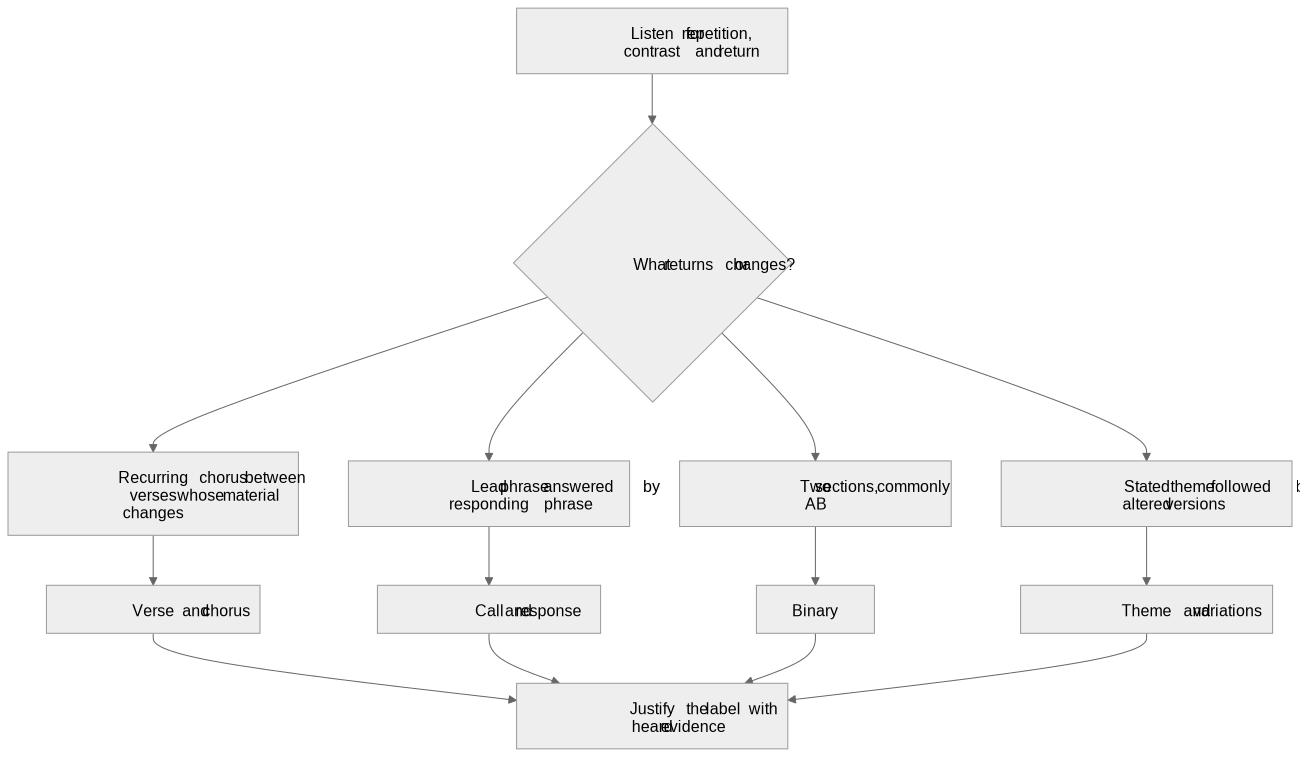
Key words
Say what each word means before you turn the card.
Organisation of musical material
Try answering aloud or in your head before turning the card.
Repetition, contrast and return
Try answering aloud or in your head before turning the card.
Named simple structures
Try answering aloud or in your head before turning the card.
Justifying a structure from listening evidence
Try answering aloud or in your head before turning the card.
See every definition
- Organisation of musical material
- How a piece arranges its musical material over time, including simple structures such as verse and chorus, call and response, binary and theme and variations.
- Repetition, contrast and return
- What a listener hears coming back unchanged, what changes, and what returns, used to match the pattern to a structure label.
- Named simple structures
- Verse and chorus, call and response, binary and theme and variations, each identified from listening rather than from the title alone.
- Justifying a structure from listening evidence
- Naming a structure and citing repetition, contrast or return of material actually heard in the extract as the reason for the label.
There is more to this lesson
The full lesson goes on to check your understanding and help you earn the marks. Create a free account to carry on, with your progress saved.
A week of Premium from your first lesson · Then the free plan continues · No card, no charge
Test your understanding of Component 3: Appraising - Musical elements: structure; organisation of musical material, including simple structure, for example verse and chorus, call and response, binary and theme and variations
Active recall beats re-reading. Take an instant quiz now to test what you’ve learned and lock it into long-term memory.
A week of Premium from your first lesson · Then the free plan continues · No card, no charge