Pearson Edexcel · GCSE · Music
Course version: 1MU0 · Version from Sept 2016
Appraising - Musical elements: sonority, including recognition of a range…
Full specification wording
Component 3: Appraising - Musical elements: sonority, including recognition of a range of instrumental and vocal timbres and articulation, for example legato and staccato
Sonority is the quality of sound produced by a particular instrument or voice, and it includes articulation, the way notes are played or sung.
- Point 4 of 7
- 4 key terms
Study notes
From the teaching notes for this specification point.
The idea
Sonority is the quality of sound produced by a particular instrument or voice, and it includes articulation, the way notes are played or sung. In appraising questions you identify timbres by their characteristic tone colour and describe articulation from how notes are joined or separated. Instrumental timbres include, for example, the bright edge of a trumpet, the mellow tone of a cello or the percussive attack of a piano; vocal timbres range from a treble voice to a bass, and include choir and solo textures. Articulation describes attack and connection: legato notes are smoothly joined, staccato notes are short and detached. Listen for tone colour to name the source, then for smoothness or detachment to describe articulation, and support each answer with a heard feature.
What earns the marks
- Identifies instrumental timbres by characteristic tone colour, such as brass, strings, woodwind or percussion.
- Identifies vocal timbres, distinguishing voice types and solo or choral sonority.
- Describes articulation as legato when notes are smoothly joined.
- Describes articulation as staccato when notes are short and detached.
- Supports a sonority answer with a heard feature of tone colour or articulation.
Common mistakes and how to put them right
Treating sonority as loudness.
Put it right: Is that sonority is tone colour and articulation, while dynamics concern volume.
Confusing legato with staccato.
Put it right: Is that legato is smooth and joined, staccato short and detached.
Naming an instrument without evidence.
Put it right: Is to cite the tone colour or articulation heard.
Ignoring the voice: correction is that vocal timbre, including voice type and choral sound, is part of sonority.
Exam tips
- Name the instrument or voice and give the tone-colour feature that identifies it.
- Use the exact terms legato and staccato when describing articulation.
- Separate sonority from dynamics and tempo so each answer addresses the right element.
- Check whether the extract is instrumental or vocal before choosing a timbre label.
Try the lesson
The start of the Component 3: Appraising - Musical elements: sonority, including recognition of a range of instrumental and vocal timbres and articulation, for example legato and staccato lesson, made from teaching notes for this specification point.
Listen
Sonority is the quality of sound produced by a particular instrument or voice, and it includes articulation, the way notes are played or sung. In appraising questions you identify timbres by their characteristic tone colour and describe articulation from how notes are joined or separated. Instrumental timbres include, for example, the bright edge of a trumpet, the mellow tone of a cello or the percussive attack of a piano; vocal timbres range from a treble voice to a bass, and include choir and solo textures. Articulation describes attack and connection: legato notes are smoothly joined, staccato notes are short and detached. Listen for tone colour to name the source, then for smoothness or detachment to describe articulation, and support each answer with a heard feature. A strong answer earns marks for these points. Identifies instrumental timbres by characteristic tone colour, such as brass, strings, woodwind or percussion. Identifies vocal timbres, distinguishing voice types and solo or choral sonority. Describes articulation as legato when notes are smoothly joined. Describes articulation as staccato when notes are short and detached. A common slip: Treating sonority as loudness. Instead, is that sonority is tone colour and articulation, while dynamics concern volume. Exam tip: Name the instrument or voice and give the tone-colour feature that identifies it.
See it
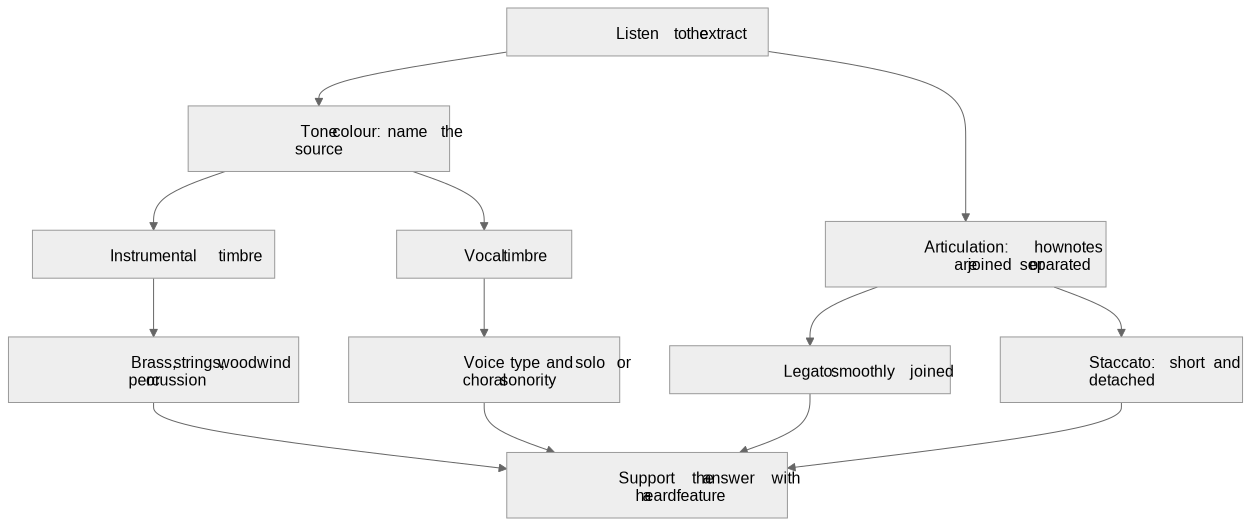
Key words
Say what each word means before you turn the card.
Sonority
Try answering aloud or in your head before turning the card.
Articulation
Try answering aloud or in your head before turning the card.
Legato
Try answering aloud or in your head before turning the card.
Staccato
Try answering aloud or in your head before turning the card.
See every definition
- Sonority
- The quality of sound produced by a particular instrument or voice, and it includes articulation, the way notes are played or sung.
- Articulation
- The way notes are played or sung, describing attack and connection, for example legato and staccato.
- Legato
- Articulation in which notes are smoothly joined.
- Staccato
- Articulation in which notes are short and detached.
Label the diagram
Some boxes have lost their names. Pick the right name for each number.
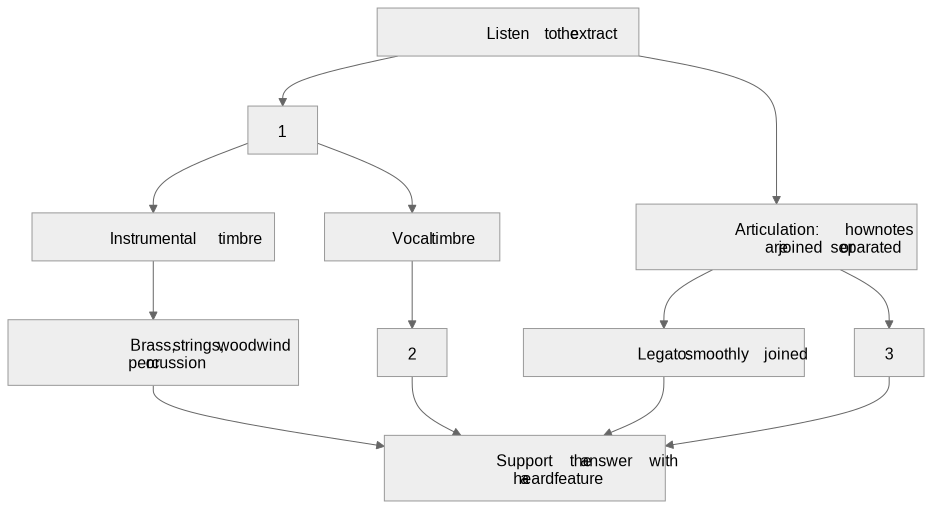
1Box 1
2Box 2
3Box 3
There is more to this lesson
The full lesson goes on to check your understanding and help you earn the marks. Create a free account to carry on, with your progress saved.
A week of Premium from your first lesson · Then the free plan continues · No card, no charge
Test your understanding of Component 3: Appraising - Musical elements: sonority, including recognition of a range of instrumental and vocal timbres and articulation, for example legato and staccato
Active recall beats re-reading. Take an instant quiz now to test what you’ve learned and lock it into long-term memory.
A week of Premium from your first lesson · Then the free plan continues · No card, no charge