Pearson Edexcel · GCSE · Music
Course version: 1MU0 · Version from Sept 2016
Appraising - Musical language: recognising and accurately using…
Full specification wording
Component 3: Appraising - Musical language: recognising and accurately using appropriate musical vocabulary and terminology related to the areas of study, for example slide, repeats and stepwise
This target tests whether you can recognise a term when you hear or see a musical example and then use the term precisely.
- Point 3 of 4
- 4 key terms
Study notes
From the teaching notes for this specification point.
The idea
This target tests whether you can recognise a term when you hear or see a musical example and then use the term precisely. The three examples point to different kinds of vocabulary: 'slide' describes a smooth glide between pitches (a glissando or portamento), 'repeats' refers to repeated sections or repeated material, and 'stepwise' describes motion by adjacent scale steps rather than by leap. To answer, listen for or read the feature, then select the term that matches it exactly, rejecting near-synonyms that describe something different. Accuracy matters: 'stepwise' is not the same as 'leaping', and a 'slide' is not the same as a 'trill'. Build a working glossary linked to each area of study so the right word comes to mind quickly.
What earns the marks
- Recognises a named feature such as a slide, a repeat or stepwise motion in a musical extract or score.
- Selects the term that precisely matches the feature rather than a loosely related one.
- Uses vocabulary accurately, for example distinguishing stepwise motion from leaps.
- Applies terminology correctly to the relevant area of study.
Common mistakes and how to put them right
Confusing stepwise motion with leaping.
Put it right: Is that stepwise means moving to an adjacent scale step, while a leap skips steps.
Using 'slide' for any ornament.
Put it right: Is that a slide is a smooth glide between pitches, not a trill or mordent.
Treating 'repeats' as any repeated note.
Put it right: Is that repeats usually refer to repeated sections or passages of music.
Exam tips
- Link each term to a concrete sound or score feature so recognition is quick.
- Read all options and eliminate near-synonyms before choosing.
- Keep a glossary organised by area of study and revise the precise definitions.
Try the lesson
The start of the Component 3: Appraising - Musical language: recognising and accurately using appropriate musical vocabulary and terminology related to the areas of study, for example slide, repeats and stepwise lesson, made from teaching notes for this specification point.
Have a go first
In music, the term 'stepwise' movement refers to:
Listen
This target tests whether you can recognise a term when you hear or see a musical example and then use the term precisely. The three examples point to different kinds of vocabulary: 'slide' describes a smooth glide between pitches (a glissando or portamento), 'repeats' refers to repeated sections or repeated material, and 'stepwise' describes motion by adjacent scale steps rather than by leap. To answer, listen for or read the feature, then select the term that matches it exactly, rejecting near-synonyms that describe something different. Accuracy matters: 'stepwise' is not the same as 'leaping', and a 'slide' is not the same as a 'trill'. Build a working glossary linked to each area of study so the right word comes to mind quickly. A strong answer earns marks for these points. Recognises a named feature such as a slide, a repeat or stepwise motion in a musical extract or score. Selects the term that precisely matches the feature rather than a loosely related one. Uses vocabulary accurately, for example distinguishing stepwise motion from leaps. Applies terminology correctly to the relevant area of study. A common slip: Confusing stepwise motion with leaping. Instead, is that stepwise means moving to an adjacent scale step, while a leap skips steps. Exam tip: Link each term to a concrete sound or score feature so recognition is quick.
See it
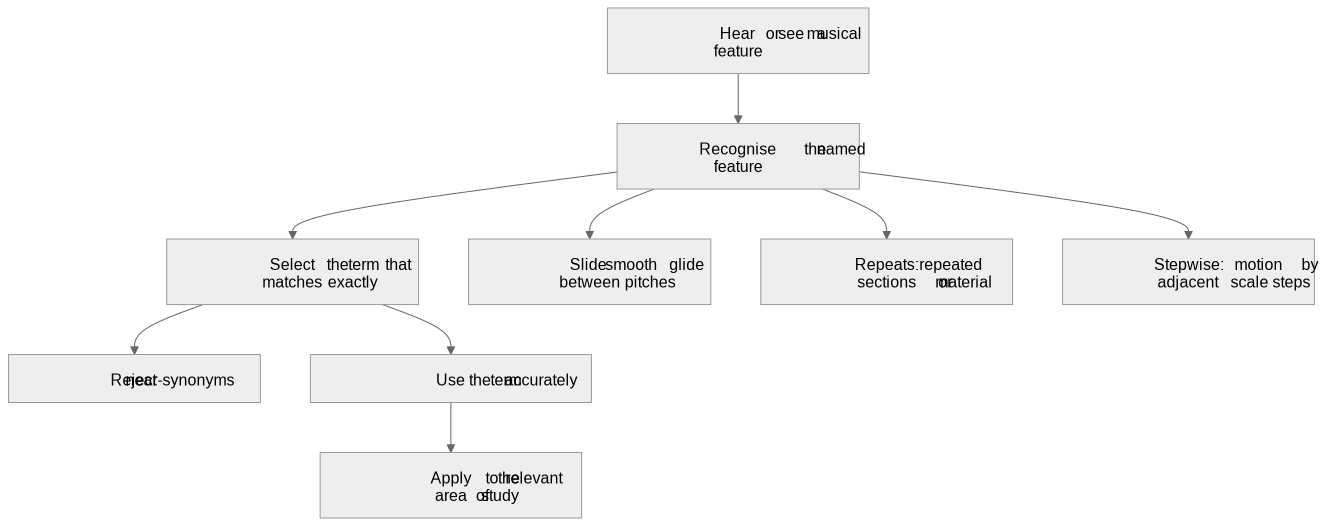
Key words
Say what each word means before you turn the card.
slide
Try answering aloud or in your head before turning the card.
repeats
Try answering aloud or in your head before turning the card.
stepwise
Try answering aloud or in your head before turning the card.
musical vocabulary and terminology
Try answering aloud or in your head before turning the card.
See every definition
- slide
- A smooth glide between pitches, rather than a trill or mordent.
- repeats
- Repeated sections or passages of music, rather than any repeated note.
- stepwise
- Motion by adjacent scale steps rather than by leap.
- musical vocabulary and terminology
- Appropriate words related to the areas of study, recognised and used accurately.
Label the diagram
Some boxes have lost their names. Pick the right name for each number.
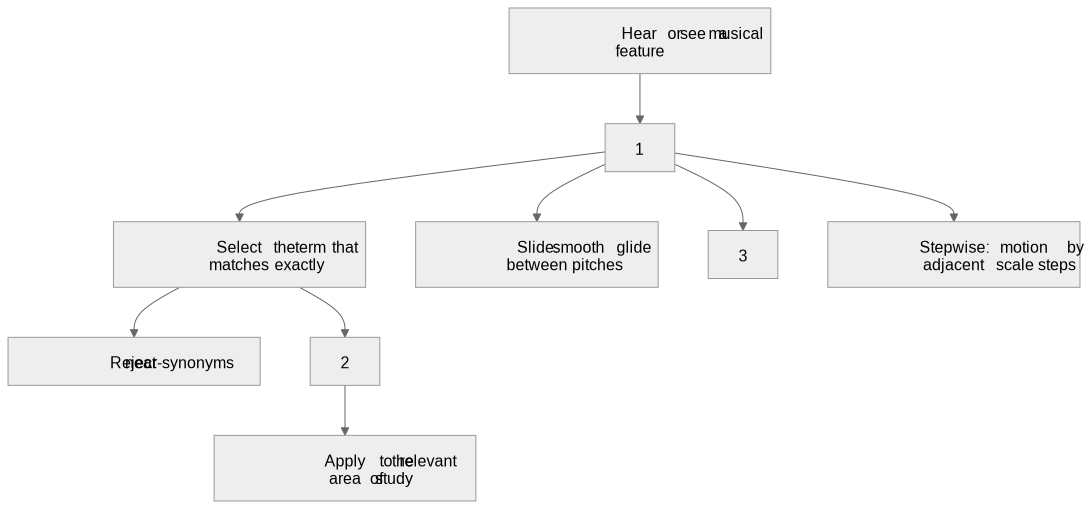
1Box 1
2Box 2
3Box 3
There is more to this lesson
The full lesson goes on to check your understanding and help you earn the marks. Create a free account to carry on, with your progress saved.
A week of Premium from your first lesson · Then the free plan continues · No card, no charge
Test your understanding of Component 3: Appraising - Musical language: recognising and accurately using appropriate musical vocabulary and terminology related to the areas of study, for example slide, repeats and stepwise
Active recall beats re-reading. Take an instant quiz now to test what you’ve learned and lock it into long-term memory.
A week of Premium from your first lesson · Then the free plan continues · No card, no charge