Pearson Edexcel · GCSE · Music
Course version: 1MU0 · Version from Sept 2016
Appraising - Musical language: recognising and accurately using…
Full specification wording
Component 3: Appraising - Musical language: recognising and accurately using appropriate terminology related to scores (e.g. continuo)
Score terminology is the vocabulary you use to read and describe a printed score.
- Point 4 of 4
- 4 key terms
Study notes
From the teaching notes for this specification point.
The idea
Score terminology is the vocabulary you use to read and describe a printed score. 'Recognising' means spotting a term or symbol on the page and knowing what it signals; 'accurately using' means applying the term correctly when you describe what you hear or see. Take 'continuo': in Baroque scores it labels the basso continuo line, a bass part with figures (figures under the bass) played by a chordal instrument such as harpsichord or organ, often with a bass instrument. Learn terms in families: texture (monophonic, homophonic, polyphonic), dynamics, articulation, tempo, ornament signs, and structural labels. For each, practise locating it in a real score and stating its effect.
What earns the marks
- Identifies the meaning of a score term such as continuo as a figured bass line played by a chordal instrument, often with a bass instrument.
- Distinguishes continuo from other bass-related terms, for example a plain bass line without figures.
- Recognises terms in context on a score excerpt rather than only as isolated definitions.
- Applies the correct term when describing a musical feature heard or seen, matching term to evidence.
Common mistakes and how to put them right
Treating 'continuo' as simply any bass line.
Put it right: Is that continuo is a figured bass part realised by chordal instruments, often with a bass instrument.
Confusing texture terms such as homophonic and polyphonic.
Put it right: Is to check whether parts move together in chords or move independently.
Choosing a term because it sounds impressive rather than because the score supports it.
Put it right: Is to point to the notation that justifies the term.
Exam tips
- Build a glossary grouped by element (texture, dynamics, articulation, tempo, structure) and test yourself by finding each term in a score.
- When a question shows a score excerpt, read the labels and symbols before answering, then match the option to what is actually printed.
- Justify your choice in one sentence linking the term to a visible feature, which trains accurate use as well as recognition.
Try the lesson
The start of the Component 3: Appraising - Musical language: recognising and accurately using appropriate terminology related to scores (e.g. continuo) lesson, made from teaching notes for this specification point.
Have a go first
In a Baroque concerto grosso, you see the instruction 'Tutti' above a section. What does this indicate?
Listen
Score terminology is the vocabulary you use to read and describe a printed score. Recognising' means spotting a term or symbol on the page and knowing what it signals; 'accurately using' means applying the term correctly when you describe what you hear or see. Take 'continuo': in Baroque scores it labels the basso continuo line, a bass part with figures (figures under the bass) played by a chordal instrument such as harpsichord or organ, often with a bass instrument. Learn terms in families: texture (monophonic, homophonic, polyphonic), dynamics, articulation, tempo, ornament signs, and structural labels. For each, practise locating it in a real score and stating its effect. A strong answer earns marks for these points. Identifies the meaning of a score term such as continuo as a figured bass line played by a chordal instrument, often with a bass instrument. Distinguishes continuo from other bass-related terms, for example a plain bass line without figures. Recognises terms in context on a score excerpt rather than only as isolated definitions. Applies the correct term when describing a musical feature heard or seen, matching term to evidence. A common slip: Treating 'continuo' as simply any bass line. Instead, is that continuo is a figured bass part realised by chordal instruments, often with a bass instrument. Exam tip: Build a glossary grouped by element (texture, dynamics, articulation, tempo, structure) and test yourself by finding each term in a score.
See it
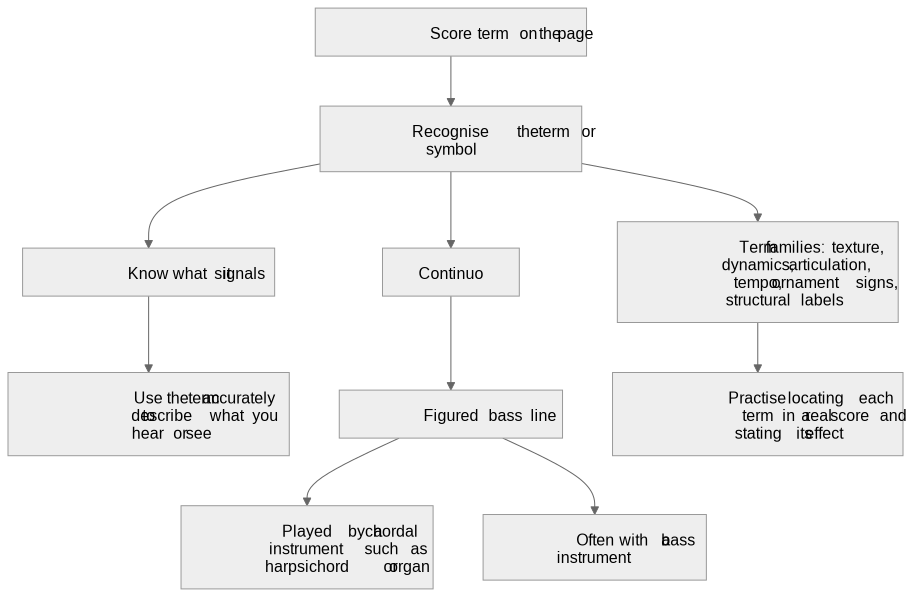
Key words
Say what each word means before you turn the card.
Continuo
Try answering aloud or in your head before turning the card.
Recognising
Try answering aloud or in your head before turning the card.
Accurately using
Try answering aloud or in your head before turning the card.
Score terminology
Try answering aloud or in your head before turning the card.
See every definition
- Continuo
- In Baroque scores it labels the basso continuo line, a bass part with figures played by a chordal instrument such as harpsichord or organ, often with a bass instrument.
- Recognising
- Spotting a term or symbol on the page and knowing what it signals.
- Accurately using
- Applying the term correctly when you describe what you hear or see.
- Score terminology
- The vocabulary you use to read and describe a printed score.
Label the diagram
Some boxes have lost their names. Pick the right name for each number.
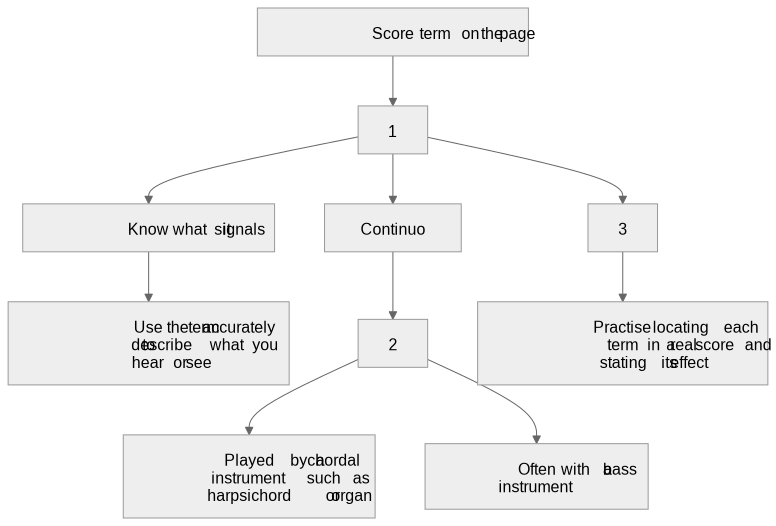
1Box 1
2Box 2
3Box 3
There is more to this lesson
The full lesson goes on to check your understanding and help you earn the marks. Create a free account to carry on, with your progress saved.
A week of Premium from your first lesson · Then the free plan continues · No card, no charge
Test your understanding of Component 3: Appraising - Musical language: recognising and accurately using appropriate terminology related to scores (e.g. continuo)
Active recall beats re-reading. Take an instant quiz now to test what you’ve learned and lock it into long-term memory.
A week of Premium from your first lesson · Then the free plan continues · No card, no charge