Pearson Edexcel · GCSE · Music
Course version: 1MU0 · Version from Sept 2016
Appraising - Set works: J S Bach: 3rd Movement from Brandenburg Concerto…
Full specification wording
Component 3: Appraising - Set works: J S Bach: 3rd Movement from Brandenburg Concerto no. 5 in D major
This set work is the third movement of Bach's Brandenburg Concerto no.
- Point 1 of 8
- 4 key terms
Study notes
From the teaching notes for this specification point.
The idea
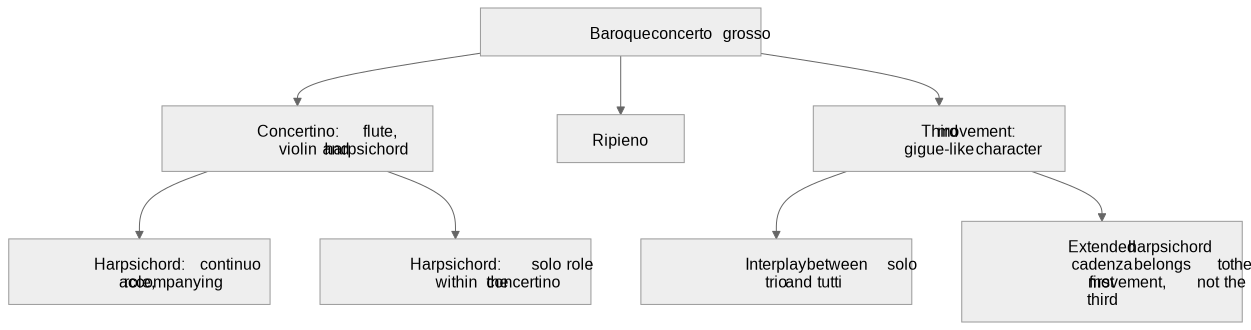
This set work is the third movement of Bach's Brandenburg Concerto no. 5 in D major, a Baroque concerto grosso featuring a concertino of flute, violin and harpsichord against the ripieno. Study the movement's structure, its gigue-like character, the interplay between the solo trio and the tutti, and the harpsichord's continuo role. Note that the celebrated extended harpsichord cadenza belongs to the first movement, not this third movement, so do not attribute it here. Learn to identify the main themes, the keys visited, the texture changes and the typical Baroque features such as terraced dynamics and ornamentation. Practise locating short extracts by ear and describing what you hear using correct musical vocabulary.
What earns the marks
- Identifies the movement as the third movement of Bach's Brandenburg Concerto no. 5 in D major, a Baroque concerto grosso.
- Describes the concertino of flute, violin and harpsichord set against the ripieno, and the harpsichord's continuo role.
- Recognises structural and thematic features of the movement, such as its gigue-like character and the interplay between soloists and tutti.
- Correctly notes that the famous extended harpsichord cadenza occurs in the first movement, not the third.
- Uses accurate musical vocabulary when describing texture, dynamics, ornamentation and tonality.
Common mistakes and how to put them right
Placing the famous extended harpsichord cadenza in the third movement.
Put it right: Is that it belongs to the first movement, so describe the third movement's own features instead.
Treating the work as a solo concerto rather than a concerto grosso.
Put it right: Is to recognise the concertino group of flute, violin and harpsichord against the ripieno.
Ignoring the harpsichord's continuo function.
Put it right: Is to note that it both accompanies and takes a solo role within the concertino.
Exam tips
- Learn the movement by listening repeatedly with the score, marking themes, keys and texture changes as you go.
- Practise describing short extracts aloud using precise terms such as concertino, ripieno, continuo and terraced dynamics.
- Keep the movements distinct in your notes so you do not mix features from the first movement into the third.
Try the lesson
The start of the Component 3: Appraising - Set works: J S Bach: 3rd Movement from Brandenburg Concerto no. 5 in D major lesson, made from teaching notes for this specification point.
Have a go first
In the third movement of Bach's Brandenburg Concerto No. 5, which instrument is the most prominent solo instrument, playing virtuosic passagework alongside the other soloists?
Listen
This set work is the third movement of Bach's Brandenburg Concerto no. 5 in D major, a Baroque concerto grosso featuring a concertino of flute, violin and harpsichord against the ripieno. Study the movement's structure, its gigue-like character, the interplay between the solo trio and the tutti, and the harpsichord's continuo role. Note that the celebrated extended harpsichord cadenza belongs to the first movement, not this third movement, so do not attribute it here. Learn to identify the main themes, the keys visited, the texture changes and the typical Baroque features such as terraced dynamics and ornamentation. Practise locating short extracts by ear and describing what you hear using correct musical vocabulary. A strong answer earns marks for these points. Identifies the movement as the third movement of Bach's Brandenburg Concerto no. 5 in D major, a Baroque concerto grosso. Describes the concertino of flute, violin and harpsichord set against the ripieno, and the harpsichord's continuo role. Recognises structural and thematic features of the movement, such as its gigue-like character and the interplay between soloists and tutti. Correctly notes that the famous extended harpsichord cadenza occurs in the first movement, not the third. A common slip: Placing the famous extended harpsichord cadenza in the third movement. Instead, is that it belongs to the first movement, so describe the third movement's own features instead. Exam tip: Learn the movement by listening repeatedly with the score, marking themes, keys and texture changes as you go.
See it
Key words
Say what each word means before you turn the card.
Baroque concerto grosso
Try answering aloud or in your head before turning the card.
Concertino and ripieno textures
Try answering aloud or in your head before turning the card.
Structure and tonality of the third movement
Try answering aloud or in your head before turning the card.
Accurate attribution of features to the correct movement
Try answering aloud or in your head before turning the card.
See every definition
- Baroque concerto grosso
- A Baroque work in which a concertino of soloists is set against the ripieno, as in this movement of Bach's Brandenburg Concerto no. 5 in D major.
- Concertino and ripieno textures
- The interplay between the solo trio of flute, violin and harpsichord and the tutti, with the harpsichord also taking a continuo role.
- Structure and tonality of the third movement
- The movement's gigue-like character, its main themes, the keys visited and its texture changes, described using accurate musical vocabulary.
- Accurate attribution of features to the correct movement
- Keeping the movements distinct, noting that the celebrated extended harpsichord cadenza belongs to the first movement, not this third movement.
Label the diagram
Some boxes have lost their names. Pick the right name for each number.
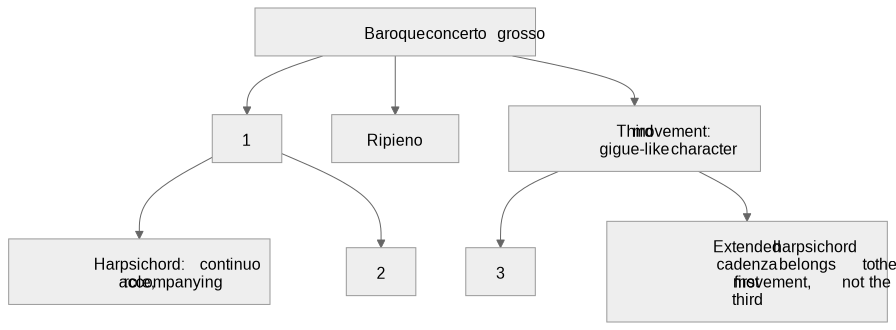
1Box 1
2Box 2
3Box 3
There is more to this lesson
The full lesson goes on to check your understanding and help you earn the marks. Create a free account to carry on, with your progress saved.
A week of Premium from your first lesson · Then the free plan continues · No card, no charge
Test your understanding of Component 3: Appraising - Set works: J S Bach: 3rd Movement from Brandenburg Concerto no. 5 in D major
Active recall beats re-reading. Take an instant quiz now to test what you’ve learned and lock it into long-term memory.
A week of Premium from your first lesson · Then the free plan continues · No card, no charge