AQA · A-Level · Philosophy
Moral philosophy
Dive into the fundamental questions of right and wrong that have shaped human civilisation for millennia. This comprehensive guide covers the three titans of moral philosophy—Utilitarianism, Kantian Deontology, and Virtue Ethics—giving you the precise terminology and critical evaluation skills needed to secure top marks in your GCSE exam.
- 5 min read
- 3 worked examples
- 5 practice questions
- 6 key terms
Study Notes
Overview
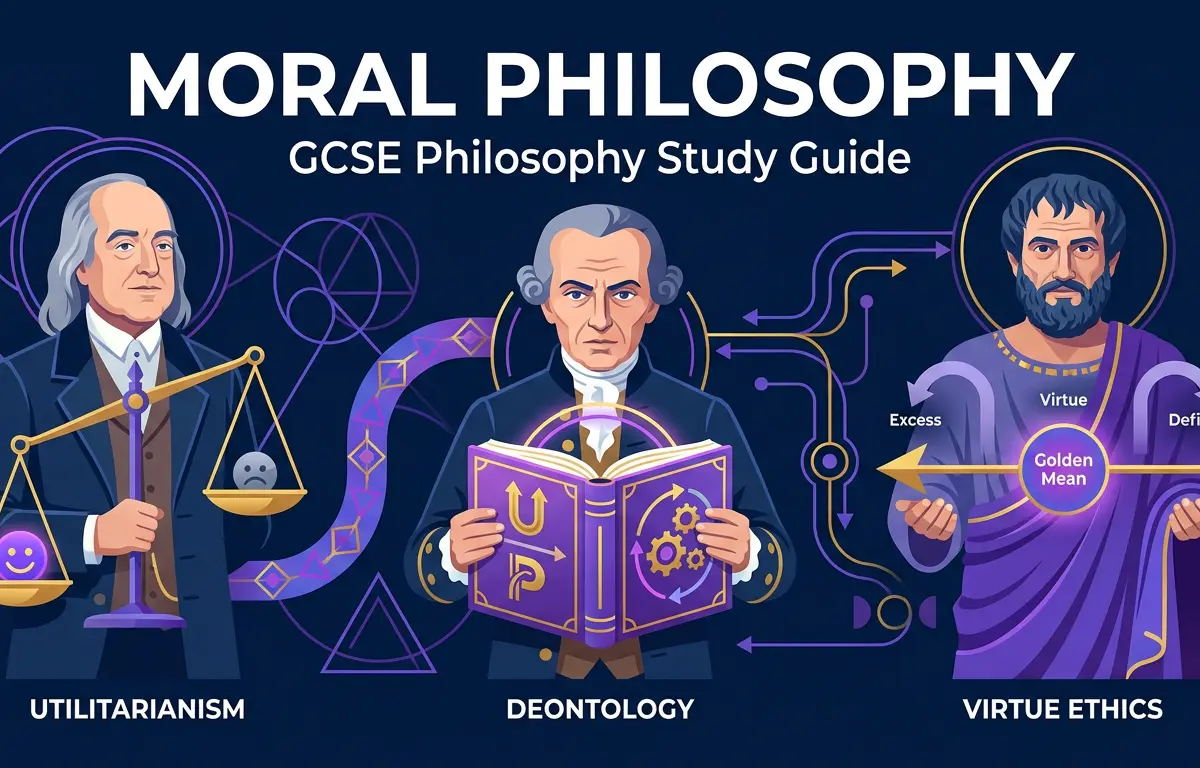
Moral philosophy, or ethics, is the branch of philosophy that asks what it means to live a good life and what makes our actions right or wrong. For your GCSE, you are required to master three major normative ethical theories: Utilitarianism (focusing on consequences), Kantian Deontological Ethics (focusing on duty), and Aristotelian Virtue Ethics (focusing on character). Examiners expect you not only to define the key concepts of each theory accurately but also to apply them to real-world ethical dilemmas—such as stealing, telling lies, or eating animals—and evaluate their strengths and weaknesses. This guide breaks down each theory, highlights common pitfalls, and provides the examiner-focused commentary you need to excel.
Listen to the Podcast
1. Utilitarianism
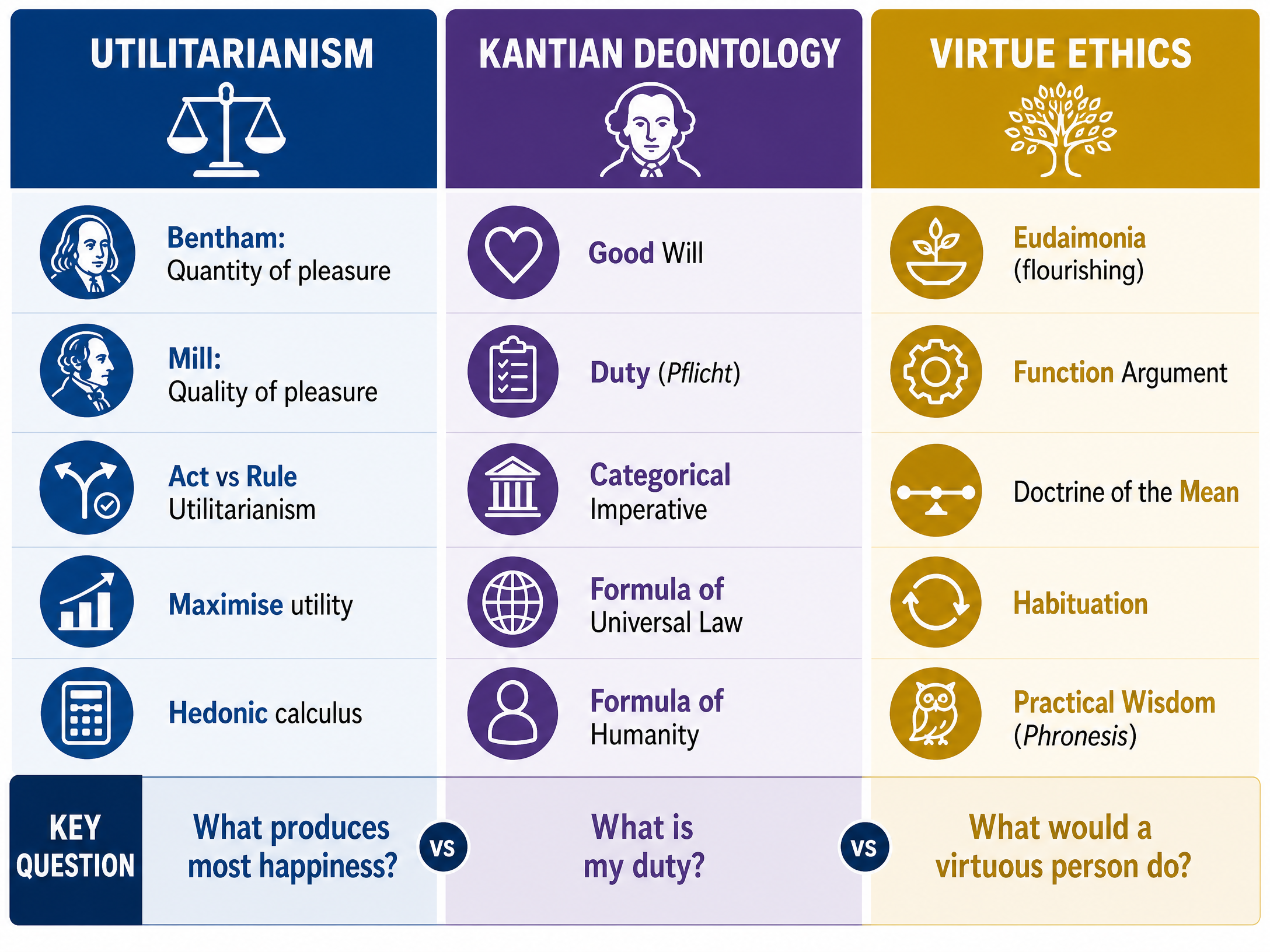
Utilitarianism is a consequentialist theory; it judges the morality of an action solely by its outcomes. The core principle is to maximise utility (happiness or pleasure) for the greatest number of people.
Jeremy Bentham and Act Utilitarianism
Key Concept: Bentham argued that pleasure is the only intrinsic good. His approach is quantitative—we should measure the amount of pleasure an act produces.
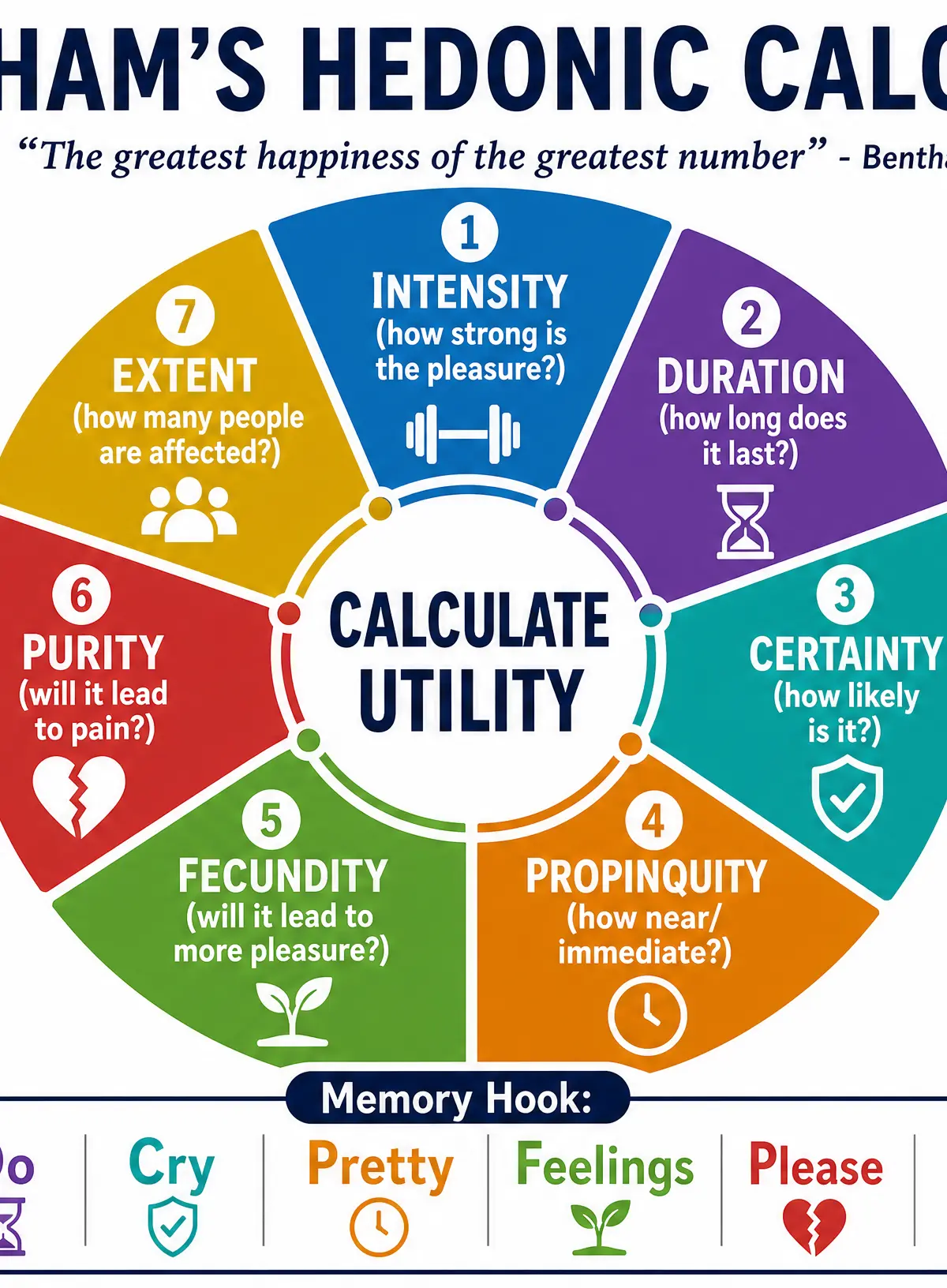
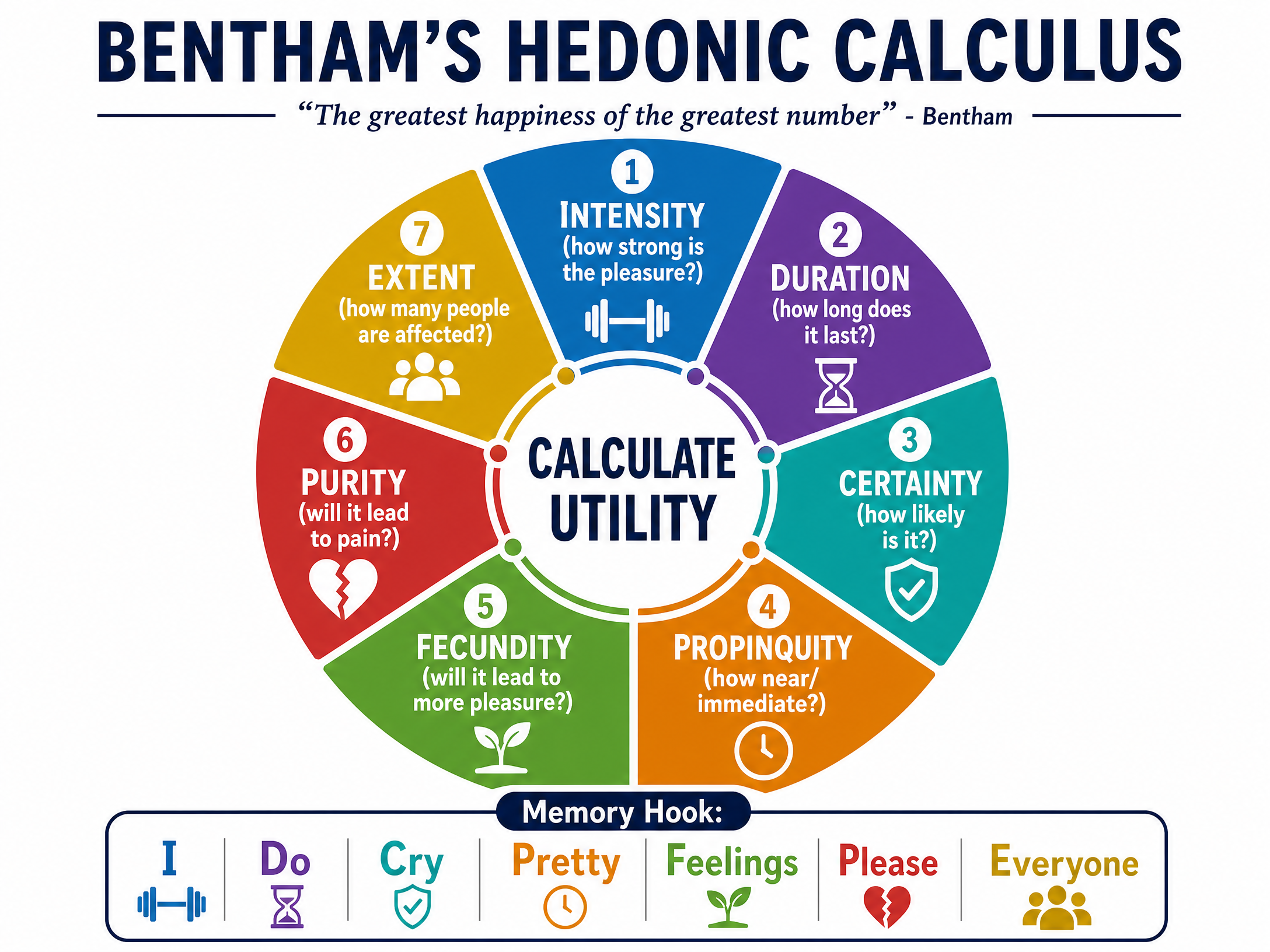
The Hedonic Calculus: Bentham devised this to calculate utility across seven dimensions:
- Intensity (how strong?)
- Duration (how long?)
- Certainty (how likely?)
- Propinquity (how soon?)
- Fecundity (will it lead to more?)
- Purity (will it lead to pain?)
- Extent (how many people?)
John Stuart Mill and Rule Utilitarianism
Key Concept: Mill, Bentham's godson, argued that pleasures differ in quality, not just quantity. He distinguished between higher pleasures (intellectual/moral) and lower pleasures (physical). Mill famously stated, "It is better to be a human being dissatisfied than a pig satisfied."
Act vs Rule: While Act Utilitarianism (Bentham) calculates utility for each individual action, Rule Utilitarianism (Mill) argues we should follow general rules that, if universally adopted, would maximise happiness (e.g., "do not steal").
Critical Issue: The Tyranny of the Majority. If torturing one innocent person brings immense pleasure to a million people, Act Utilitarianism might justify it. This deeply counter-intuitive result is a key evaluative point.
2. Kantian Deontological Ethics
Immanuel Kant completely rejected consequentialism. For Kant, an action is only morally right if it is done out of duty, regardless of the outcome.
The Good Will and Duty
Key Concept: The only thing unconditionally good is a "good will"—a will that acts purely out of reverence for the moral law (duty). Acting out of compassion or self-interest has no moral worth.
The Categorical Imperative
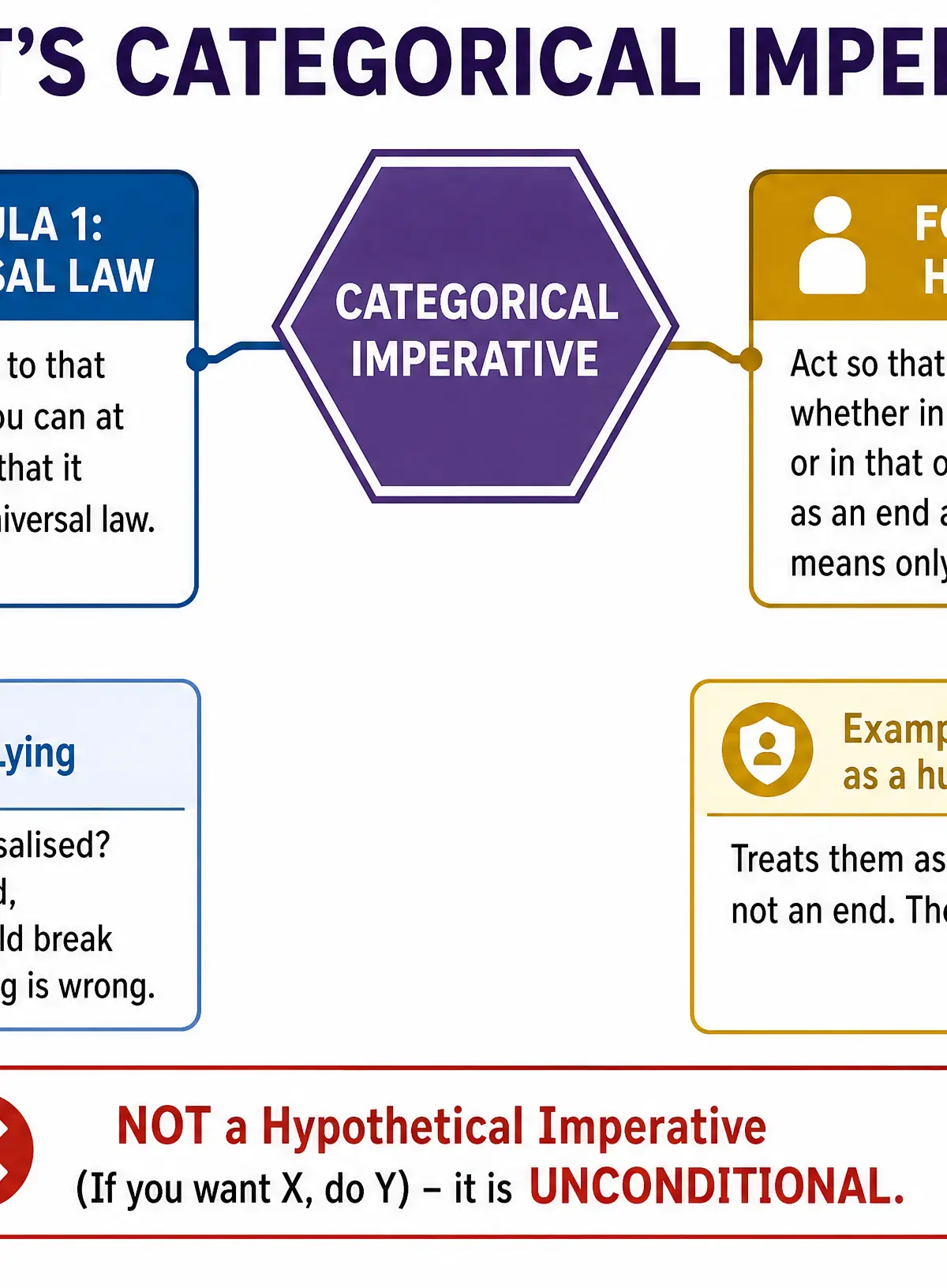
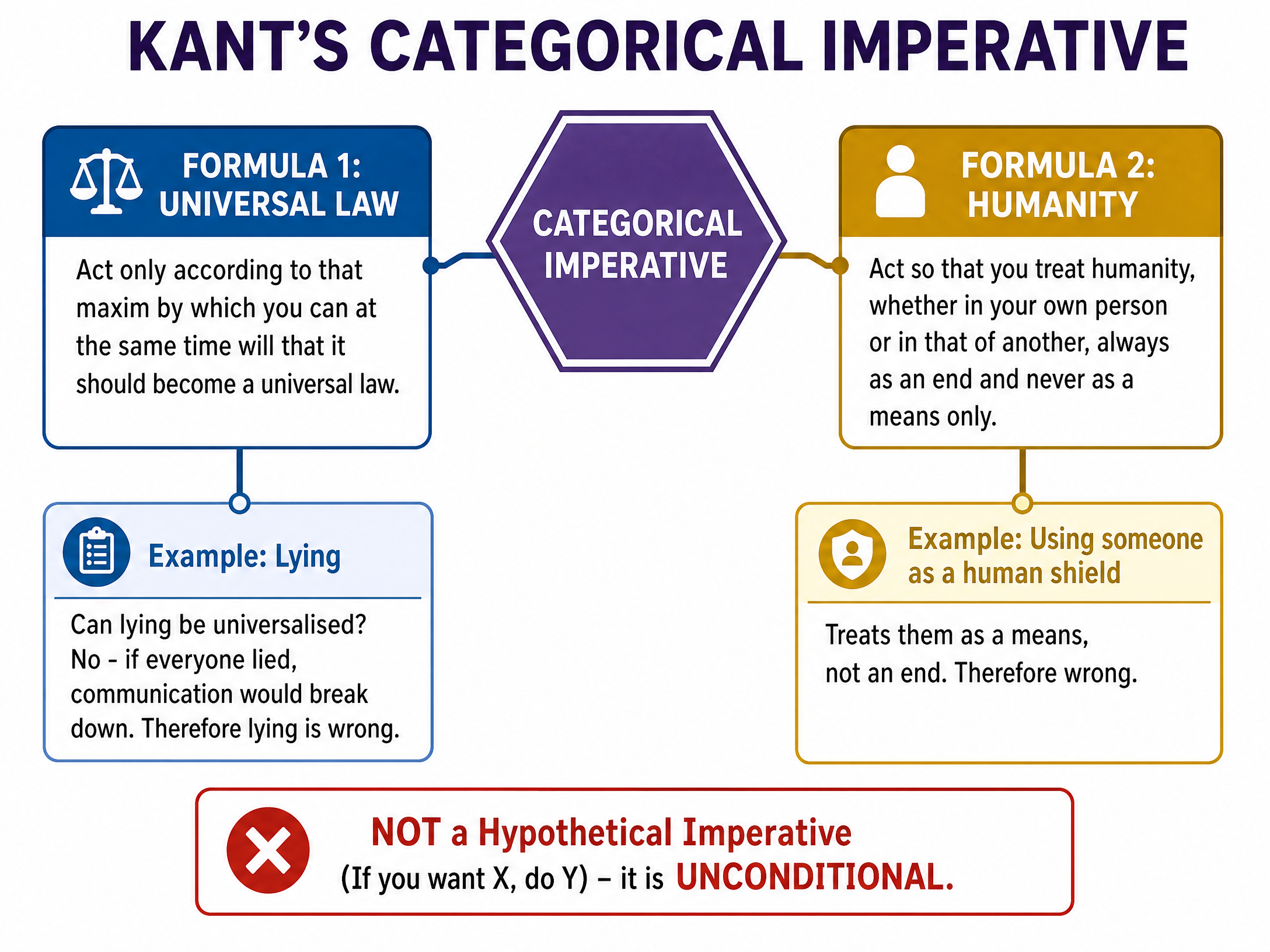
Kant argued that moral duties are categorical—they apply unconditionally to everyone, always. This is distinct from hypothetical imperatives ("If you want X, do Y").
Formula of Universal Law: "Act only according to that maxim by which you can at the same time will that it should become a universal law." (e.g., Lying is wrong because if everyone lied, communication would break down).
Formula of Humanity: "Act so that you treat humanity... always as an end and never as a means only." (e.g., You cannot use a person merely as a tool to achieve your goals).
Critical Issue: Clashing Duties. What if telling the truth (a duty) leads to someone's murder (violating the duty to preserve life)? Kant's rigid system struggles to resolve conflicting absolute duties.
3. Aristotelian Virtue Ethics
Aristotle shifts the focus from "What should I do?" to "What kind of person should I be?" It is an agent-centred theory.
Eudaimonia and the Function Argument
Key Concept: The ultimate goal of human life is Eudaimonia (flourishing or living well). Aristotle argues that everything has a function (ergon). The function of a human is to exercise reason excellently. To do this, we need virtues (arête).
The Doctrine of the Mean
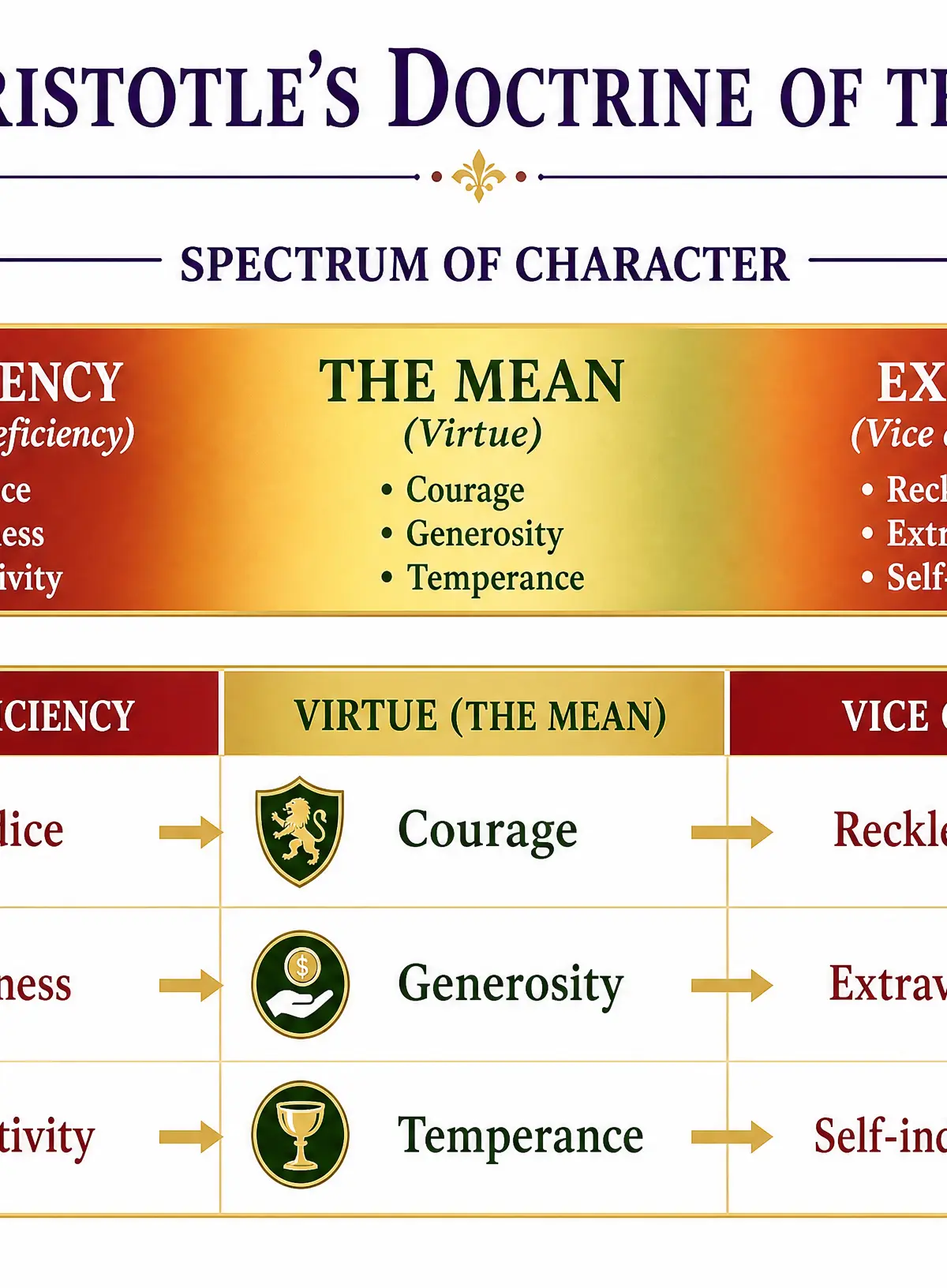
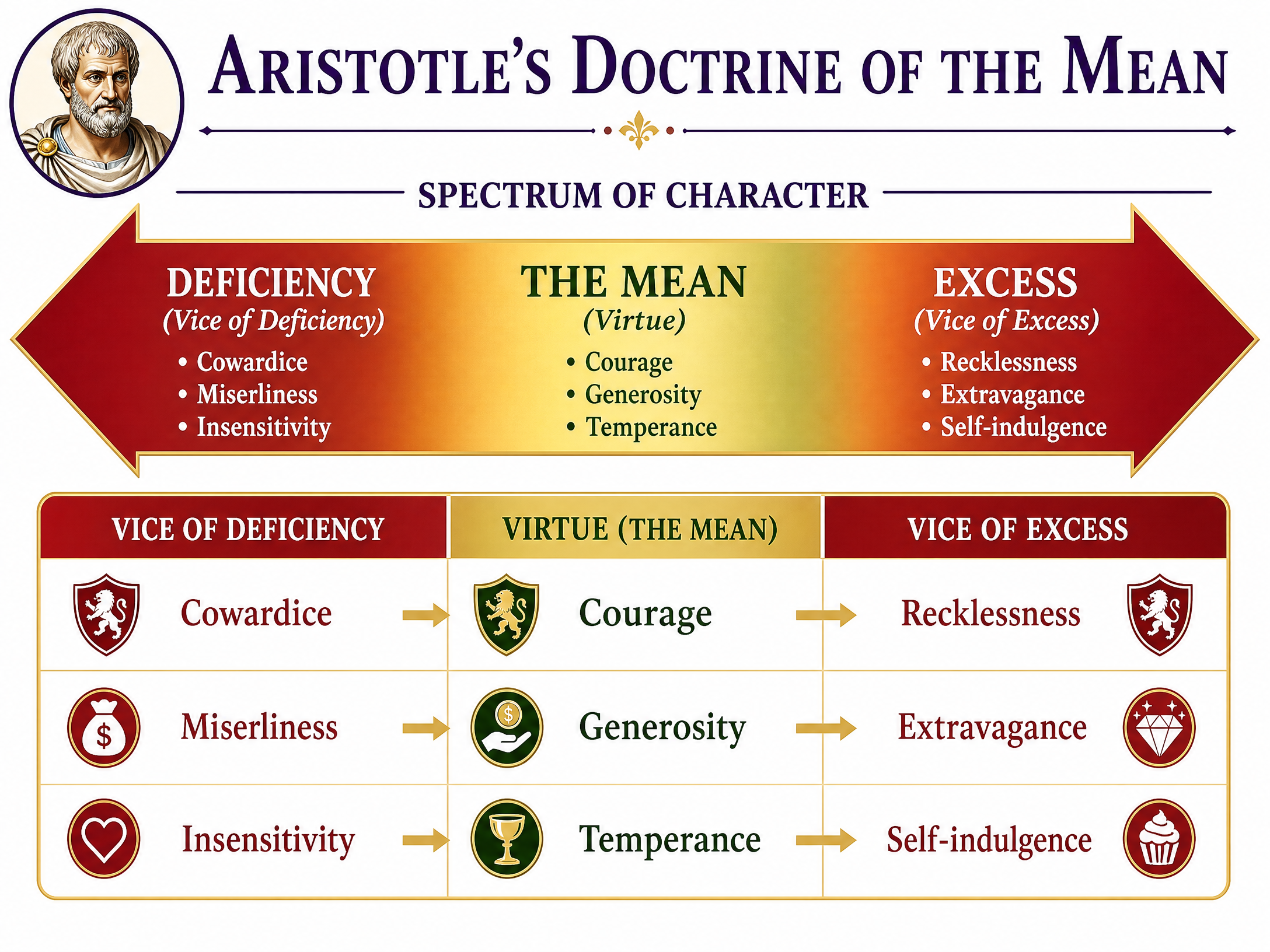
Key Concept: A virtue is the golden mean between two vices: a vice of deficiency and a vice of excess. For example, courage is the mean between cowardice (deficiency) and recklessness (excess).
Habituation and Practical Wisdom
We are not born virtuous. We develop virtues through habituation (practising virtuous acts). To navigate complex moral situations and find the mean, we must develop practical wisdom (phronesis).
Critical Issue: The Skill Analogy. Aristotle compares becoming virtuous to learning a skill (like playing the harp). Critics argue that moral virtue is fundamentally different from a practical skill, as morality involves intention and emotion in ways skills do not.
Comparing the Theories
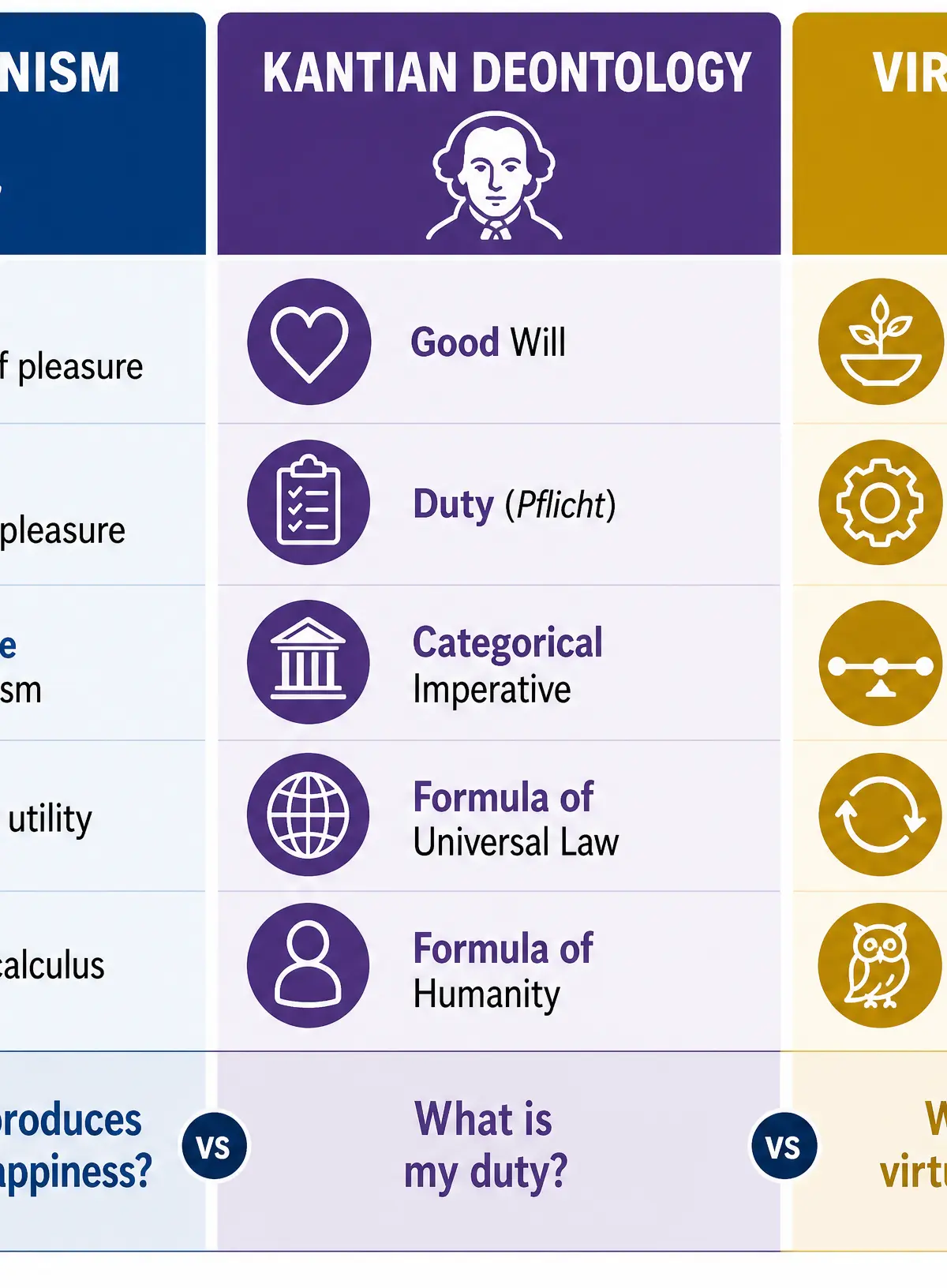
Visual Resources
4 diagrams and illustrations
Interactive Diagrams
1 interactive diagram to visualise key concepts
Conceptual Flow Outline
How the three theories approach a moral dilemma
Worked Examples
3 worked examples — open one to explore the question and available guidance.
Practice Questions
Test your understanding — click to reveal model answers
Explain Kant's concept of the 'good will'. (5 marks)
Hint: Contrast it with acting out of emotion or for consequences.
Outline the problem of the 'tyranny of the majority' for Utilitarianism. (5 marks)
Hint: Think about what happens to individual rights if only total happiness matters.
Explain Aristotle's function argument. (5 marks)
Hint: What is the ergon of a human? How does it relate to arête?
Evaluate Utilitarianism as a theory for moral decision making. (12 marks)
Hint: Compare Bentham and Mill, and evaluate using Nozick's experience machine or the tyranny of the majority.
Explain how Kant's Formula of Humanity applies to the issue of stealing. (5 marks)
Hint: How does stealing treat the victim? Are they being respected as a rational agent?
Test your understanding of Moral philosophy
Active recall beats re-reading. Take an instant quiz now to test what you’ve learned and lock it into long-term memory.
7 days Premium · Then free forever · No card, no charge