AQA · A-Level · Physical Education
Course version: 7582 · Version from Sept 2016
Achievement motivation theory: Achievement goal theory.
Achievement goal theory explains why performers choose, persist at and judge success in physical activity differently.
Checked against the AQA 7582 specification (opens in a new tab) on .
- Point 6 of 8
- 4 key terms
Study notes
From the checked teaching notes for this specification point.
The idea
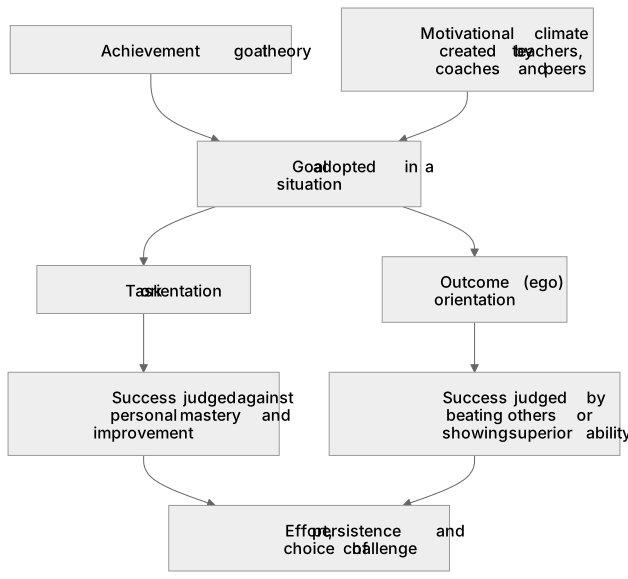
Achievement goal theory explains why performers choose, persist at and judge success in physical activity differently. It holds that the goal a performer adopts in a situation shapes their effort, their choice of challenge and how they feel about the result. Two goal perspectives are central: task orientation, where success is judged against personal mastery and improvement, and outcome (ego) orientation, where success is judged by beating others or showing superior ability. The theory also recognises that the motivational climate created by teachers, coaches and peers influences which goal becomes dominant. A performer high in task orientation may persist at a difficult skill because progress itself is rewarding, while a performer high in outcome orientation may avoid a task where they risk looking inferior. Understanding this helps explain behaviour in lessons and competition.
What earns the marks
- Achievement goal theory explains how the goal a performer adopts influences motivation, effort, persistence and choice of challenge.
- Task orientation judges success against personal mastery, improvement and effort rather than comparison with others.
- Outcome (ego) orientation judges success by outperforming others or demonstrating superior ability.
- The motivational climate created by teachers, coaches and peers can shape which goal orientation becomes dominant in a situation.
- Goal orientations help explain why performers differ in persistence, task choice and reactions to success or failure.
Common mistakes and how to put them right
Thinking task orientation means doing easy tasks.
Put it right: Task orientation means judging success by personal mastery and improvement, which can involve difficult challenges.
Confusing outcome orientation with having no motivation.
Put it right: Outcome orientation is a valid goal perspective where success is judged by comparison with others.
Believing goal orientation is fixed for life.
Put it right: The situation and motivational climate can influence which goal perspective dominates.
Assuming achievement goal theory only applies to elite sport.
Put it right: It applies to physical education lessons, recreational activity and competition alike.
Exam tips
- Link each goal orientation to a concrete behaviour, such as persisting at a skill or avoiding a challenging task, rather than only defining the term.
- Use the phrase 'judged against' to make clear the standard of success for task and outcome orientations.
- When a question gives a scenario, identify the goal orientation shown and justify it with evidence from the scenario.
Try the lesson
The start of the Achievement motivation theory: Achievement goal theory. lesson, made from checked teaching notes for this specification point.
Have a go first
In achievement goal theory, what does a performer's goal orientation describe?
Listen
Achievement goal theory explains why performers choose, persist at and judge success in physical activity differently. It holds that the goal a performer adopts in a situation shapes their effort, their choice of challenge and how they feel about the result. Two goal perspectives are central: task orientation, where success is judged against personal mastery and improvement, and outcome (ego) orientation, where success is judged by beating others or showing superior ability. The theory also recognises that the motivational climate created by teachers, coaches and peers influences which goal becomes dominant. A performer high in task orientation may persist at a difficult skill because progress itself is rewarding, while a performer high in outcome orientation may avoid a task where they risk looking inferior. Understanding this helps explain behaviour in lessons and competition. A strong answer earns marks for these points. Achievement goal theory explains how the goal a performer adopts influences motivation, effort, persistence and choice of challenge. Task orientation judges success against personal mastery, improvement and effort rather than comparison with others. Outcome (ego) orientation judges success by outperforming others or demonstrating superior ability. The motivational climate created by teachers, coaches and peers can shape which goal orientation becomes dominant in a situation. A common slip: Thinking task orientation means doing easy tasks. Instead, task orientation means judging success by personal mastery and improvement, which can involve difficult challenges. Exam tip: Link each goal orientation to a concrete behaviour, such as persisting at a skill or avoiding a challenging task, rather than only defining the term.
See it
Key words
Say what each word means before you turn the card.
Achievement goal theory
Try answering aloud or in your head before turning the card.
Task orientation
Try answering aloud or in your head before turning the card.
Outcome (ego) orientation
Try answering aloud or in your head before turning the card.
Motivational climate
Try answering aloud or in your head before turning the card.
See every definition
- Achievement goal theory
- Explains why performers choose, persist at and judge success in physical activity differently, holding that the goal a performer adopts in a situation shapes their effort, choice of challenge and feelings about the result.
- Task orientation
- A goal perspective where success is judged against personal mastery and improvement, rather than comparison with others.
- Outcome (ego) orientation
- A goal perspective where success is judged by beating others or showing superior ability.
- Motivational climate
- The climate created by teachers, coaches and peers that influences which goal becomes dominant.
Label the diagram
Some boxes have lost their names. Pick the right name for each number.
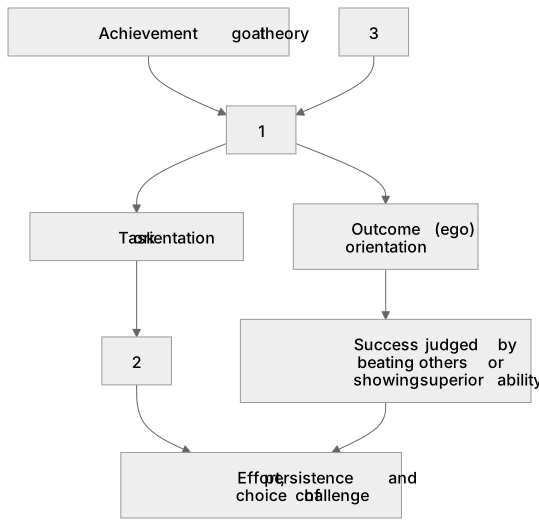
1Box 1
2Box 2
3Box 3
There is more to this lesson
The full lesson goes on to check your understanding and help you earn the marks. Create a free account to carry on, with your progress saved.
A week of Premium from your first lesson · Then the free plan continues · No card, no charge
Test your understanding of Achievement motivation theory: Achievement goal theory.
Active recall beats re-reading. Take an instant quiz now to test what you’ve learned and lock it into long-term memory.
A week of Premium from your first lesson · Then the free plan continues · No card, no charge