AQA · A-Level · Physical Education
Course version: 7582 · Version from Sept 2016
Impact of situational component of achievement motivation.
Full specification wording
Achievement motivation theory: Impact of situational component of achievement motivation.
Achievement motivation is not a fixed trait: the situation itself influences how strongly a performer seeks success or avoids failure.
Checked against the AQA 7582 specification (opens in a new tab) on .
- Point 4 of 8
- 4 key terms
Study notes
From the checked teaching notes for this specification point.
The idea
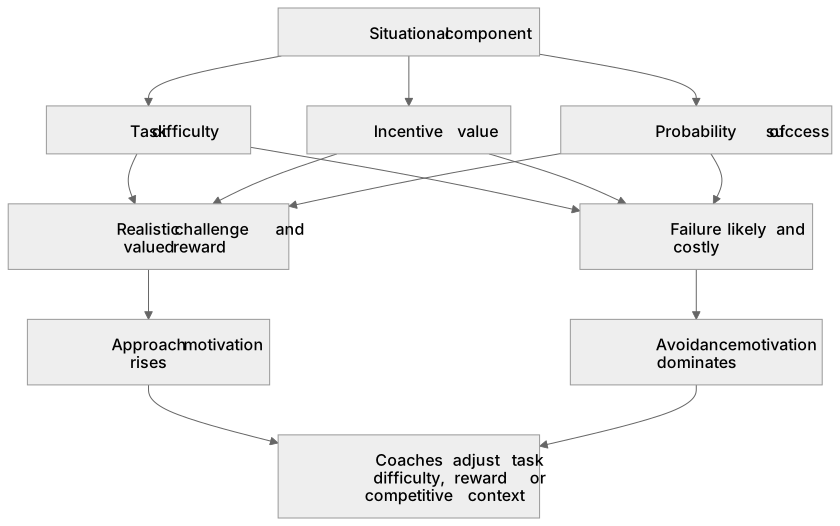
Achievement motivation is not a fixed trait: the situation itself influences how strongly a performer seeks success or avoids failure. The situational component covers factors such as the difficulty of the task, the incentive available and the probability of success. A footballer taking a penalty faces a high-pressure situation where the incentive (winning the match) is large but the probability of scoring is uncertain. If the situation offers a realistic challenge and valued reward, approach motivation rises; if failure is likely and costly, avoidance motivation dominates. Coaches can manipulate the situation by adjusting task difficulty, reward and competitive context to encourage approach behaviour. This explains why the same athlete may attack one contest and protect a lead in another.
What earns the marks
- The situational component refers to features of the environment or task that influence achievement motivation, such as task difficulty, incentive value and probability of success.
- A high incentive combined with a realistic probability of success tends to increase approach motivation (seeking success).
- A low probability of success combined with a high cost of failure tends to increase avoidance motivation (avoiding failure).
- Coaches and teachers can alter the situation by changing task difficulty, reward or competitive conditions to promote approach behaviour.
- The same performer may show different motivation in different situations, showing that achievement motivation is interactional rather than purely dispositional.
Common mistakes and how to put them right
Treating achievement motivation as a fixed personality trait.
Put it right by explaining that the situational component means the environment and task also shape motivation.
Assuming high incentive always increases effort.
Put it right by noting that if probability of success is very low, avoidance motivation may dominate instead.
Ignoring the interaction between the situational and personal components.
Put it right by stating that the situation is interpreted through the performer's own motives.
Confusing incentive value with probability of success.
Put it right by defining incentive as the attractiveness of the reward and probability as the perceived chance of achieving it.
Exam tips
- Define the situational component precisely before applying it to a sporting example.
- Use a named sport example to show how changing the situation changes approach or avoidance motivation.
- Link the situational component back to the wider achievement motivation theory rather than describing it in isolation.
Try the lesson
The start of the Achievement motivation theory: Impact of situational component of achievement motivation. lesson, made from checked teaching notes for this specification point.
Have a go first
In achievement motivation theory, which situational factor most directly raises a performer's motivation to approach a competitive task?
Listen
Achievement motivation is not a fixed trait: the situation itself influences how strongly a performer seeks success or avoids failure. The situational component covers factors such as the difficulty of the task, the incentive available and the probability of success. A footballer taking a penalty faces a high-pressure situation where the incentive (winning the match) is large but the probability of scoring is uncertain. If the situation offers a realistic challenge and valued reward, approach motivation rises; if failure is likely and costly, avoidance motivation dominates. Coaches can manipulate the situation by adjusting task difficulty, reward and competitive context to encourage approach behaviour. This explains why the same athlete may attack one contest and protect a lead in another. A strong answer earns marks for these points. The situational component refers to features of the environment or task that influence achievement motivation, such as task difficulty, incentive value and probability of success. A high incentive combined with a realistic probability of success tends to increase approach motivation (seeking success). A low probability of success combined with a high cost of failure tends to increase avoidance motivation (avoiding failure). Coaches and teachers can alter the situation by changing task difficulty, reward or competitive conditions to promote approach behaviour. A common slip: Treating achievement motivation as a fixed personality trait. Instead, explaining that the situational component means the environment and task also shape motivation. Exam tip: Define the situational component precisely before applying it to a sporting example.
See it
Key words
Say what each word means before you turn the card.
Situational component
Try answering aloud or in your head before turning the card.
Approach motivation
Try answering aloud or in your head before turning the card.
Avoidance motivation
Try answering aloud or in your head before turning the card.
Incentive value
Try answering aloud or in your head before turning the card.
See every definition
- Situational component
- Features of the environment or task, such as task difficulty, incentive value and probability of success, that influence achievement motivation.
- Approach motivation
- Seeking success, which rises when the situation offers a realistic challenge and valued reward.
- Avoidance motivation
- Avoiding failure, which dominates when failure is likely and costly.
- Incentive value
- The attractiveness of the reward available in the situation.
Label the diagram
Some boxes have lost their names. Pick the right name for each number.
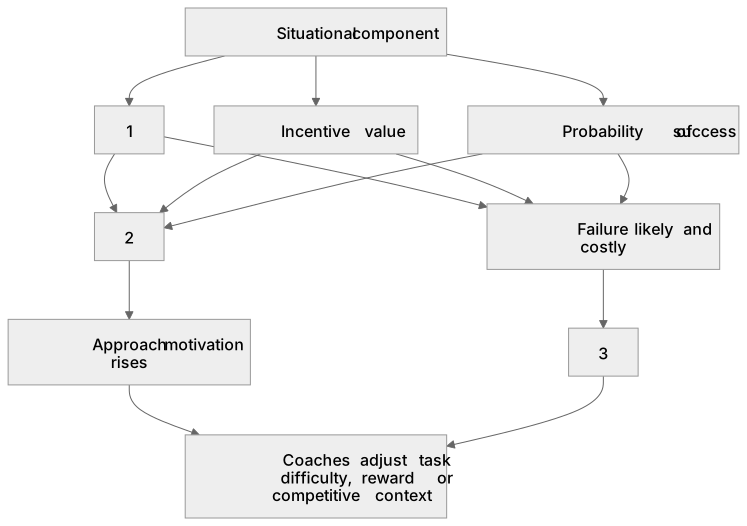
1Box 1
2Box 2
3Box 3
There is more to this lesson
The full lesson goes on to check your understanding and help you earn the marks. Create a free account to carry on, with your progress saved.
A week of Premium from your first lesson · Then the free plan continues · No card, no charge
Test your understanding of Achievement motivation theory: Impact of situational component of achievement motivation.
Active recall beats re-reading. Take an instant quiz now to test what you’ve learned and lock it into long-term memory.
A week of Premium from your first lesson · Then the free plan continues · No card, no charge