AQA · A-Level · Physical Education
Course version: 7582 · Version from Sept 2016
Need to achieve (Nach) and Need to avoid failure (Naf).
Full specification wording
Achievement motivation theory: Need to achieve (Nach) and Need to avoid failure (Naf).
Nach and Naf are the two opposing motives in achievement motivation theory.
Checked against the AQA 7582 specification (opens in a new tab) on .
- Point 3 of 8
- 2 key terms
Study notes
From the checked teaching notes for this specification point.
The idea
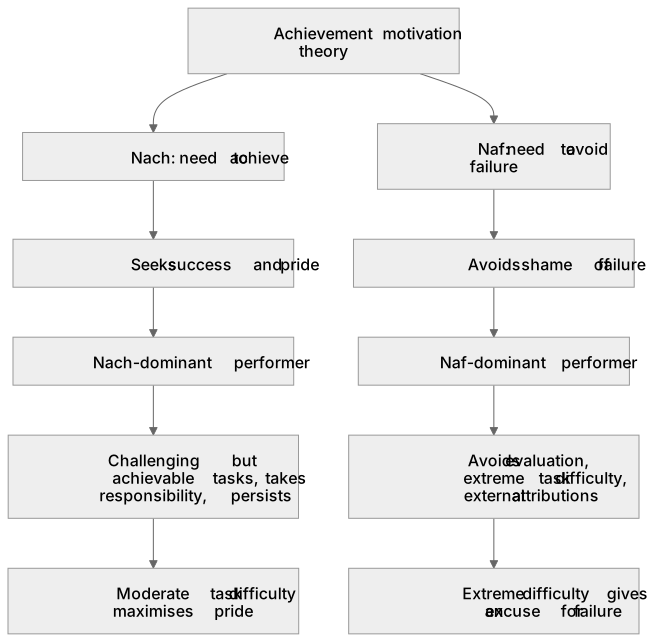
Nach and Naf are the two opposing motives in achievement motivation theory. Nach is the desire to succeed and to experience pride in accomplishment. Naf is the desire to avoid the shame of failure. Every performer holds both, but their relative strength predicts behaviour. A Nach-dominant performer selects challenging but achievable tasks, takes risks, accepts responsibility and persists after failure. A Naf-dominant performer avoids evaluation, chooses tasks that are very easy or impossibly hard, and attributes outcomes to external factors such as luck. Task difficulty matters: a moderately difficult task maximises the chance of pride for a Nach performer, while extreme difficulty gives a Naf performer an excuse for failure. Coaches can raise Nach by setting progressive challenges and rewarding effort.
What earns the marks
- Nach is the need to achieve, the motive to seek success and the pride it brings.
- Naf is the need to avoid failure, the motive to escape the shame of failing.
- Nach-dominant performers choose challenging tasks, take responsibility and persist.
- Naf-dominant performers avoid evaluation, choose extreme task difficulty and attribute outcomes externally.
- Task difficulty and coaching feedback can shift the balance between Nach and Naf.
Common mistakes and how to put them right
Treating Nach and Naf as separate personality types rather than two motives present in everyone.
Put it right by stating that their relative strength determines behaviour.
Assuming a Naf-dominant performer lacks ability.
Put it right by explaining that the motive affects task choice and persistence, not underlying skill.
Thinking easy tasks always suit high Nach performers.
Put it right by noting that moderate challenge maximises pride for Nach.
Confusing Naf with low self-confidence.
Put it right by defining it specifically as the motive to avoid the shame of failure.
Exam tips
- Use task-difficulty choice as your main behavioural indicator when distinguishing Nach from Naf.
- Explain attribution style, such as blaming luck or the referee, as evidence of Naf dominance.
- Apply the theory to a named sporting context so the motive is shown in action, not just defined.
Try the lesson
The start of the Achievement motivation theory: Need to achieve (Nach) and Need to avoid failure (Naf). lesson, made from checked teaching notes for this specification point.
Have a go first
In achievement motivation theory, what does the abbreviation Naf stand for?
Listen
Nach and Naf are the two opposing motives in achievement motivation theory. Nach is the desire to succeed and to experience pride in accomplishment. Naf is the desire to avoid the shame of failure. Every performer holds both, but their relative strength predicts behaviour. A Nach-dominant performer selects challenging but achievable tasks, takes risks, accepts responsibility and persists after failure. A Naf-dominant performer avoids evaluation, chooses tasks that are very easy or impossibly hard, and attributes outcomes to external factors such as luck. Task difficulty matters: a moderately difficult task maximises the chance of pride for a Nach performer, while extreme difficulty gives a Naf performer an excuse for failure. Coaches can raise Nach by setting progressive challenges and rewarding effort. A strong answer earns marks for these points. Nach is the need to achieve, the motive to seek success and the pride it brings. Naf is the need to avoid failure, the motive to escape the shame of failing. Nach-dominant performers choose challenging tasks, take responsibility and persist. Naf-dominant performers avoid evaluation, choose extreme task difficulty and attribute outcomes externally. A common slip: Treating Nach and Naf as separate personality types rather than two motives present in everyone. Instead, stating that their relative strength determines behaviour. Exam tip: Use task-difficulty choice as your main behavioural indicator when distinguishing Nach from Naf.
See it
Key words
Say what each word means before you turn the card.
Need to achieve
Try answering aloud or in your head before turning the card.
Need to avoid failure
Try answering aloud or in your head before turning the card.
See every definition
- Need to achieve
- The desire to succeed and to experience pride in accomplishment.
- Need to avoid failure
- The desire to avoid the shame of failure.
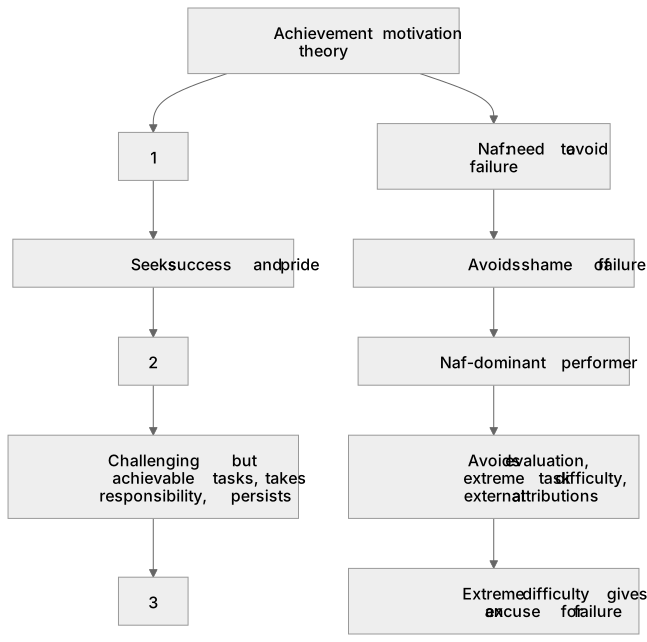
Label the diagram
Some boxes have lost their names. Pick the right name for each number.
1Box 1
2Box 2
3Box 3
There is more to this lesson
The full lesson goes on to check your understanding and help you earn the marks. Create a free account to carry on, with your progress saved.
A week of Premium from your first lesson · Then the free plan continues · No card, no charge
Test your understanding of Achievement motivation theory: Need to achieve (Nach) and Need to avoid failure (Naf).
Active recall beats re-reading. Take an instant quiz now to test what you’ve learned and lock it into long-term memory.
A week of Premium from your first lesson · Then the free plan continues · No card, no charge