AQA · A-Level · Physical Education
Course version: 7582 · Version from Sept 2016
Strategies to develop approach behaviours leading to improvements in…
Full specification wording
Achievement motivation theory: Strategies to develop approach behaviours leading to improvements in performance.
Achievement motivation theory distinguishes the motive to approach success from the motive to avoid failure.
Checked against the AQA 7582 specification (opens in a new tab) on .
- Point 8 of 8
- 4 key terms
Study notes
From the checked teaching notes for this specification point.
The idea
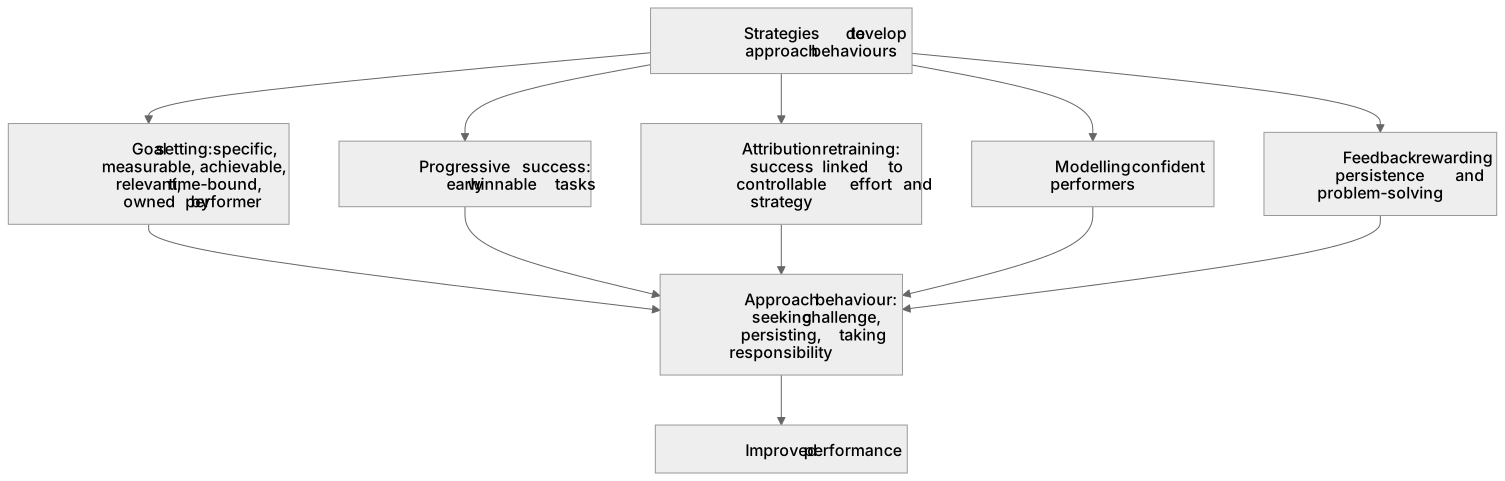
Achievement motivation theory distinguishes the motive to approach success from the motive to avoid failure. Approach behaviour means seeking challenging tasks, persisting after setbacks and taking personal responsibility for outcomes. Strategies to develop it include setting specific, measurable, achievable, relevant and time-bound goals that the performer owns; arranging progressive success so early tasks are winnable; attributing success to controllable effort and strategy rather than luck; modelling confident performers; and giving feedback that rewards persistence and problem-solving. For example, a coach might set a gymnast weekly process goals for a vault, record attempts, and review effort attributions after each session. Over time the performer chooses harder challenges, practises more, and performance improves.
What earns the marks
- Approach behaviour involves seeking challenging tasks, persisting and taking responsibility for outcomes.
- Achievement motivation theory contrasts the motive to approach success with the motive to avoid failure.
- Goal setting that is specific, measurable, achievable, relevant and time-bound, and owned by the performer, develops approach tendencies.
- Progressive success and early winnable tasks build confidence to attempt harder challenges.
- Attribution retraining that links success to controllable effort and strategy strengthens approach behaviour.
- Modelling and feedback that reward persistence and problem-solving encourage repeated approach behaviour.
- Sustained approach behaviour increases practice quality and persistence, which supports performance improvement.
Common mistakes and how to put them right
Treating approach behaviour as simply wanting to win.
Put it right: It is the tendency to seek challenge, persist and take responsibility, not just a desire for victory.
Assuming praise alone develops approach behaviour.
Put it right: Feedback must reward controllable effort and strategy, and goals must be owned by the performer.
Believing approach behaviour is fixed.
Put it right: It can be developed through goal setting, progressive success and attribution retraining.
Confusing approach behaviour with high ability.
Put it right: A less able performer can still show strong approach tendencies through persistence and task choice.
Exam tips
- Link each strategy to the mechanism it changes, such as confidence, attribution or task choice, rather than listing strategies.
- Use a short applied example, such as a swimmer setting weekly process goals, to show how approach behaviour leads to improved performance.
- Check the command word: if asked to explain, give the strategy and the resulting behaviour and performance effect in one chain.
Try the lesson
The start of the Achievement motivation theory: Strategies to develop approach behaviours leading to improvements in performance. lesson, made from checked teaching notes for this specification point.
Have a go first
In achievement motivation theory, which strategy is most likely to develop approach behaviours in a performer?
Listen
Achievement motivation theory distinguishes the motive to approach success from the motive to avoid failure. Approach behaviour means seeking challenging tasks, persisting after setbacks and taking personal responsibility for outcomes. Strategies to develop it include setting specific, measurable, achievable, relevant and time-bound goals that the performer owns; arranging progressive success so early tasks are winnable; attributing success to controllable effort and strategy rather than luck; modelling confident performers; and giving feedback that rewards persistence and problem-solving. For example, a coach might set a gymnast weekly process goals for a vault, record attempts, and review effort attributions after each session. Over time the performer chooses harder challenges, practises more, and performance improves. A strong answer earns marks for these points. Approach behaviour involves seeking challenging tasks, persisting and taking responsibility for outcomes. Achievement motivation theory contrasts the motive to approach success with the motive to avoid failure. Goal setting that is specific, measurable, achievable, relevant and time-bound, and owned by the performer, develops approach tendencies. Progressive success and early winnable tasks build confidence to attempt harder challenges. A common slip: Treating approach behaviour as simply wanting to win. Instead, it is the tendency to seek challenge, persist and take responsibility, not just a desire for victory. Exam tip: Link each strategy to the mechanism it changes, such as confidence, attribution or task choice, rather than listing strategies.
See it
Key words
Say what each word means before you turn the card.
Achievement motivation theory
Try answering aloud or in your head before turning the card.
Approach behaviour
Try answering aloud or in your head before turning the card.
Goal setting
Try answering aloud or in your head before turning the card.
Attribution
Try answering aloud or in your head before turning the card.
See every definition
- Achievement motivation theory
- Distinguishes the motive to approach success from the motive to avoid failure.
- Approach behaviour
- Seeking challenging tasks, persisting after setbacks and taking personal responsibility for outcomes.
- Goal setting
- Setting specific, measurable, achievable, relevant and time-bound goals that the performer owns develops approach tendencies.
- Attribution
- Attributing success to controllable effort and strategy rather than luck strengthens approach behaviour.
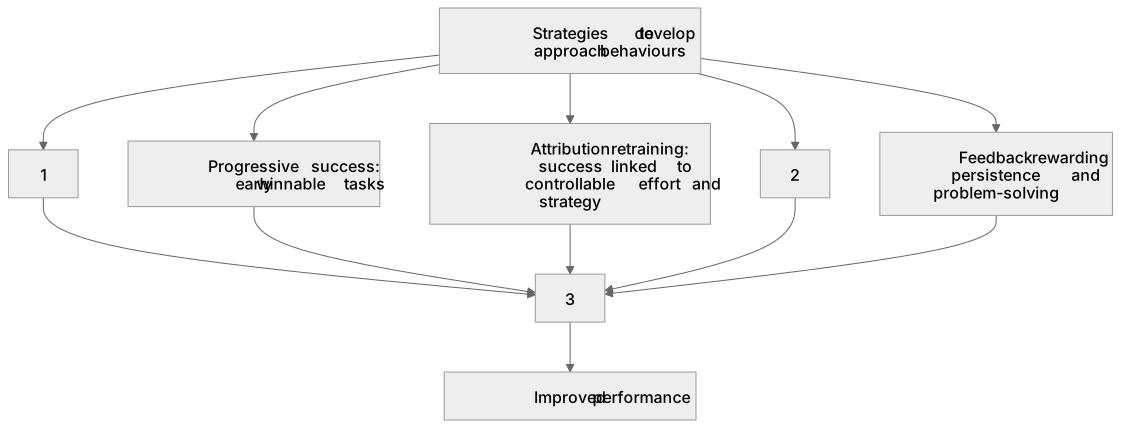
Label the diagram
Some boxes have lost their names. Pick the right name for each number.
1Box 1
2Box 2
3Box 3
There is more to this lesson
The full lesson goes on to check your understanding and help you earn the marks. Create a free account to carry on, with your progress saved.
A week of Premium from your first lesson · Then the free plan continues · No card, no charge
Test your understanding of Achievement motivation theory: Strategies to develop approach behaviours leading to improvements in performance.
Active recall beats re-reading. Take an instant quiz now to test what you’ve learned and lock it into long-term memory.
A week of Premium from your first lesson · Then the free plan continues · No card, no charge