AQA · A-Level · Physical Education
Course version: 7582 · Version from Sept 2016
Aggression: Difference between aggression and assertive behaviour.
In sport, distinguishing between aggression and assertive behaviour is crucial.
Checked against the AQA 7582 specification (opens in a new tab) on .
- Point 1 of 4
- 3 key terms
Study notes
From the checked teaching notes for this specification point.
The idea
In sport, distinguishing between aggression and assertive behaviour is crucial. Aggression involves an intent to harm another individual outside the rules of the game, such as a footballer deliberately punching an opponent. It is driven by anger and a desire to inflict injury. Conversely, assertive behaviour is goal-directed, strictly within the rules, and lacks the intent to harm, even if it involves high physical force. A rugby player executing a hard, legal tackle to stop a try is displaying assertion. The key differences lie in the intention behind the action, adherence to the rules, and the presence or absence of malicious intent.
What earns the marks
- Define aggression as behaviour with the primary intention to harm or injure another person.
- State that aggression occurs outside the established rules of the sport.
- Define assertive behaviour as forceful, goal-directed action that remains within the rules.
- Emphasise that assertive behaviour involves absolutely no intention to cause harm.
Common mistakes and how to put them right
Confusing high physical force with aggression.
Put it right: Understand that high physical force can be purely assertive if it is within the rules and lacks intent to harm.
Believing accidental injury is aggression.
Put it right: Recognise that aggression requires deliberate intent to harm; accidental injury during legal play is not aggression.
Using the terms aggression and assertion interchangeably.
Put it right: Clearly separate the two concepts based on intent to harm and adherence to the rules.
Exam tips
- Always use the phrase 'intent to harm' when defining aggression in an exam answer.
- Provide clear sporting examples that contrast an aggressive act with an assertive act in the same sport.
- Remember that assertion is goal-directed and rule-bound, whereas aggression is driven by anger and breaks the rules.
Try the lesson
The start of the Aggression: Difference between aggression and assertive behaviour. lesson, made from checked teaching notes for this specification point.
Have a go first
A hockey player deliberately swings her stick at an opponent's ankle to hurt her out of anger after losing the ball. Which term best describes this action?
Listen
In sport, distinguishing between aggression and assertive behaviour is crucial. Aggression involves an intent to harm another individual outside the rules of the game, such as a footballer deliberately punching an opponent. It is driven by anger and a desire to inflict injury. Conversely, assertive behaviour is goal-directed, strictly within the rules, and lacks the intent to harm, even if it involves high physical force. A rugby player executing a hard, legal tackle to stop a try is displaying assertion. The key differences lie in the intention behind the action, adherence to the rules, and the presence or absence of malicious intent. A strong answer earns marks for these points. Define aggression as behaviour with the primary intention to harm or injure another person. State that aggression occurs outside the established rules of the sport. Define assertive behaviour as forceful, goal-directed action that remains within the rules. Emphasise that assertive behaviour involves absolutely no intention to cause harm. A common slip: Confusing high physical force with aggression. Instead, Understand that high physical force can be purely assertive if it is within the rules and lacks intent to harm. Exam tip: Always use the phrase 'intent to harm' when defining aggression in an exam answer.
See it

Key words
Say what each word means before you turn the card.
Intent to harm
Try answering aloud or in your head before turning the card.
Rule adherence
Try answering aloud or in your head before turning the card.
Goal-directed behaviour
Try answering aloud or in your head before turning the card.
See every definition
- Intent to harm
- The primary intention to harm or injure another person, which defines aggression.
- Rule adherence
- Remaining within the established rules of the sport, as assertive behaviour does, whereas aggression occurs outside them.
- Goal-directed behaviour
- Forceful action that is directed towards a goal and remains within the rules, with no intention to cause harm.
Label the diagram
Some boxes have lost their names. Pick the right name for each number.
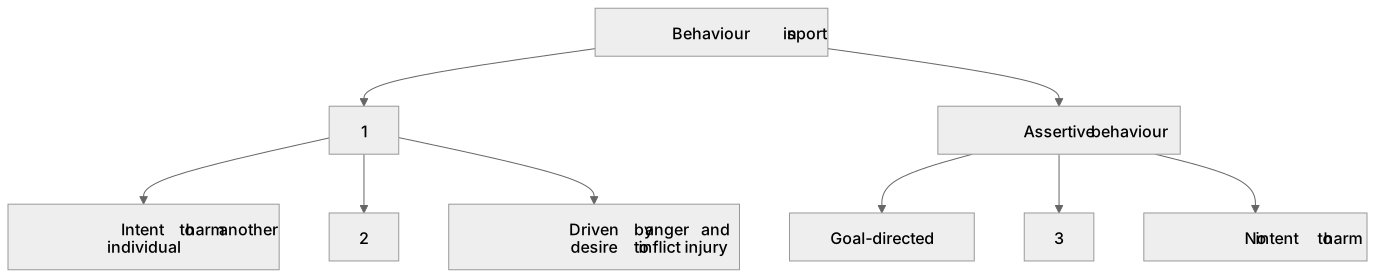
1Box 1
2Box 2
3Box 3
There is more to this lesson
The full lesson goes on to check your understanding and help you earn the marks. Create a free account to carry on, with your progress saved.
A week of Premium from your first lesson · Then the free plan continues · No card, no charge
Test your understanding of Aggression: Difference between aggression and assertive behaviour.
Active recall beats re-reading. Take an instant quiz now to test what you’ve learned and lock it into long-term memory.
A week of Premium from your first lesson · Then the free plan continues · No card, no charge