AQA · A-Level · Physical Education
Course version: 7582 · Version from Sept 2016
Aggression: Theories of aggression.
Aggression in sport is behaviour intended to harm another performer.
Checked against the AQA 7582 specification (opens in a new tab) on .
- Point 2 of 4
- 4 key terms
Study notes
From the checked teaching notes for this specification point.
The idea
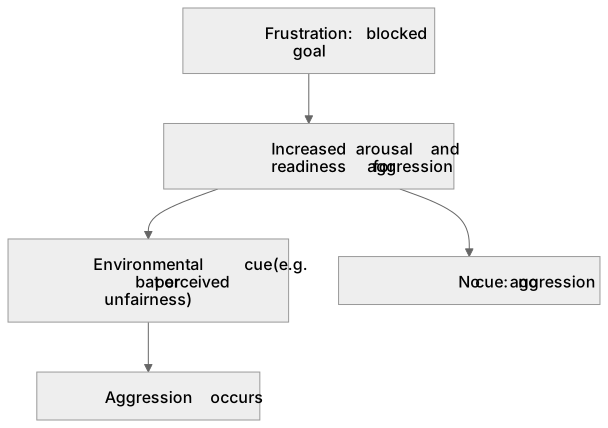
Aggression in sport is behaviour intended to harm another performer. AQA expects you to explain it through named psychological theories. Instinct theory treats aggression as innate, an inborn drive released by competition. The frustration-aggression hypothesis argues that blocked goals create frustration, which directly produces aggression. Social learning theory explains aggression as observed and imitated from role models, then reinforced by rewards. Berkowitz's aggressive cue theory modifies the frustration-aggression link: it states that frustration creates increased arousal and a readiness for aggression, but actual aggression only occurs if triggered by environmental cues, such as a bat or perceived unfairness. Apply each to a sporting example, for example a striker fouled near goal, and state the theory's limitation.
What earns the marks
- Instinct theory: aggression is innate and biologically driven, an inborn trait or drive that competition can release.
- Frustration-aggression hypothesis: a blocked goal creates frustration, and frustration directly produces aggression.
- Social learning theory: aggression is learned by observing and imitating role models, then maintained by reinforcement.
- Aggressive cue theory: frustration creates a readiness for aggression, which is then triggered by environmental cues (e.g., equipment or crowd noise).
- Application: link each theory to a specific sporting situation, such as a fouled striker or a provoked defender.
- Evaluation: identify a limitation, for example instinct theory struggles to explain why aggression varies between the same performer in different situations.
Common mistakes and how to put them right
Stating that aggressive cues trigger aggression without frustration.
Put it right: Aggressive cue theory requires frustration to create the readiness first, which the cue then triggers.
Treating aggression as identical to assertion.
Put it right: Assertion is goal-directed, within the rules and not intended to harm, whereas aggression is intended to harm.
Describing social learning theory as copying without reinforcement.
Put it right: Observation alone is not enough; the behaviour must be reinforced or rewarded to be repeated.
Exam tips
- Name the theory first, then state its mechanism in one sentence before applying it to a sport.
- For aggressive cue theory, explicitly mention both the frustration-induced readiness and the environmental trigger.
- Finish each explanation with a limitation to show evaluation rather than description.
Try the lesson
The start of the Aggression: Theories of aggression. lesson, made from checked teaching notes for this specification point.
Have a go first
Which theory proposes that aggression is an innate, biologically programmed drive that all humans possess from birth?
Listen
Aggression in sport is behaviour intended to harm another performer. AQA expects you to explain it through named psychological theories. Instinct theory treats aggression as innate, an inborn drive released by competition. The frustration-aggression hypothesis argues that blocked goals create frustration, which directly produces aggression. Social learning theory explains aggression as observed and imitated from role models, then reinforced by rewards. Berkowitz's aggressive cue theory modifies the frustration-aggression link: it states that frustration creates increased arousal and a readiness for aggression, but actual aggression only occurs if triggered by environmental cues, such as a bat or perceived unfairness. Apply each to a sporting example, for example a striker fouled near goal, and state the theory's limitation. A strong answer earns marks for these points. Instinct theory: aggression is innate and biologically driven, an inborn trait or drive that competition can release. Frustration-aggression hypothesis: a blocked goal creates frustration, and frustration directly produces aggression. Social learning theory: aggression is learned by observing and imitating role models, then maintained by reinforcement. Aggressive cue theory: frustration creates a readiness for aggression, which is then triggered by environmental cues (e.g., equipment or crowd noise). Exam tip: Name the theory first, then state its mechanism in one sentence before applying it to a sport.
See it
Key words
Say what each word means before you turn the card.
Instinct theory
Try answering aloud or in your head before turning the card.
Frustration-aggression hypothesis
Try answering aloud or in your head before turning the card.
Social learning theory
Try answering aloud or in your head before turning the card.
Aggressive cue theory
Try answering aloud or in your head before turning the card.
See every definition
- Instinct theory
- Aggression is innate and biologically driven, an inborn trait or drive that competition can release.
- Frustration-aggression hypothesis
- A blocked goal creates frustration, and frustration directly produces aggression.
- Social learning theory
- Aggression is learned by observing and imitating role models, then maintained by reinforcement.
- Aggressive cue theory
- Frustration creates a readiness for aggression, which is then triggered by environmental cues.
Label the diagram
Some boxes have lost their names. Pick the right name for each number.
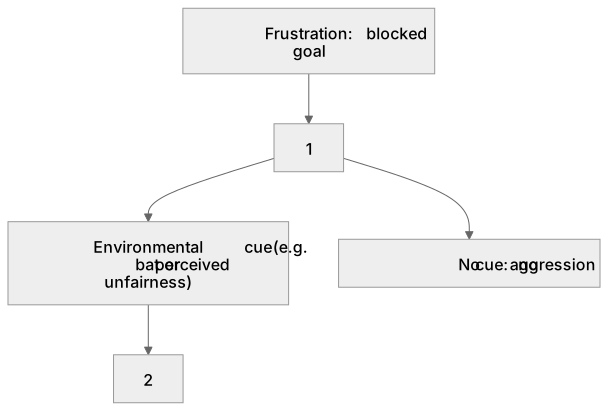
1Box 1
2Box 2
There is more to this lesson
The full lesson goes on to check your understanding and help you earn the marks. Create a free account to carry on, with your progress saved.
A week of Premium from your first lesson · Then the free plan continues · No card, no charge
Test your understanding of Aggression: Theories of aggression.
Active recall beats re-reading. Take an instant quiz now to test what you’ve learned and lock it into long-term memory.
A week of Premium from your first lesson · Then the free plan continues · No card, no charge