AQA · A-Level · Physical Education
Course version: 7582 · Version from Sept 2016
Angular displacement, angular velocity, angular acceleration.
Full specification wording
Angular motion: Angular displacement, angular velocity, angular acceleration.
These three quantities form a chain of rates.
Checked against the AQA 7582 specification (opens in a new tab) on .
- Point 3 of 4
- 4 key terms
Study notes
From the checked teaching notes for this specification point.
The idea
These three quantities form a chain of rates. Angular displacement θ is the angle turned about an axis, in radians. Angular velocity ω is how fast that angle changes, ω = Δθ/Δt, in rad s⁻¹. Angular acceleration α is how fast angular velocity changes, α = Δω/Δt, in rad s⁻². For a trampolinist completing a somersault, θ might be 2π rad for one rotation; dividing by the time of the rotation gives ω; if ω changes from 0 to that value during take-off, dividing by the take-off time gives α. A negative value shows rotation or change of rotation in the opposite direction to the chosen positive sense. In multiple-choice items, check the units and the direction sign before choosing.
What earns the marks
- Angular displacement θ is the angle turned about an axis, measured in radians.
- Angular velocity ω = Δθ/Δt is the rate of change of angular displacement, measured in rad s⁻¹.
- Angular acceleration α = Δω/Δt is the rate of change of angular velocity, measured in rad s⁻².
- A change in angular velocity over time produces angular acceleration, including when a rotating body slows down.
- The sign of an angular quantity indicates the direction of rotation relative to a chosen positive sense.
- Calculations require consistent radian measure and a stated axis of rotation.
Common mistakes and how to put them right
Treating angular displacement as a linear distance.
Put it right: θ is an angle in radians.
Assuming angular acceleration only occurs when a body speeds up.
Put it right: Any change in ω over time, including slowing, is angular acceleration.
Dividing degrees by seconds and labelling the answer rad s⁻¹.
Put it right: Convert to radians first, then divide by time.
Ignoring the sign of ω or α.
Put it right: State the positive sense and keep signs consistent.
Exam tips
- Write the defining equation before substituting values, so the quantity being found is clear.
- Convert all angles to radians at the start of a calculation to avoid unit errors.
- Use the sign of the answer to describe direction, and state the positive sense you have chosen.
Try the lesson
The start of the Angular motion: Angular displacement, angular velocity, angular acceleration. lesson, made from checked teaching notes for this specification point.
Have a go first
A gymnast rotates through 90° during a swing on the high bar. What is this angular displacement expressed in radians?
Listen
These three quantities form a chain of rates. Angular displacement θ is the angle turned about an axis, in radians. Angular velocity ω is how fast that angle changes, ω = Δθ/Δt, in rad s⁻¹. Angular acceleration α is how fast angular velocity changes, α = Δω/Δt, in rad s⁻². For a trampolinist completing a somersault, θ might be 2π rad for one rotation; dividing by the time of the rotation gives ω; if ω changes from 0 to that value during take-off, dividing by the take-off time gives α. A negative value shows rotation or change of rotation in the opposite direction to the chosen positive sense. In multiple-choice items, check the units and the direction sign before choosing. A strong answer earns marks for these points. Angular displacement θ is the angle turned about an axis, measured in radians. Angular velocity ω = Δθ/Δt is the rate of change of angular displacement, measured in rad s⁻¹. Angular acceleration α = Δω/Δt is the rate of change of angular velocity, measured in rad s⁻². A change in angular velocity over time produces angular acceleration, including when a rotating body slows down. A common slip: Treating angular displacement as a linear distance: the error is giving metres for a rotation. Instead, θ is an angle in radians. Exam tip: Write the defining equation before substituting values, so the quantity being found is clear.
See it
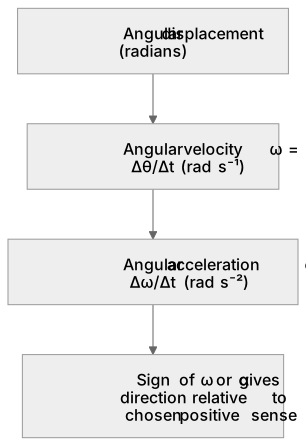
Put it in order
Put these steps in the order they happen.
- 1. Angular acceleration α = Δω/Δt (rad s⁻²)
- 2. Sign of ω or α gives direction relative to chosen positive sense
- 3. Angular velocity ω = Δθ/Δt (rad s⁻¹)
- 4. Angular displacement θ (radians)
Key words
Say what each word means before you turn the card.
Angular displacement
Try answering aloud or in your head before turning the card.
Angular velocity
Try answering aloud or in your head before turning the card.
Angular acceleration
Try answering aloud or in your head before turning the card.
Sign of an angular quantity
Try answering aloud or in your head before turning the card.
See every definition
- Angular displacement
- The angle turned about an axis, measured in radians.
- Angular velocity
- The rate of change of angular displacement, ω = Δθ/Δt, measured in rad s⁻¹.
- Angular acceleration
- The rate of change of angular velocity, α = Δω/Δt, measured in rad s⁻².
- Sign of an angular quantity
- Indicates the direction of rotation relative to a chosen positive sense.
Label the diagram
Some boxes have lost their names. Pick the right name for each number.
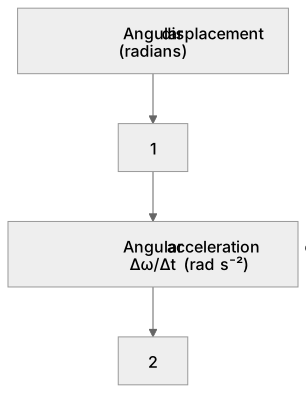
1Box 1
2Box 2
There is more to this lesson
The full lesson goes on to check your understanding and help you earn the marks. Create a free account to carry on, with your progress saved.
A week of Premium from your first lesson · Then the free plan continues · No card, no charge
Test your understanding of Angular motion: Angular displacement, angular velocity, angular acceleration.
Active recall beats re-reading. Take an instant quiz now to test what you’ve learned and lock it into long-term memory.
A week of Premium from your first lesson · Then the free plan continues · No card, no charge