AQA · A-Level · Physical Education
Course version: 7582 · Version from Sept 2016
Angular motion: Definitions and units for angular motion.
Angular motion describes rotation about an axis, so every quantity is defined relative to that axis.
Checked against the AQA 7582 specification (opens in a new tab) on .
- Point 2 of 4
- 4 key terms
Study notes
From the checked teaching notes for this specification point.
The idea
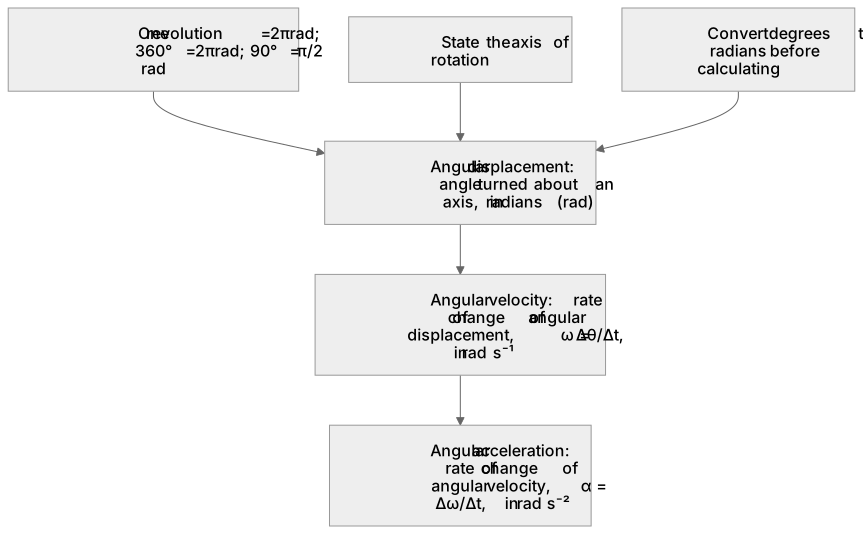
Angular motion describes rotation about an axis, so every quantity is defined relative to that axis. Angular displacement is the angle through which a body turns, measured in radians (rad); one full revolution is 2π rad, so 360° equals 2π rad and 90° equals π/2 rad. Angular velocity is the rate of change of angular displacement, ω = Δθ/Δt, with unit rad s⁻¹. Angular acceleration is the rate of change of angular velocity, α = Δω/Δt, with unit rad s⁻². Because radians are dimensionless, the units reduce to s⁻¹ and s⁻². A gymnast's giant circle on a bar, a diver's somersault and a cyclist's pedal crank all rotate about an axis, so these definitions apply. Always state the axis and convert degrees to radians before calculating.
What earns the marks
- Angular displacement is the angle turned about an axis, measured in radians (rad).
- Angular velocity is the rate of change of angular displacement, ω = Δθ/Δt, measured in rad s⁻¹.
- Angular acceleration is the rate of change of angular velocity, α = Δω/Δt, measured in rad s⁻².
- One complete revolution equals 2π rad, so 360° = 2π rad and 90° = π/2 rad.
- Radians are dimensionless, so rad s⁻¹ simplifies to s⁻¹ and rad s⁻² simplifies to s⁻².
- Angular quantities must be defined about a stated axis of rotation.
Common mistakes and how to put them right
Using degrees per second instead of radians per second.
Put it right: Convert every angle to radians before dividing by time.
Confusing angular velocity with linear velocity.
Put it right: Note that ω is measured in rad s⁻¹ while v is measured in m s⁻¹ and depends on radius.
Writing the unit of angular acceleration as rad s⁻¹.
Put it right: Rad s⁻² because angular velocity changes per second.
Forgetting to state the axis.
Put it right: Name the axis, such as the bar for a gymnast's giant circle.
Exam tips
- Convert degrees to radians first: multiply by π/180, so 180° becomes π rad and 270° becomes 3π/2 rad.
- Check units by cancelling: rad s⁻¹ divided by s gives rad s⁻², confirming angular acceleration.
- In multiple-choice questions, eliminate options with wrong units before doing any calculation.
Try the lesson
The start of the Angular motion: Definitions and units for angular motion. lesson, made from checked teaching notes for this specification point.
Have a go first
Which of the following is the correct standard unit for angular velocity in biomechanics?
Listen
Angular motion describes rotation about an axis, so every quantity is defined relative to that axis. Angular displacement is the angle through which a body turns, measured in radians (rad); one full revolution is 2π rad, so 360° equals 2π rad and 90° equals π/2 rad. Angular velocity is the rate of change of angular displacement, ω = Δθ/Δt, with unit rad s⁻¹. Angular acceleration is the rate of change of angular velocity, α = Δω/Δt, with unit rad s⁻². Because radians are dimensionless, the units reduce to s⁻¹ and s⁻². A gymnast's giant circle on a bar, a diver's somersault and a cyclist's pedal crank all rotate about an axis, so these definitions apply. Always state the axis and convert degrees to radians before calculating. A strong answer earns marks for these points. Angular displacement is the angle turned about an axis, measured in radians (rad). Angular velocity is the rate of change of angular displacement, ω = Δθ/Δt, measured in rad s⁻¹. Angular acceleration is the rate of change of angular velocity, α = Δω/Δt, measured in rad s⁻². One complete revolution equals 2π rad, so 360° = 2π rad and 90° = π/2 rad. A common slip: Using degrees per second instead of radians per second: the error is mixing degree and radian measures. Instead, convert every angle to radians before dividing by time. Exam tip: Convert degrees to radians first: multiply by π/180, so 180° becomes π rad and 270° becomes 3π/2 rad.
See it
Key words
Say what each word means before you turn the card.
Rotation about an axis
Try answering aloud or in your head before turning the card.
Radian measure
Try answering aloud or in your head before turning the card.
Rate of change of angular displacement
Try answering aloud or in your head before turning the card.
Rate of change of angular velocity
Try answering aloud or in your head before turning the card.
See every definition
- Rotation about an axis
- Angular motion describes this, so every quantity is defined relative to that axis.
- Radian measure
- The angle through which a body turns is measured in radians (rad), where one full revolution is 2π rad.
- Rate of change of angular displacement
- Angular velocity, ω = Δθ/Δt, with unit rad s⁻¹.
- Rate of change of angular velocity
- Angular acceleration, α = Δω/Δt, with unit rad s⁻².
Label the diagram
Some boxes have lost their names. Pick the right name for each number.
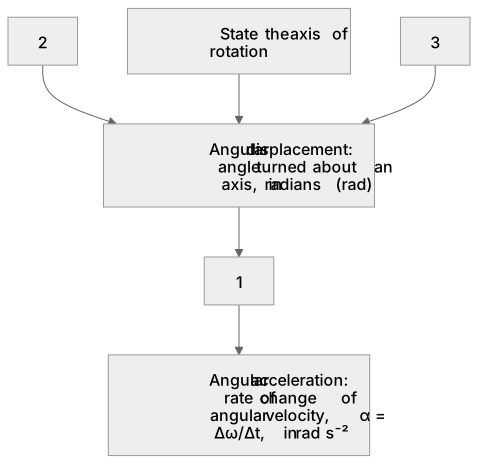
1Box 1
2Box 2
3Box 3
There is more to this lesson
The full lesson goes on to check your understanding and help you earn the marks. Create a free account to carry on, with your progress saved.
A week of Premium from your first lesson · Then the free plan continues · No card, no charge
Test your understanding of Angular motion: Definitions and units for angular motion.
Active recall beats re-reading. Take an instant quiz now to test what you’ve learned and lock it into long-term memory.
A week of Premium from your first lesson · Then the free plan continues · No card, no charge