AQA · A-Level · Physical Education
Course version: 7582 · Version from Sept 2016
Anxiety: Somatic, cognitive, competitive trait and competitive state.
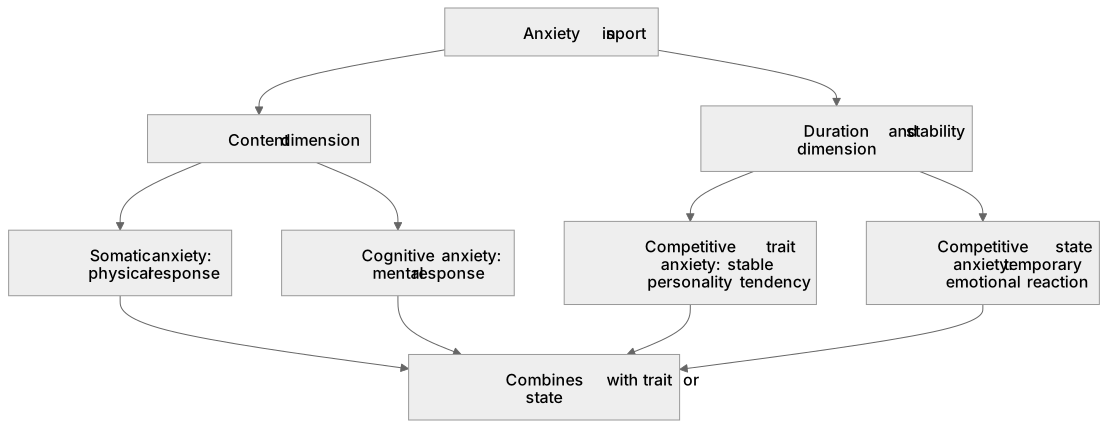
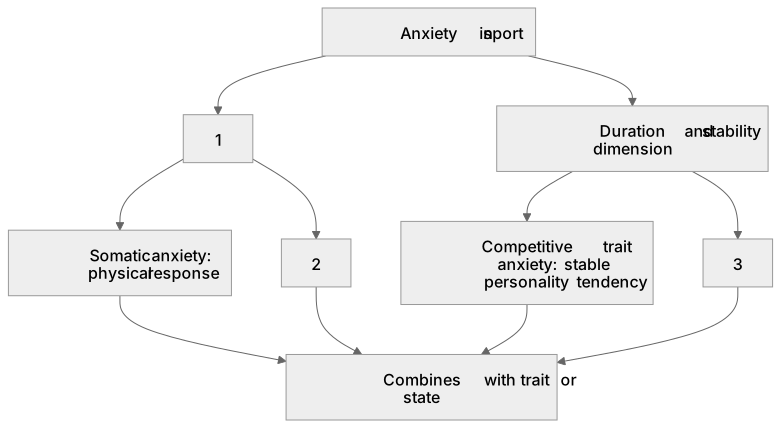
Anxiety in sport is classified along two dimensions.
Checked against the AQA 7582 specification (opens in a new tab) on .
- Point 2 of 2
- 4 key terms
Study notes
From the checked teaching notes for this specification point.
The idea
Anxiety in sport is classified along two dimensions. The first is content: somatic anxiety is the physical response, including raised heart rate, sweating, trembling, muscle tension and butterflies; cognitive anxiety is the mental response, including worry, negative thoughts, fear of failure and narrowed attention. The second is duration and stability: competitive trait anxiety is a stable personality tendency to perceive competitive situations as threatening, so a performer high in it tends to feel anxious across many competitions; competitive state anxiety is the temporary emotional reaction to a particular moment, such as the minutes before a specific final. A performer can be high in trait anxiety yet experience low state anxiety on a given day, and the four labels combine, for example cognitive state anxiety before one match.
What earns the marks
- Somatic anxiety is the physical response, such as raised heart rate, sweating, trembling and muscle tension.
- Cognitive anxiety is the mental response, such as worry, negative thoughts, fear of failure and narrowed attention.
- Competitive trait anxiety is a stable personality tendency to perceive competitive situations as threatening.
- Competitive state anxiety is a temporary emotional reaction to a specific competitive situation.
- Trait anxiety raises the likelihood of state anxiety, but the two do not always rise and fall together.
- The content and duration dimensions combine, so a performer can show cognitive state anxiety before one particular match.
Common mistakes and how to put them right
Reversing the somatic and cognitive labels.
Put it right: Somatic refers to the physical signs, while cognitive refers to the worrying thoughts.
Confusing trait and state anxiety.
Put it right: Trait anxiety is a stable personality tendency, whereas state anxiety is a temporary reaction to a specific situation.
Assuming a highly trait-anxious performer must always be state-anxious.
Put it right: Trait anxiety raises the likelihood but does not fix the reaction on a given day.
Treating the four labels as mutually exclusive.
Put it right: They combine, so cognitive state anxiety is a valid and common description.
Exam tips
- Use a two-step check: first decide whether the sign is physical or mental, then decide whether it is a lasting tendency or a reaction to this event.
- Attach each label to a concrete moment, such as a gymnast's trembling hands on the beam for somatic state anxiety.
- In multiple-choice questions, eliminate options that swap the somatic and cognitive terms before comparing the trait and state options.
Try the lesson
The start of the Anxiety: Somatic, cognitive, competitive trait and competitive state. lesson, made from checked teaching notes for this specification point.
Have a go first
A gymnast feels her heart pounding and her palms sweating just before she steps onto the beam. Which specific component of anxiety do these physical symptoms represent?
Listen
Anxiety in sport is classified along two dimensions. The first is content: somatic anxiety is the physical response, including raised heart rate, sweating, trembling, muscle tension and butterflies; cognitive anxiety is the mental response, including worry, negative thoughts, fear of failure and narrowed attention. The second is duration and stability: competitive trait anxiety is a stable personality tendency to perceive competitive situations as threatening, so a performer high in it tends to feel anxious across many competitions; competitive state anxiety is the temporary emotional reaction to a particular moment, such as the minutes before a specific final. A performer can be high in trait anxiety yet experience low state anxiety on a given day, and the four labels combine, for example cognitive state anxiety before one match. A strong answer earns marks for these points. Somatic anxiety is the physical response, such as raised heart rate, sweating, trembling and muscle tension. Cognitive anxiety is the mental response, such as worry, negative thoughts, fear of failure and narrowed attention. Competitive trait anxiety is a stable personality tendency to perceive competitive situations as threatening. Competitive state anxiety is a temporary emotional reaction to a specific competitive situation. Exam tip: Use a two-step check: first decide whether the sign is physical or mental, then decide whether it is a lasting tendency or a reaction to this event.
See it
Key words
Say what each word means before you turn the card.
Somatic anxiety
Try answering aloud or in your head before turning the card.
Cognitive anxiety
Try answering aloud or in your head before turning the card.
Competitive trait anxiety
Try answering aloud or in your head before turning the card.
Competitive state anxiety
Try answering aloud or in your head before turning the card.
See every definition
- Somatic anxiety
- The physical response, including raised heart rate, sweating, trembling, muscle tension and butterflies.
- Cognitive anxiety
- The mental response, including worry, negative thoughts, fear of failure and narrowed attention.
- Competitive trait anxiety
- A stable personality tendency to perceive competitive situations as threatening, so a performer high in it tends to feel anxious across many competitions.
- Competitive state anxiety
- The temporary emotional reaction to a particular moment, such as the minutes before a specific final.
Label the diagram
Some boxes have lost their names. Pick the right name for each number.
1Box 1
2Box 2
3Box 3
There is more to this lesson
The full lesson goes on to check your understanding and help you earn the marks. Create a free account to carry on, with your progress saved.
A week of Premium from your first lesson · Then the free plan continues · No card, no charge
Test your understanding of Anxiety: Somatic, cognitive, competitive trait and competitive state.
Active recall beats re-reading. Take an instant quiz now to test what you’ve learned and lock it into long-term memory.
A week of Premium from your first lesson · Then the free plan continues · No card, no charge