AQA · A-Level · Physical Education
Course version: 7582 · Version from Sept 2016
Anxiety: Types of anxiety.
Anxiety is a negative emotional state of apprehension and worry, experienced when a performer perceives a situation as threatening.
Checked against the AQA 7582 specification (opens in a new tab) on .
- Point 1 of 2
- 4 key terms
Study notes
From the checked teaching notes for this specification point.
The idea
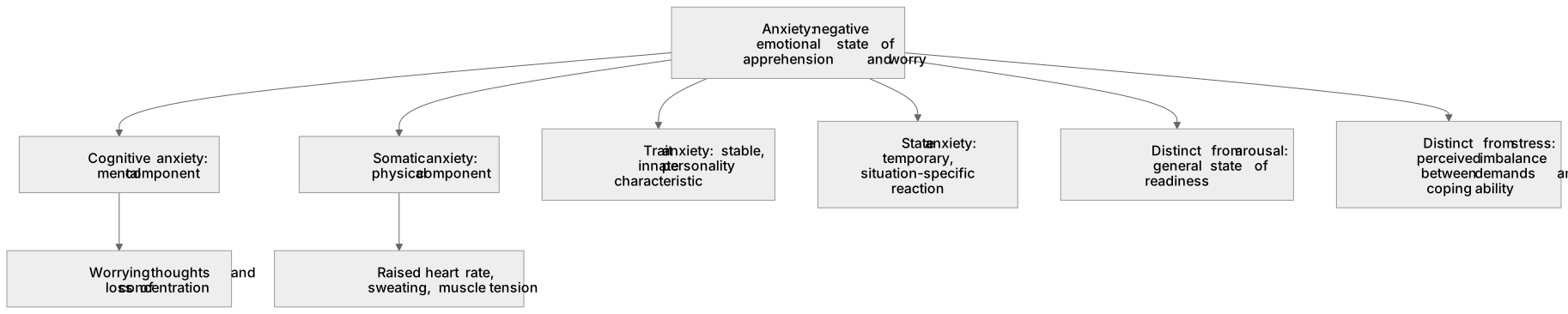
Anxiety is a negative emotional state of apprehension and worry, experienced when a performer perceives a situation as threatening. It is distinct from arousal, a general state of readiness, and stress, the perceived imbalance between demands and coping ability. AQA requires specific terminology to classify anxiety. Cognitive anxiety is the mental component, involving worrying thoughts and loss of concentration. Somatic anxiety is the physical component, characterised by a raised heart rate, sweating, and muscle tension. Anxiety is also classified by its duration and trigger: trait anxiety is a stable, innate personality characteristic where a person is generally prone to anxiety, whereas state anxiety is a temporary, situation-specific emotional reaction to a particular competitive moment.
What earns the marks
- Defines anxiety as a negative emotional state linked to apprehension and worry about a perceived threat.
- Distinguishes cognitive anxiety as the mental component, such as worrying thoughts and reduced concentration.
- Distinguishes somatic anxiety as the physical component, such as increased heart rate, sweating, and muscle tension.
- Defines trait anxiety as a stable, enduring personality characteristic predisposing a performer to worry.
- Defines state anxiety as a temporary, situation-specific reaction to a particular competitive event.
- Differentiates anxiety from arousal (general readiness) and stress (imbalance between demands and ability).
Common mistakes and how to put them right
Using everyday terms instead of A-Level terminology.
Put it right: Use 'cognitive' for mental symptoms and 'somatic' for physical symptoms.
Confusing trait and state anxiety.
Put it right: Trait is a permanent personality feature, while state is a temporary reaction to a specific situation.
Treating anxiety and arousal as identical.
Put it right: Arousal is general readiness or intensity, while anxiety is a negative emotional state.
Exam tips
- Learn a one-line definition for cognitive, somatic, trait, and state anxiety.
- For each type of anxiety, prepare a short scenario, such as a penalty taker before a shoot-out experiencing state and somatic anxiety.
- When a question asks you to identify a type of anxiety, check whether the scenario describes a stable personal tendency (trait) or a reaction to one specific event (state).
Try the lesson
The start of the Anxiety: Types of anxiety. lesson, made from checked teaching notes for this specification point.
Have a go first
A gymnast feels a churning stomach and sweaty palms before a routine. Which type of anxiety do these feelings represent?
Listen
Anxiety is a negative emotional state of apprehension and worry, experienced when a performer perceives a situation as threatening. It is distinct from arousal, a general state of readiness, and stress, the perceived imbalance between demands and coping ability. AQA requires specific terminology to classify anxiety. Cognitive anxiety is the mental component, involving worrying thoughts and loss of concentration. Somatic anxiety is the physical component, characterised by a raised heart rate, sweating, and muscle tension. Anxiety is also classified by its duration and trigger: trait anxiety is a stable, innate personality characteristic where a person is generally prone to anxiety, whereas state anxiety is a temporary, situation-specific emotional reaction to a particular competitive moment. A strong answer earns marks for these points. Defines anxiety as a negative emotional state linked to apprehension and worry about a perceived threat. Distinguishes cognitive anxiety as the mental component, such as worrying thoughts and reduced concentration. Distinguishes somatic anxiety as the physical component, such as increased heart rate, sweating, and muscle tension. Defines trait anxiety as a stable, enduring personality characteristic predisposing a performer to worry. Exam tip: Learn a one-line definition for cognitive, somatic, trait, and state anxiety.
See it
Key words
Say what each word means before you turn the card.
Cognitive and somatic anxiety
Try answering aloud or in your head before turning the card.
Trait and state anxiety
Try answering aloud or in your head before turning the card.
Distinction between anxiety, arousal, and stress
Try answering aloud or in your head before turning the card.
Application to sporting scenarios
Try answering aloud or in your head before turning the card.
See every definition
- Cognitive and somatic anxiety
- Cognitive anxiety is the mental component, involving worrying thoughts and loss of concentration, while somatic anxiety is the physical component, characterised by a raised heart rate, sweating, and muscle tension.
- Trait and state anxiety
- Trait anxiety is a stable, innate personality characteristic where a person is generally prone to anxiety, whereas state anxiety is a temporary, situation-specific emotional reaction to a particular competitive moment.
- Distinction between anxiety, arousal, and stress
- Anxiety is a negative emotional state of apprehension and worry, distinct from arousal, a general state of readiness, and stress, the perceived imbalance between demands and coping ability.
- Application to sporting scenarios
- A performer may experience state and somatic anxiety in a particular competitive moment, such as a penalty taker before a shoot-out.
Label the diagram
Some boxes have lost their names. Pick the right name for each number.
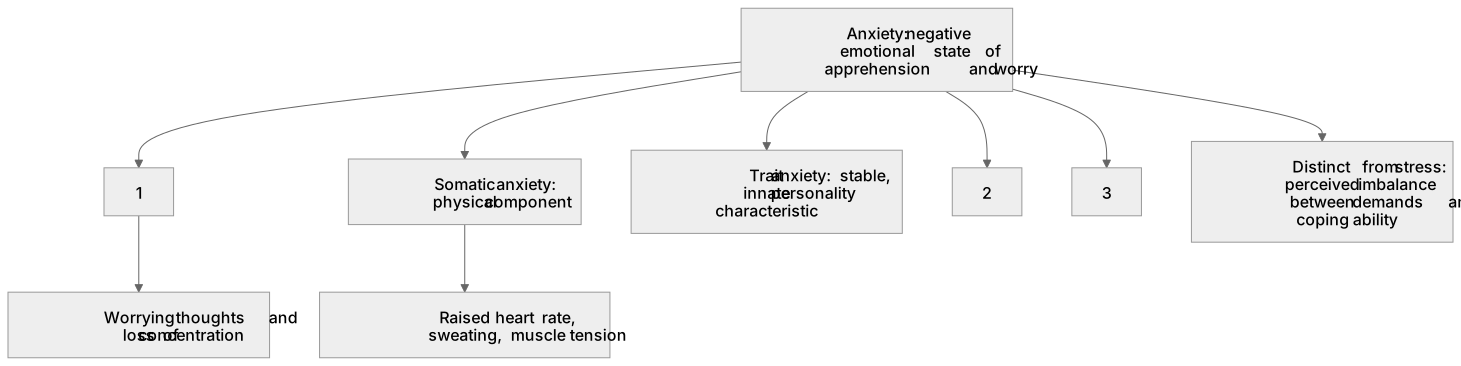
1Box 1
2Box 2
3Box 3
There is more to this lesson
The full lesson goes on to check your understanding and help you earn the marks. Create a free account to carry on, with your progress saved.
A week of Premium from your first lesson · Then the free plan continues · No card, no charge
Test your understanding of Anxiety: Types of anxiety.
Active recall beats re-reading. Take an instant quiz now to test what you’ve learned and lock it into long-term memory.
A week of Premium from your first lesson · Then the free plan continues · No card, no charge