AQA · A-Level · Physical Education
Course version: 7582 · Version from Sept 2016
Drive theory, inverted U theory, catastrophe theory and zone of optimal…
Full specification wording
Arousal: Drive theory, inverted U theory, catastrophe theory and zone of optimal functioning theory.
These four theories explain how arousal links to performance.
Checked against the AQA 7582 specification (opens in a new tab) on .
- Point 2 of 3
- 4 key terms
Study notes
From the checked teaching notes for this specification point.
The idea
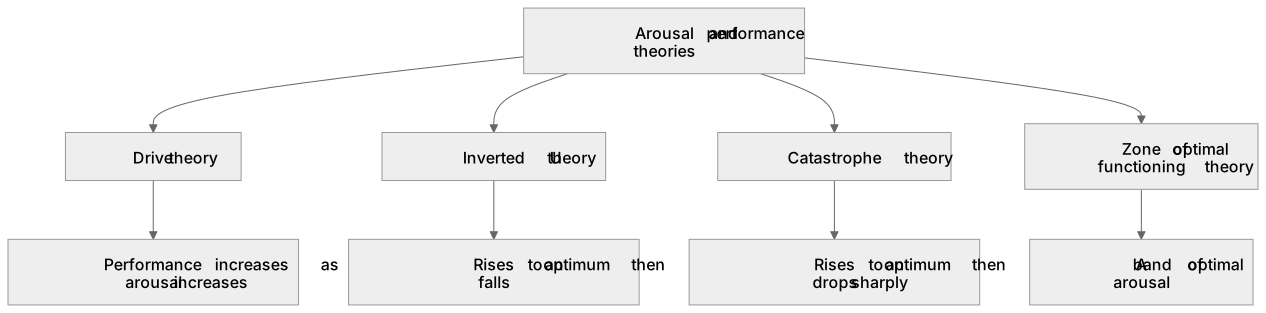
These four theories explain how arousal links to performance. Drive theory says performance rises with arousal because the dominant response strengthens; it fits simple or well-learned skills. Inverted U theory says performance improves to an optimum then declines, with the optimum shifting by task and performer. Catastrophe theory says performance rises to an optimum then collapses suddenly, and recovery is slow unless arousal drops far below the optimum. Zone of optimal functioning theory says each performer has a band of arousal, not one point, in which performance is best. Learn each claim, its shape and its limitation so you can select the right theory for a scenario.
What earns the marks
- Drive theory: performance increases as arousal increases because the dominant response is strengthened; it suits simple or well-learned skills.
- Inverted U theory: performance rises to an optimum arousal then falls, producing an inverted U relationship.
- In inverted U theory the optimum shifts with task type and individual, so fine skills usually need lower arousal than gross skills.
- Catastrophe theory: performance improves to an optimum then drops sharply, and returning to the optimum is difficult once the collapse has occurred.
- Zone of optimal functioning theory: each performer has a range or band of optimal arousal rather than a single ideal point.
- Comparing theories: drive theory is linear, inverted U is a smooth curve, catastrophe theory has a sudden drop, and zone of optimal functioning theory uses a band.
Common mistakes and how to put them right
Saying drive theory predicts a curve.
Put it right: Drive theory predicts a straight-line increase in performance with arousal.
Claiming catastrophe theory declines smoothly.
Put it right: The drop after the optimum is sudden and severe.
Treating the zone of optimal functioning as one fixed point.
Put it right: It is a band of arousal that varies between performers.
Applying inverted U theory identically to all skills.
Put it right: The optimum arousal level depends on whether the skill is fine or gross and on the individual.
Exam tips
- Build a comparison table with columns for claim, shape of graph and best-fit example for each theory.
- In scenario questions, name the theory and then justify it with one feature of the scenario, such as skill complexity or the performer's experience.
- Check whether the question asks for a single theory or a comparison, because comparison answers need a stated difference between theories.
Try the lesson
The start of the Arousal: Drive theory, inverted U theory, catastrophe theory and zone of optimal functioning theory. lesson, made from checked teaching notes for this specification point.
Have a go first
Which theory of arousal states that each performer has a band or range of arousal within which performance is at its best?
Listen
These four theories explain how arousal links to performance. Drive theory says performance rises with arousal because the dominant response strengthens; it fits simple or well-learned skills. Inverted U theory says performance improves to an optimum then declines, with the optimum shifting by task and performer. Catastrophe theory says performance rises to an optimum then collapses suddenly, and recovery is slow unless arousal drops far below the optimum. Zone of optimal functioning theory says each performer has a band of arousal, not one point, in which performance is best. Learn each claim, its shape and its limitation so you can select the right theory for a scenario. A strong answer earns marks for these points. Drive theory: performance increases as arousal increases because the dominant response is strengthened; it suits simple or well-learned skills. Inverted U theory: performance rises to an optimum arousal then falls, producing an inverted U relationship. In inverted U theory the optimum shifts with task type and individual, so fine skills usually need lower arousal than gross skills. Catastrophe theory: performance improves to an optimum then drops sharply, and returning to the optimum is difficult once the collapse has occurred. A common slip: Saying drive theory predicts a curve. Instead, drive theory predicts a straight-line increase in performance with arousal. Exam tip: Build a comparison table with columns for claim, shape of graph and best-fit example for each theory.
See it
Key words
Say what each word means before you turn the card.
Linear versus curved arousal–performance relationships
Try answering aloud or in your head before turning the card.
Sudden collapse versus gradual decline
Try answering aloud or in your head before turning the card.
Optimal arousal as a zone rather than a point
Try answering aloud or in your head before turning the card.
Task and individual influences on optimal arousal
Try answering aloud or in your head before turning the card.
See every definition
- Linear versus curved arousal–performance relationships
- Drive theory predicts a straight-line increase in performance with arousal, whereas inverted U theory predicts a smooth curve that rises to an optimum then falls.
- Sudden collapse versus gradual decline
- In catastrophe theory the drop after the optimum is sudden and severe, while inverted U theory shows performance falling after the optimum as a smooth curve.
- Optimal arousal as a zone rather than a point
- Zone of optimal functioning theory holds that each performer has a range or band of optimal arousal rather than a single ideal point.
- Task and individual influences on optimal arousal
- In inverted U theory the optimum shifts with task type and individual, so fine skills usually need lower arousal than gross skills.
Label the diagram
Some boxes have lost their names. Pick the right name for each number.
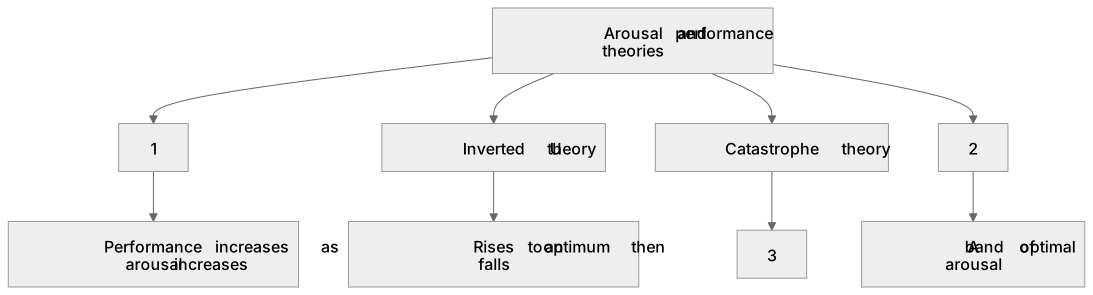
1Box 1
2Box 2
3Box 3
There is more to this lesson
The full lesson goes on to check your understanding and help you earn the marks. Create a free account to carry on, with your progress saved.
A week of Premium from your first lesson · Then the free plan continues · No card, no charge
Test your understanding of Arousal: Drive theory, inverted U theory, catastrophe theory and zone of optimal functioning theory.
Active recall beats re-reading. Take an instant quiz now to test what you’ve learned and lock it into long-term memory.
A week of Premium from your first lesson · Then the free plan continues · No card, no charge