AQA · A-Level · Physical Education
Course version: 7582 · Version from Sept 2016
Arousal: Theories of arousal.
Arousal is the general state of physiological and psychological readiness a performer brings to a task, ranging from deep sleep to intense excitement.
Checked against the AQA 7582 specification (opens in a new tab) on .
- Point 1 of 3
- 4 key terms
Study notes
From the checked teaching notes for this specification point.
The idea
Arousal is the general state of physiological and psychological readiness a performer brings to a task, ranging from deep sleep to intense excitement. This topic introduces the theories that explain how that readiness relates to performance quality. You need to know what each theory claims about the arousal–performance relationship, the shape of that relationship, and the sporting situations each explains best. A sprinter may need very high arousal to explode from the blocks, while a golfer putting to win needs lower, controlled arousal. The theories give competing explanations of such differences, so learn each one's core claim and its limitation before comparing them.
What earns the marks
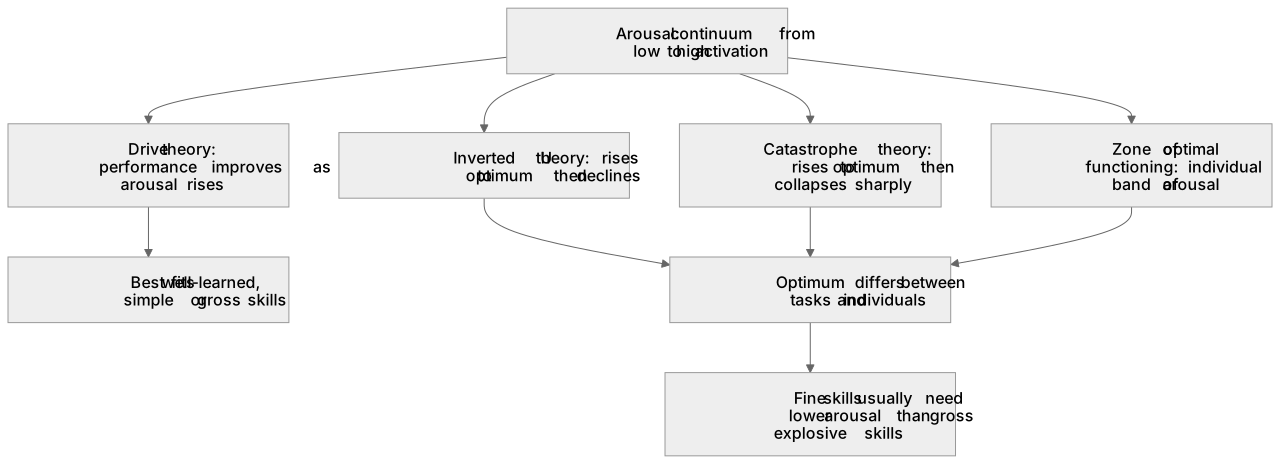
- Arousal is a general physiological and psychological activation state that varies in intensity along a continuum.
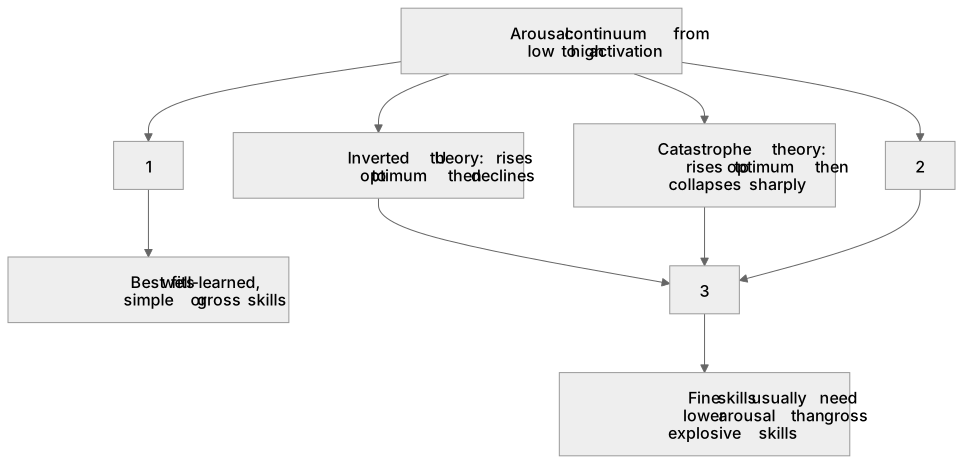
- Drive theory claims performance improves as arousal rises, because increased arousal strengthens the dominant response.
- Inverted U theory claims performance improves up to an optimal point then declines, giving an inverted U shape.
- Catastrophe theory claims performance rises with arousal to an optimum, then collapses sharply rather than declining gradually.
- Zone of optimal functioning theory claims each performer has a band of arousal within which performance is best, not one single point.
- The optimum arousal level differs between tasks and individuals, for example fine skills usually need lower arousal than gross explosive skills.
Common mistakes and how to put them right
Treating drive theory as always true.
Put it right: It best fits well-learned, simple or gross skills where the dominant response is the correct one.
Drawing the inverted U as a straight line.
Put it right: Performance rises to an optimum then falls away on both sides.
Confusing catastrophe theory with the inverted U.
Put it right: Catastrophe theory predicts a sudden, dramatic drop after the optimum, not a smooth decline.
Assuming everyone has the same optimum arousal.
Put it right: Zone of optimal functioning theory stresses an individual band that varies between performers and tasks.
Exam tips
- Learn each theory as a claim plus a shape, so you can match a description of a curve to its theory quickly.
- Use a contrasting pair of sports, such as a sprint start and a golf putt, to test whether a theory explains both.
- When a question gives a scenario, identify the skill type first, because fine skills and gross skills shift the optimum arousal level.
Try the lesson
The start of the Arousal: Theories of arousal. lesson, made from checked teaching notes for this specification point.
Have a go first
Which theory of arousal predicts that performance improves in a straight-line fashion as arousal increases?
Listen
Arousal is the general state of physiological and psychological readiness a performer brings to a task, ranging from deep sleep to intense excitement. This topic introduces the theories that explain how that readiness relates to performance quality. You need to know what each theory claims about the arousal–performance relationship, the shape of that relationship, and the sporting situations each explains best. A sprinter may need very high arousal to explode from the blocks, while a golfer putting to win needs lower, controlled arousal. The theories give competing explanations of such differences, so learn each one's core claim and its limitation before comparing them. A strong answer earns marks for these points. Arousal is a general physiological and psychological activation state that varies in intensity along a continuum. Drive theory claims performance improves as arousal rises, because increased arousal strengthens the dominant response. Inverted U theory claims performance improves up to an optimal point then declines, giving an inverted U shape. Catastrophe theory claims performance rises with arousal to an optimum, then collapses sharply rather than declining gradually. A common slip: Treating drive theory as always true. Instead, it best fits well-learned, simple or gross skills where the dominant response is the correct one. Exam tip: Learn each theory as a claim plus a shape, so you can match a description of a curve to its theory quickly.
See it
Key words
Say what each word means before you turn the card.
Arousal
Try answering aloud or in your head before turning the card.
Drive theory
Try answering aloud or in your head before turning the card.
Inverted U theory
Try answering aloud or in your head before turning the card.
Catastrophe theory
Try answering aloud or in your head before turning the card.
See every definition
- Arousal
- A general physiological and psychological activation state that varies in intensity along a continuum.
- Drive theory
- Claims performance improves as arousal rises, because increased arousal strengthens the dominant response.
- Inverted U theory
- Claims performance improves up to an optimal point then declines, giving an inverted U shape.
- Catastrophe theory
- Claims performance rises with arousal to an optimum, then collapses sharply rather than declining gradually.
Label the diagram
Some boxes have lost their names. Pick the right name for each number.
1Box 1
2Box 2
3Box 3
There is more to this lesson
The full lesson goes on to check your understanding and help you earn the marks. Create a free account to carry on, with your progress saved.
A week of Premium from your first lesson · Then the free plan continues · No card, no charge
Test your understanding of Arousal: Theories of arousal.
Active recall beats re-reading. Take an instant quiz now to test what you’ve learned and lock it into long-term memory.
A week of Premium from your first lesson · Then the free plan continues · No card, no charge