AQA · A-Level · Physical Education
Course version: 7582 · Version from Sept 2016
Aspects of personality: Hollander, Lewin.
This row names two theorists, Hollander and Lewin, whose work underpins the interactionist perspective on personality within AQA A-Level Physical Education, section 3.2.3.1.1.
Checked against the AQA 7582 specification (opens in a new tab) on .
- Point 3 of 3
- 4 key terms
Study notes
From the checked teaching notes for this specification point.
The idea
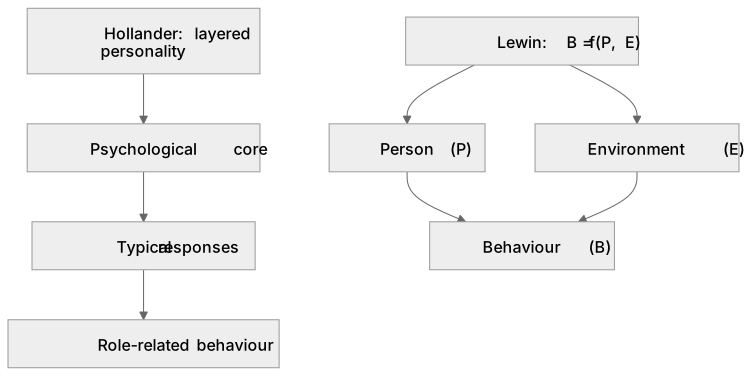
This row names two theorists, Hollander and Lewin, whose work underpins the interactionist perspective on personality within AQA A-Level Physical Education, section 3.2.3.1.1. Hollander's model treats personality as layered: a psychological core, typical responses and role-related behaviour, so behaviour shifts with the situation while a stable core remains. Lewin's approach explains behaviour as an interaction between the person and the environment, often summarised as B = f(P, E). Together they show that neither traits alone nor situations alone explain a performer. A quiet training athlete may become an assertive captain on match day because the role and setting change, not the core self. Learn each theorist's key idea, the layer or formula used, and one sporting example, then match them accurately in multiple-choice questions.
What earns the marks
- Hollander: personality is layered, moving from a stable psychological core through typical responses to role-related behaviour that varies with the situation.
- Hollander: the psychological core is the most stable, internal layer and is least influenced by the immediate environment.
- Lewin: behaviour is a function of the person and the environment, commonly expressed as B = f(P, E).
- Lewin: the same performer can behave differently in different settings because the environmental term changes.
- Application: a performer's role-related behaviour in a team sport may differ from typical responses shown in training.
Common mistakes and how to put them right
Treating Hollander's layers as equally fixed.
Put it right: The psychological core is the most stable layer, while role-related behaviour is the most changeable.
Attributing B = f(P, E) to Hollander.
Put it right: This person-environment interaction formula belongs to Lewin.
Assuming the interactionist perspective means the situation alone determines behaviour.
Put it right: It is the interaction of person and environment that matters.
Confusing typical responses with the psychological core.
Put it right: Typical responses are how a person usually acts across many situations, not the deepest stable layer.
Exam tips
- Learn a one-line summary of each theorist and a contrasting sporting example, then check the stem names the correct theorist before choosing.
- For Lewin questions, identify both the person factor and the environment factor in the scenario rather than selecting an answer that mentions only one.
- For Hollander questions, decide which layer the scenario describes: core, typical response or role-related behaviour.
Try the lesson
The start of the Aspects of personality: Hollander, Lewin. lesson, made from checked teaching notes for this specification point.
Have a go first
What are the three levels that make up Hollander's model of personality?
Listen
This row names two theorists, Hollander and Lewin, whose work underpins the interactionist perspective on personality within AQA A-Level Physical Education, section 3.2.3.1.1. Hollander's model treats personality as layered: a psychological core, typical responses and role-related behaviour, so behaviour shifts with the situation while a stable core remains. Lewin's approach explains behaviour as an interaction between the person and the environment, often summarised as B = f(P, E). Together they show that neither traits alone nor situations alone explain a performer. A quiet training athlete may become an assertive captain on match day because the role and setting change, not the core self. Learn each theorist's key idea, the layer or formula used, and one sporting example, then match them accurately in multiple-choice questions. A strong answer earns marks for these points. Hollander: personality is layered, moving from a stable psychological core through typical responses to role-related behaviour that varies with the situation. Hollander: the psychological core is the most stable, internal layer and is least influenced by the immediate environment. Lewin: behaviour is a function of the person and the environment, commonly expressed as B = f(P, E). Lewin: the same performer can behave differently in different settings because the environmental term changes. Exam tip: Learn a one-line summary of each theorist and a contrasting sporting example, then check the stem names the correct theorist before choosing.
See it
Key words
Say what each word means before you turn the card.
Interactionist perspective on personality
Try answering aloud or in your head before turning the card.
Layered model of personality
Try answering aloud or in your head before turning the card.
Person and environment interaction
Try answering aloud or in your head before turning the card.
Stability and change in sporting behaviour
Try answering aloud or in your head before turning the card.
See every definition
- Interactionist perspective on personality
- The view, underpinned by Hollander and Lewin, that neither traits alone nor situations alone explain a performer.
- Layered model of personality
- Hollander's model treats personality as layered: a psychological core, typical responses and role-related behaviour, so behaviour shifts with the situation while a stable core remains.
- Person and environment interaction
- Lewin's approach explains behaviour as an interaction between the person and the environment, often summarised as B = f(P, E).
- Stability and change in sporting behaviour
- A quiet training athlete may become an assertive captain on match day because the role and setting change, not the core self.
Label the diagram
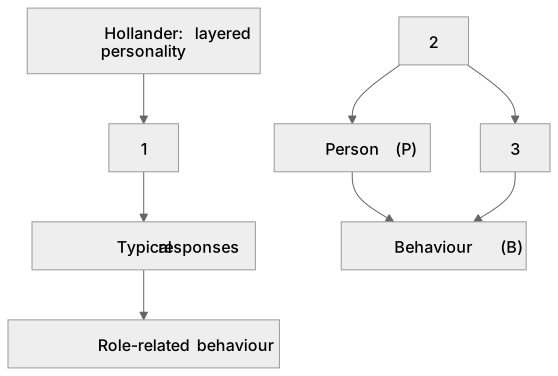
Some boxes have lost their names. Pick the right name for each number.
1Box 1
2Box 2
3Box 3
There is more to this lesson
The full lesson goes on to check your understanding and help you earn the marks. Create a free account to carry on, with your progress saved.
A week of Premium from your first lesson · Then the free plan continues · No card, no charge
Test your understanding of Aspects of personality: Hollander, Lewin.
Active recall beats re-reading. Take an instant quiz now to test what you’ve learned and lock it into long-term memory.
A week of Premium from your first lesson · Then the free plan continues · No card, no charge