AQA · A-Level · Physical Education
Course version: 7582 · Version from Sept 2016
Aspects of personality: Interactionist perspective.
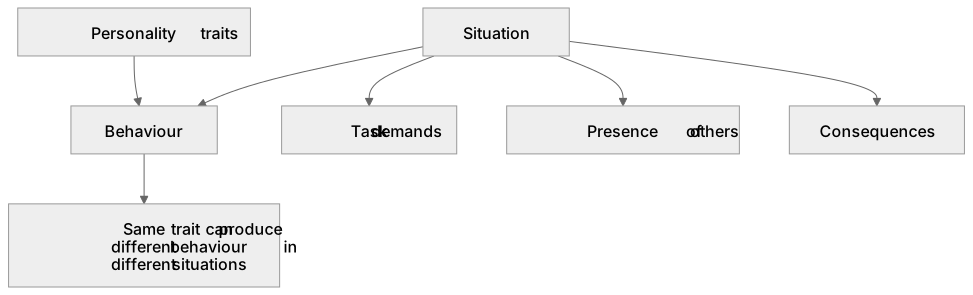
The interactionist perspective explains behaviour as the product of both personality traits and the situation, rather than either alone.
Checked against the AQA 7582 specification (opens in a new tab) on .
- Point 2 of 3
- 4 key terms
Study notes
From the checked teaching notes for this specification point.
The idea
The interactionist perspective explains behaviour as the product of both personality traits and the situation, rather than either alone. Traits predispose a performer towards certain responses, but the specific situation, including the demands of the task, the presence of others and the consequences, determines whether and how that predisposition is expressed. For example, a performer with a strong trait of competitiveness may be assertive in a close match but quiet in a training drill that offers no reward for assertiveness. This perspective is often represented as behaviour being a function of personality and environment together, and it underpins approaches such as the trait-situation debate resolution.
What earns the marks
- Interactionist perspective combines trait and situational explanations rather than choosing one over the other.
- Behaviour is influenced by enduring personality characteristics and by the specific situation in which the performer acts.
- The same trait can produce different behaviour in different situations, depending on task demands, audience and consequences.
- The perspective is often summarised as behaviour being a function of personality and environment interacting.
- Applied implication: coaches should consider both the performer's typical tendencies and the features of the current setting when predicting or shaping behaviour.
Common mistakes and how to put them right
Misunderstanding: interactionism means the situation always overrides personality.
Put it right: Both contribute, and their relative influence can vary by person and context.
Misunderstanding: interactionism is the same as trait theory with a different name.
Put it right: It explicitly includes situational factors, which trait theory alone underplays.
Misunderstanding: interactionism is the same as social learning theory.
Put it right: Social learning emphasises learning and reinforcement, while interactionism emphasises the joint influence of traits and situations.
Misunderstanding: interactionism predicts behaviour perfectly.
Put it right: It improves prediction by combining factors but does not guarantee exact forecasts.
Exam tips
- Look for stems that mention both a personal characteristic and a situational factor; these point to the interactionist perspective.
- Reject options that claim only personality or only the situation determines behaviour.
- Use the phrase 'personality and environment together' as a quick check when choosing between similar options.
Try the lesson
The start of the Aspects of personality: Interactionist perspective. lesson, made from checked teaching notes for this specification point.
Have a go first
According to the interactionist perspective on personality, how is a performer's behaviour in a competitive match best explained?
Listen
The interactionist perspective explains behaviour as the product of both personality traits and the situation, rather than either alone. Traits predispose a performer towards certain responses, but the specific situation, including the demands of the task, the presence of others and the consequences, determines whether and how that predisposition is expressed. For example, a performer with a strong trait of competitiveness may be assertive in a close match but quiet in a training drill that offers no reward for assertiveness. This perspective is often represented as behaviour being a function of personality and environment together, and it underpins approaches such as the trait-situation debate resolution. A strong answer earns marks for these points. Interactionist perspective combines trait and situational explanations rather than choosing one over the other. Behaviour is influenced by enduring personality characteristics and by the specific situation in which the performer acts. The same trait can produce different behaviour in different situations, depending on task demands, audience and consequences. The perspective is often summarised as behaviour being a function of personality and environment interacting. A common slip: Misunderstanding: interactionism means the situation always overrides personality. Instead, both contribute, and their relative influence can vary by person and context. Exam tip: Look for stems that mention both a personal characteristic and a situational factor; these point to the interactionist perspective.
See it
Key words
Say what each word means before you turn the card.
Interactionist perspective
Try answering aloud or in your head before turning the card.
Behaviour as a function of personality and environment
Try answering aloud or in your head before turning the card.
Situational specificity of trait expression
Try answering aloud or in your head before turning the card.
Resolution of the trait-situation debate
Try answering aloud or in your head before turning the card.
See every definition
- Interactionist perspective
- Explains behaviour as the product of both personality traits and the situation, rather than either alone.
- Behaviour as a function of personality and environment
- The summary that behaviour results from personality and environment interacting together.
- Situational specificity of trait expression
- Traits predispose a performer towards certain responses, but the specific situation determines whether and how that predisposition is expressed.
- Resolution of the trait-situation debate
- Acknowledges that neither traits alone nor situations alone fully predict behaviour.
Label the diagram
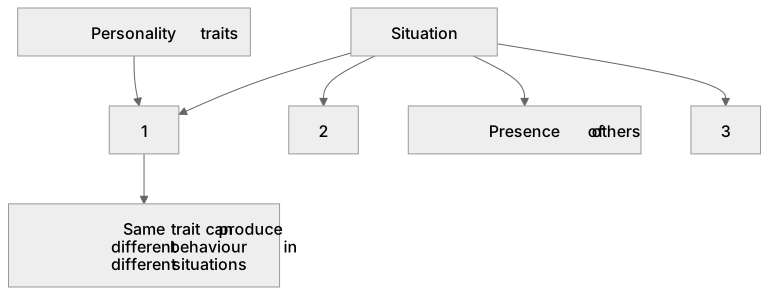
Some boxes have lost their names. Pick the right name for each number.
1Box 1
2Box 2
3Box 3
There is more to this lesson
The full lesson goes on to check your understanding and help you earn the marks. Create a free account to carry on, with your progress saved.
A week of Premium from your first lesson · Then the free plan continues · No card, no charge
Test your understanding of Aspects of personality: Interactionist perspective.
Active recall beats re-reading. Take an instant quiz now to test what you’ve learned and lock it into long-term memory.
A week of Premium from your first lesson · Then the free plan continues · No card, no charge