AQA · A-Level · Physical Education
Course version: 7582 · Version from Sept 2016
Aspects of personality: Trait, social learning.
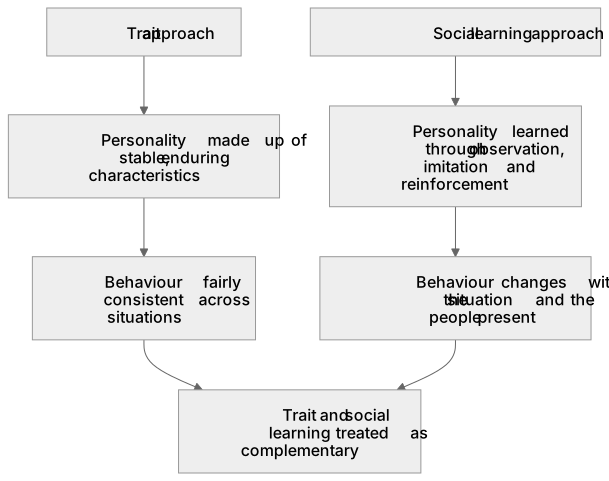
The trait approach holds that personality consists of stable, enduring characteristics that a performer carries into many situations, so behaviour is fairly consistent across contexts.
Checked against the AQA 7582 specification (opens in a new tab) on .
- Point 1 of 3
- 4 key terms
Study notes
From the checked teaching notes for this specification point.
The idea
The trait approach holds that personality consists of stable, enduring characteristics that a performer carries into many situations, so behaviour is fairly consistent across contexts. The social learning approach instead explains personality as learned through observation, imitation and reinforcement, so behaviour changes with the situation and the people present. A trait theorist might predict that a consistently confident games player will also be confident in a new activity; a social learning theorist would ask what the performer has seen, copied and had rewarded in that new setting. Most sport psychologists treat the two as complementary rather than exclusive.
What earns the marks
- Trait theory: personality is made up of stable, enduring characteristics that remain fairly consistent across situations and over time.
- Trait theory predicts cross-situational consistency, so a performer high in a given trait tends to behave similarly in different sporting contexts.
- Social learning theory: personality and behaviour are acquired through observation, imitation and reinforcement from significant others such as coaches, peers and family.
- Social learning theory predicts situation-specific behaviour, because what is learned and rewarded in one setting may not transfer to another.
- A valid comparison recognises that trait explanations emphasise innate or enduring dispositions while social learning explanations emphasise environmental influence and learning.
- Applied implication: a coach may use trait information to anticipate general tendencies but use social learning principles, such as modelling and positive reinforcement, to shape specific behaviours.
Common mistakes and how to put them right
Misunderstanding: trait theory says personality never changes at all.
Put it right: Trait theory claims relative stability and consistency, not total rigidity; behaviour can still vary somewhat with circumstances.
Misunderstanding: social learning theory means personality is copied wholesale from one person.
Put it right: It involves observation, imitation and reinforcement, and the learner actively processes what is seen and rewarded.
Misunderstanding: the two approaches are mutually exclusive and only one can be correct.
Put it right: They can be combined, with enduring traits interacting with learning and situational factors.
Misunderstanding: social learning theory ignores cognition.
Put it right: It depends on attention, retention and motivation, so thinking and interpretation matter.
Exam tips
- Read the stem carefully to identify whether it describes consistency across situations (trait) or learning from others and reinforcement (social learning).
- Eliminate options that overstate a theory, such as claiming traits are fixed for life or that social learning requires no thinking.
- When two options seem plausible, choose the one that matches the key term in the stem, for example 'enduring' for trait or 'observed and reinforced' for social learning.
Try the lesson
The start of the Aspects of personality: Trait, social learning. lesson, made from checked teaching notes for this specification point.
Have a go first
Which description best fits the trait approach to personality in sport?
Listen
The trait approach holds that personality consists of stable, enduring characteristics that a performer carries into many situations, so behaviour is fairly consistent across contexts. The social learning approach instead explains personality as learned through observation, imitation and reinforcement, so behaviour changes with the situation and the people present. A trait theorist might predict that a consistently confident games player will also be confident in a new activity; a social learning theorist would ask what the performer has seen, copied and had rewarded in that new setting. Most sport psychologists treat the two as complementary rather than exclusive. A strong answer earns marks for these points. Trait theory: personality is made up of stable, enduring characteristics that remain fairly consistent across situations and over time. Trait theory predicts cross-situational consistency, so a performer high in a given trait tends to behave similarly in different sporting contexts. Social learning theory: personality and behaviour are acquired through observation, imitation and reinforcement from significant others such as coaches, peers and family. Social learning theory predicts situation-specific behaviour, because what is learned and rewarded in one setting may not transfer to another. A common slip: Misunderstanding: trait theory says personality never changes at all. Instead, trait theory claims relative stability and consistency, not total rigidity; behaviour can still vary somewhat with circumstances. Exam tip: Read the stem carefully to identify whether it describes consistency across situations (trait) or learning from others and reinforcement (social learning).
See it
Key words
Say what each word means before you turn the card.
Stable and enduring characteristics
Try answering aloud or in your head before turning the card.
Consistency across situations
Try answering aloud or in your head before turning the card.
Learning through observation and imitation
Try answering aloud or in your head before turning the card.
Reinforcement and situational influence
Try answering aloud or in your head before turning the card.
See every definition
- Stable and enduring characteristics
- The trait approach holds that personality consists of these, which a performer carries into many situations, so behaviour is fairly consistent across contexts.
- Consistency across situations
- Trait theory predicts this, so a performer high in a given trait tends to behave similarly in different sporting contexts.
- Learning through observation and imitation
- The social learning approach explains personality as learned this way and through reinforcement, so behaviour changes with the situation and the people present.
- Reinforcement and situational influence
- Social learning theory predicts situation-specific behaviour, because what is learned and rewarded in one setting may not transfer to another.
Label the diagram
Some boxes have lost their names. Pick the right name for each number.
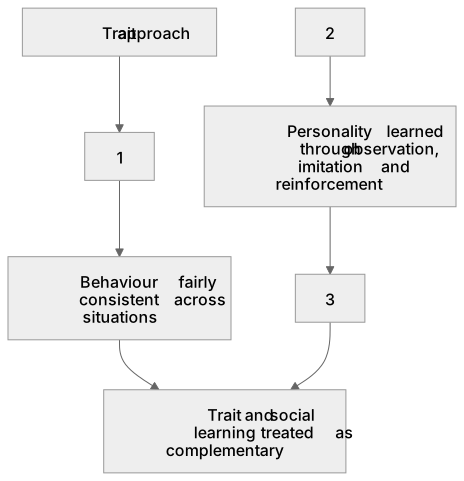
1Box 1
2Box 2
3Box 3
There is more to this lesson
The full lesson goes on to check your understanding and help you earn the marks. Create a free account to carry on, with your progress saved.
A week of Premium from your first lesson · Then the free plan continues · No card, no charge
Test your understanding of Aspects of personality: Trait, social learning.
Active recall beats re-reading. Take an instant quiz now to test what you’ve learned and lock it into long-term memory.
A week of Premium from your first lesson · Then the free plan continues · No card, no charge