AQA · A-Level · Physical Education
Course version: 7582 · Version from Sept 2016
Changing attitudes through cognitive dissonance and persuasive…
Full specification wording
Attitudes: Changing attitudes through cognitive dissonance and persuasive communication.
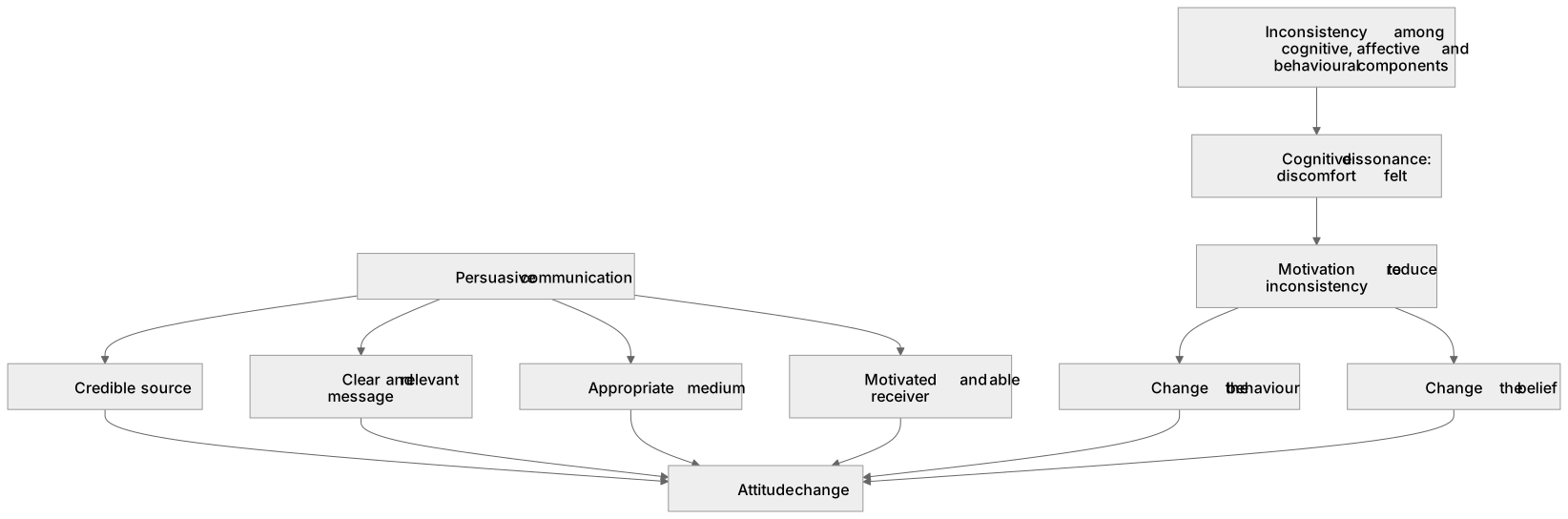
Attitudes can change when new information or experience creates inconsistency among the cognitive, affective and behavioural components.
Checked against the AQA 7582 specification (opens in a new tab) on .
- Point 4 of 4
- 4 key terms
Study notes
From the checked teaching notes for this specification point.
The idea
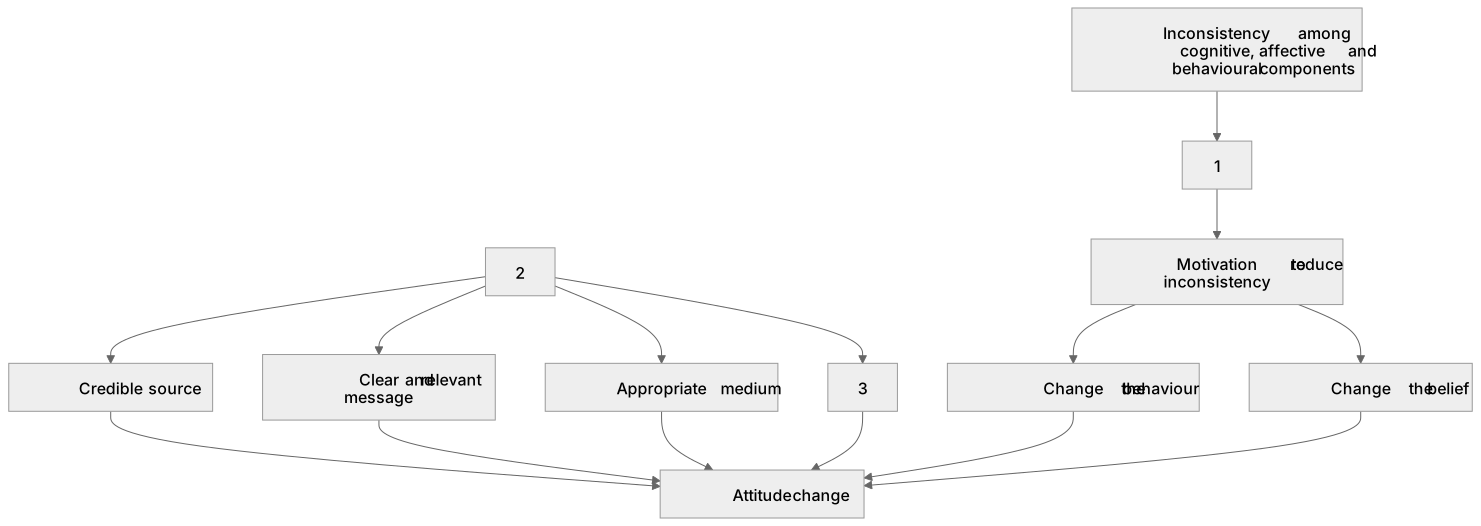
Attitudes can change when new information or experience creates inconsistency among the cognitive, affective and behavioural components. Cognitive dissonance is the discomfort felt when these components conflict; a performer who believes warm-ups prevent injury but skips them may feel unease and restore consistency by changing the behaviour or the belief. Persuasive communication aims to change attitudes through a credible source, a clear and relevant message, an appropriate medium and a receiver who is motivated and able to process it. For example, a respected coach presenting injury data to a team can reduce dissonance and shift attitudes. Change is more likely when the message is personally relevant, the source is trusted and the performer has support to act differently.
What earns the marks
- Cognitive dissonance is the discomfort experienced when a person's beliefs, feelings and behaviour are inconsistent.
- Dissonance motivates the individual to reduce inconsistency, for example by changing the behaviour or changing the belief.
- Persuasive communication can change attitudes through a credible source, a clear message, a suitable medium and an attentive receiver.
- The likelihood of attitude change increases when the message is relevant, the source is trusted and the receiver is motivated and able to process it.
- Attitude change may also require practical support, such as access to facilities or social approval, so that new behaviour can be maintained.
Common mistakes and how to put them right
Thinking cognitive dissonance is simply feeling nervous before performance.
Put it right: Dissonance is specifically the discomfort caused by inconsistency among beliefs, feelings and behaviour.
Believing any message from any source will change attitudes.
Put it right: Persuasive communication depends on source credibility, message clarity and relevance, suitable medium and receiver motivation.
Assuming attitude change is always immediate and permanent.
Put it right: Change is a process that may need repeated persuasive messages, reduced dissonance and ongoing support.
Confusing dissonance with persuasion.
Put it right: Dissonance is an internal state of discomfort, whereas persuasive communication is an external attempt to influence attitudes.
Exam tips
- In multiple-choice questions, match the scenario to the correct process: look for internal inconsistency for cognitive dissonance and for a credible source delivering a message for persuasive communication.
- Check whether the option names a condition that makes persuasion more effective, such as source credibility or personal relevance, rather than an unrelated factor.
- Reject options that describe changing a skill or a physical capacity when the stem asks about changing an attitude.
Try the lesson
The start of the Attitudes: Changing attitudes through cognitive dissonance and persuasive communication. lesson, made from checked teaching notes for this specification point.
Have a go first
In the context of changing attitudes, what does cognitive dissonance refer to?
Listen
Attitudes can change when new information or experience creates inconsistency among the cognitive, affective and behavioural components. Cognitive dissonance is the discomfort felt when these components conflict; a performer who believes warm-ups prevent injury but skips them may feel unease and restore consistency by changing the behaviour or the belief. Persuasive communication aims to change attitudes through a credible source, a clear and relevant message, an appropriate medium and a receiver who is motivated and able to process it. For example, a respected coach presenting injury data to a team can reduce dissonance and shift attitudes. Change is more likely when the message is personally relevant, the source is trusted and the performer has support to act differently. A strong answer earns marks for these points. Cognitive dissonance is the discomfort experienced when a person's beliefs, feelings and behaviour are inconsistent. Dissonance motivates the individual to reduce inconsistency, for example by changing the behaviour or changing the belief. Persuasive communication can change attitudes through a credible source, a clear message, a suitable medium and an attentive receiver. The likelihood of attitude change increases when the message is relevant, the source is trusted and the receiver is motivated and able to process it. A common slip: Thinking cognitive dissonance is simply feeling nervous before performance. Instead, dissonance is specifically the discomfort caused by inconsistency among beliefs, feelings and behaviour. Exam tip: In multiple-choice questions, match the scenario to the correct process: look for internal inconsistency for cognitive dissonance and for a credible source delivering a message for persuasive communication.
See it
Key words
Say what each word means before you turn the card.
Cognitive dissonance
Try answering aloud or in your head before turning the card.
Persuasive communication
Try answering aloud or in your head before turning the card.
Source credibility
Try answering aloud or in your head before turning the card.
Support
Try answering aloud or in your head before turning the card.
See every definition
- Cognitive dissonance
- The discomfort felt when a person's beliefs, feelings and behaviour are inconsistent, motivating the individual to reduce the inconsistency.
- Persuasive communication
- An external attempt to change attitudes through a credible source, a clear and relevant message, an appropriate medium and a motivated receiver.
- Source credibility
- The trust placed in the source of a message, which increases the likelihood of attitude change.
- Support
- Practical help such as access to facilities or social approval, which may be required so that new behaviour can be maintained.
Label the diagram
Some boxes have lost their names. Pick the right name for each number.
1Box 1
2Box 2
3Box 3
There is more to this lesson
The full lesson goes on to check your understanding and help you earn the marks. Create a free account to carry on, with your progress saved.
A week of Premium from your first lesson · Then the free plan continues · No card, no charge
Test your understanding of Attitudes: Changing attitudes through cognitive dissonance and persuasive communication.
Active recall beats re-reading. Take an instant quiz now to test what you’ve learned and lock it into long-term memory.
A week of Premium from your first lesson · Then the free plan continues · No card, no charge