AQA · A-Level · Physical Education
Course version: 7582 · Version from Sept 2016
Attitudes: Formation of attitudes.
Attitudes are learned evaluations that predispose a performer to respond consistently towards sport, training or competition.
Checked against the AQA 7582 specification (opens in a new tab) on .
- Point 3 of 4
- 4 key terms
Study notes
From the checked teaching notes for this specification point.
The idea
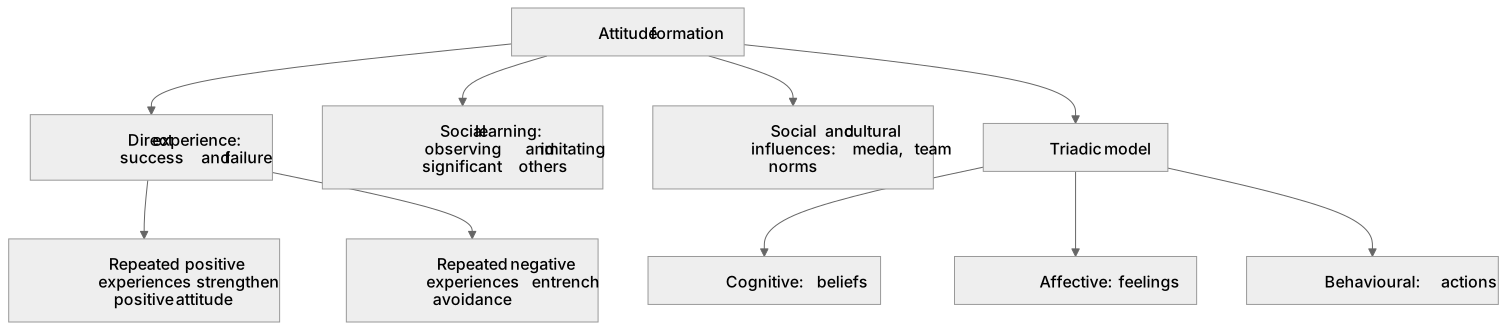
Attitudes are learned evaluations that predispose a performer to respond consistently towards sport, training or competition. They form through direct experience of success and failure, through observing and imitating significant others such as coaches, peers and family, and through social and cultural influences including media coverage and team norms. The triadic model separates cognitive (beliefs), affective (feelings) and behavioural (actions) components; a performer who believes stretching prevents injury, enjoys the routine and stretches daily shows all three. Formation is therefore not fixed: repeated positive experiences, credible role models and a supportive environment can strengthen a positive attitude, while negative experiences can entrench avoidance. Understanding formation helps explain why two athletes react differently to the same session.
What earns the marks
- Attitudes are learned predispositions to respond consistently towards an attitude object such as a sport, training or competition.
- Formation occurs through direct experience, including success and failure in physical activity.
- Formation occurs through social learning: observing, imitating and modelling significant others such as coaches, peers and family.
- Formation occurs through social and cultural influences such as media, team norms and the values of the sporting environment.
- The triadic model describes attitudes as having cognitive (beliefs), affective (feelings) and behavioural (actions) components.
- A positive attitude can be strengthened by repeated positive experiences and credible role models; a negative attitude can be entrenched by repeated negative experiences.
Common mistakes and how to put them right
Believing attitudes are innate and unchangeable.
Put it right: Attitudes are learned through experience, observation and social influence, so they can be formed and reformed.
Treating attitude as only a feeling.
Put it right: The triadic model includes cognitive beliefs, affective feelings and behavioural actions, and all three should be considered.
Assuming one bad session permanently creates a negative attitude.
Put it right: Formation depends on repeated experiences and the wider social environment, so a single event is rarely decisive.
Confusing attitude with personality.
Put it right: Personality is a relatively stable trait pattern, whereas an attitude is a learned evaluation of a specific attitude object.
Exam tips
- In multiple-choice questions, identify the attitude object first, then decide whether the option describes a learned evaluation rather than an innate trait.
- When a stem describes a performer's beliefs, feelings and actions, check whether the option correctly links all three components of the triadic model.
- Eliminate options that describe only one influence on formation when the stem asks for the broad process of attitude formation.
Try the lesson
The start of the Attitudes: Formation of attitudes. lesson, made from checked teaching notes for this specification point.
Have a go first
Which of the following best describes how an individual's attitude towards a sport is formed through socialisation?
Listen
Attitudes are learned evaluations that predispose a performer to respond consistently towards sport, training or competition. They form through direct experience of success and failure, through observing and imitating significant others such as coaches, peers and family, and through social and cultural influences including media coverage and team norms. The triadic model separates cognitive (beliefs), affective (feelings) and behavioural (actions) components; a performer who believes stretching prevents injury, enjoys the routine and stretches daily shows all three. Formation is therefore not fixed: repeated positive experiences, credible role models and a supportive environment can strengthen a positive attitude, while negative experiences can entrench avoidance. Understanding formation helps explain why two athletes react differently to the same session. A strong answer earns marks for these points. Attitudes are learned predispositions to respond consistently towards an attitude object such as a sport, training or competition. Formation occurs through direct experience, including success and failure in physical activity. Formation occurs through social learning: observing, imitating and modelling significant others such as coaches, peers and family. Formation occurs through social and cultural influences such as media, team norms and the values of the sporting environment. A common slip: Believing attitudes are innate and unchangeable. Instead, attitudes are learned through experience, observation and social influence, so they can be formed and reformed. Exam tip: In multiple-choice questions, identify the attitude object first, then decide whether the option describes a learned evaluation rather than an innate trait.
See it
Key words
Say what each word means before you turn the card.
Attitudes as learned evaluations
Try answering aloud or in your head before turning the card.
Direct experience and social learning
Try answering aloud or in your head before turning the card.
Cognitive, affective and behavioural components
Try answering aloud or in your head before turning the card.
Social and cultural influences on formation
Try answering aloud or in your head before turning the card.
See every definition
- Attitudes as learned evaluations
- Learned evaluations that predispose a performer to respond consistently towards sport, training or competition.
- Direct experience and social learning
- Formation through direct experience of success and failure, and through observing and imitating significant others such as coaches, peers and family.
- Cognitive, affective and behavioural components
- The triadic model separates cognitive (beliefs), affective (feelings) and behavioural (actions) components.
- Social and cultural influences on formation
- Formation through social and cultural influences including media coverage and team norms.
Label the diagram
Some boxes have lost their names. Pick the right name for each number.
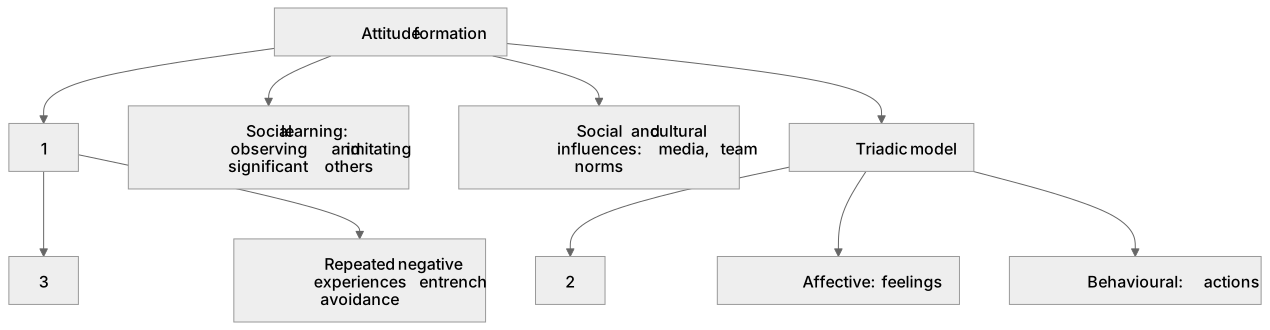
1Box 1
2Box 2
3Box 3
There is more to this lesson
The full lesson goes on to check your understanding and help you earn the marks. Create a free account to carry on, with your progress saved.
A week of Premium from your first lesson · Then the free plan continues · No card, no charge
Test your understanding of Attitudes: Formation of attitudes.
Active recall beats re-reading. Take an instant quiz now to test what you’ve learned and lock it into long-term memory.
A week of Premium from your first lesson · Then the free plan continues · No card, no charge