AQA · A-Level · Physical Education
Course version: 7582 · Version from Sept 2016
Attitudes: Triadic model.
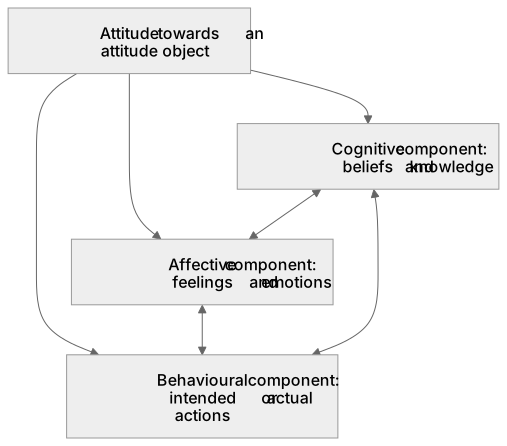
The triadic model describes an attitude as having three components that together shape how a person responds to an attitude object such as exercise, a team or a rival.
Checked against the AQA 7582 specification (opens in a new tab) on .
- Point 1 of 4
- 4 key terms
Study notes
From the checked teaching notes for this specification point.
The idea
The triadic model describes an attitude as having three components that together shape how a person responds to an attitude object such as exercise, a team or a rival. The cognitive component covers beliefs and knowledge, for example believing that regular running improves health. The affective component covers feelings and emotions, such as enjoying the buzz of a race. The behavioural component covers intended or actual actions, such as training four times a week. The three components interact: a strong belief plus positive feeling makes consistent behaviour more likely, while a negative feeling can override knowledge. In multiple-choice assessment you must identify which component a described example belongs to, so read the stem carefully and match the wording to belief, feeling or action.
What earns the marks
- The triadic model treats an attitude as having three components: cognitive, affective and behavioural.
- The cognitive component concerns beliefs, knowledge and thoughts about the attitude object.
- The affective component concerns feelings and emotions towards the attitude object.
- The behavioural component concerns intended or actual actions towards the attitude object.
- The components interact, so a change in one can influence the others.
- A multiple-choice stem describing a belief points to the cognitive component, a feeling to the affective component and an action to the behavioural component.
Common mistakes and how to put them right
Treating the triadic model as three separate attitudes rather than three components of one attitude.
Put it right by stating that cognitive, affective and behavioural parts combine into a single attitude towards one object.
Labelling a statement of feeling, such as enjoying training, as cognitive.
Put it right by reserving cognitive for beliefs and knowledge and affective for emotions.
Labelling an intention to act, such as planning to join a club, as purely cognitive.
Put it right by placing intended or actual behaviour in the behavioural component.
Assuming the three components must always agree.
Put it right by noting that a person can know exercise is healthy yet dislike it and avoid it.
Exam tips
- Underline the key noun in the stem: belief, feeling or action, then select the matching component.
- Check whether the stem describes what a performer thinks, feels or does before looking at the options.
- Eliminate options that name a component already ruled out by the stem wording, then choose between the remaining options.
Try the lesson
The start of the Attitudes: Triadic model. lesson, made from checked teaching notes for this specification point.
Have a go first
In the triadic model of attitudes, which component describes the performer's feelings or emotional response towards the attitude object?
Listen
The triadic model describes an attitude as having three components that together shape how a person responds to an attitude object such as exercise, a team or a rival. The cognitive component covers beliefs and knowledge, for example believing that regular running improves health. The affective component covers feelings and emotions, such as enjoying the buzz of a race. The behavioural component covers intended or actual actions, such as training four times a week. The three components interact: a strong belief plus positive feeling makes consistent behaviour more likely, while a negative feeling can override knowledge. In multiple-choice assessment you must identify which component a described example belongs to, so read the stem carefully and match the wording to belief, feeling or action. A strong answer earns marks for these points. The triadic model treats an attitude as having three components: cognitive, affective and behavioural. The cognitive component concerns beliefs, knowledge and thoughts about the attitude object. The affective component concerns feelings and emotions towards the attitude object. The behavioural component concerns intended or actual actions towards the attitude object. A common slip: Treating the triadic model as three separate attitudes rather than three components of one attitude. Instead, stating that cognitive, affective and behavioural parts combine into a single attitude towards one object. Exam tip: Underline the key noun in the stem: belief, feeling or action, then select the matching component.
See it
Key words
Say what each word means before you turn the card.
Triadic model
Try answering aloud or in your head before turning the card.
Cognitive component
Try answering aloud or in your head before turning the card.
Affective component
Try answering aloud or in your head before turning the card.
Behavioural component
Try answering aloud or in your head before turning the card.
See every definition
- Triadic model
- Describes an attitude as having three components that together shape how a person responds to an attitude object such as exercise, a team or a rival.
- Cognitive component
- Covers beliefs and knowledge about the attitude object, for example believing that regular running improves health.
- Affective component
- Covers feelings and emotions towards the attitude object, such as enjoying the buzz of a race.
- Behavioural component
- Covers intended or actual actions towards the attitude object, such as training four times a week.
Label the diagram
Some boxes have lost their names. Pick the right name for each number.
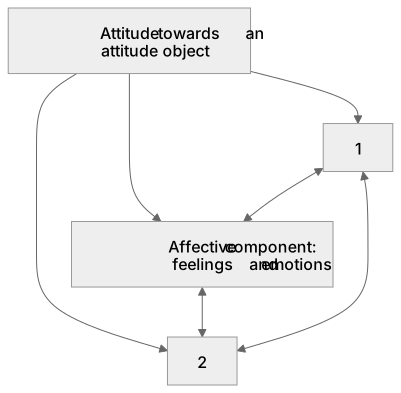
1Box 1
2Box 2
There is more to this lesson
The full lesson goes on to check your understanding and help you earn the marks. Create a free account to carry on, with your progress saved.
A week of Premium from your first lesson · Then the free plan continues · No card, no charge
Test your understanding of Attitudes: Triadic model.
Active recall beats re-reading. Take an instant quiz now to test what you’ve learned and lock it into long-term memory.
A week of Premium from your first lesson · Then the free plan continues · No card, no charge