AQA · A-Level · Physical Education
Course version: 7582 · Version from Sept 2016
Attitudes: Components of an attitude.
An attitude is a settled way of thinking and feeling about an attitude object, which may be a sport, an activity, a person or a group.
Checked against the AQA 7582 specification (opens in a new tab) on .
- Point 2 of 4
- 4 key terms
Study notes
From the checked teaching notes for this specification point.
The idea
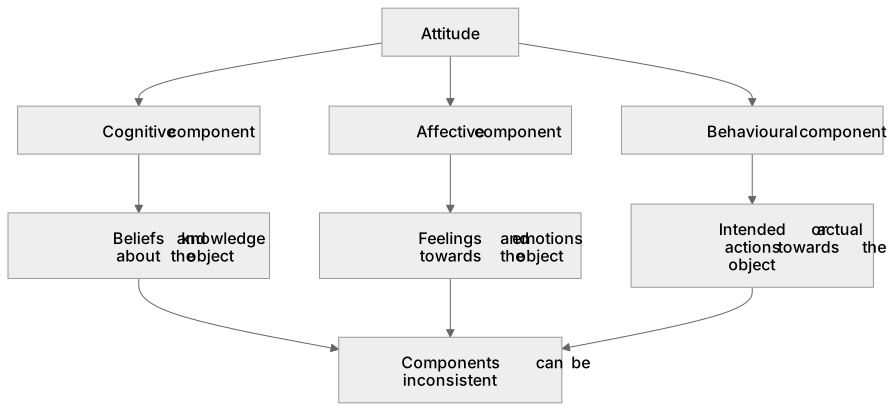
An attitude is a settled way of thinking and feeling about an attitude object, which may be a sport, an activity, a person or a group. Its components are cognitive, affective and behavioural. The cognitive part is what the performer believes or knows, for example knowing that swimming develops stamina. The affective part is the emotion attached to the object, such as feeling nervous before a gala. The behavioural part is the action or intention, such as attending training twice a week. These components can pull in different directions, which explains why someone may value fitness yet still avoid exercise. In multiple-choice questions you match each described element to the correct component and recognise that all three together form the attitude.
What earns the marks
- An attitude is a settled way of thinking and feeling about an attitude object.
- The cognitive component is made up of beliefs, knowledge and thoughts about the object.
- The affective component is made up of feelings and emotions towards the object.
- The behavioural component is made up of intended or actual actions towards the object.
- The components can be inconsistent with one another, which helps explain behaviour that seems to contradict stated beliefs.
- In multiple-choice assessment, each option must be judged against the definition of the component it names.
Common mistakes and how to put them right
Defining an attitude as only a feeling.
Put it right by including beliefs and behaviour alongside emotion.
Confusing the affective component with the behavioural component.
Put it right by linking affective to emotions and behavioural to actions or intentions.
Assuming attitudes are fixed for life.
Put it right by recognising that attitudes can be formed and changed through experience and persuasion.
Ignoring the attitude object.
Put it right by naming the specific sport, activity or person the attitude is directed towards.
Exam tips
- Read each option and ask whether it describes a belief, a feeling or an action before choosing.
- Watch for distractors that describe ability or fitness rather than any component of an attitude.
- Where two options seem similar, choose the one that matches the component named in the stem most precisely.
Try the lesson
The start of the Attitudes: Components of an attitude. lesson, made from checked teaching notes for this specification point.
Have a go first
Which component of an attitude concerns what a performer knows and believes about the attitude object?
Listen
An attitude is a settled way of thinking and feeling about an attitude object, which may be a sport, an activity, a person or a group. Its components are cognitive, affective and behavioural. The cognitive part is what the performer believes or knows, for example knowing that swimming develops stamina. The affective part is the emotion attached to the object, such as feeling nervous before a gala. The behavioural part is the action or intention, such as attending training twice a week. These components can pull in different directions, which explains why someone may value fitness yet still avoid exercise. In multiple-choice questions you match each described element to the correct component and recognise that all three together form the attitude. A strong answer earns marks for these points. An attitude is a settled way of thinking and feeling about an attitude object. The cognitive component is made up of beliefs, knowledge and thoughts about the object. The affective component is made up of feelings and emotions towards the object. The behavioural component is made up of intended or actual actions towards the object. A common slip: Defining an attitude as only a feeling. Instead, including beliefs and behaviour alongside emotion. Exam tip: Read each option and ask whether it describes a belief, a feeling or an action before choosing.
See it
Key words
Say what each word means before you turn the card.
Definition of an attitude
Try answering aloud or in your head before turning the card.
Cognitive, affective and behavioural components
Try answering aloud or in your head before turning the card.
Consistency and inconsistency between components
Try answering aloud or in your head before turning the card.
Attitudes towards sport and exercise participation
Try answering aloud or in your head before turning the card.
See every definition
- Definition of an attitude
- A settled way of thinking and feeling about an attitude object, which may be a sport, an activity, a person or a group.
- Cognitive, affective and behavioural components
- The parts of an attitude made up of what the performer believes or knows, the emotion attached to the object, and the action or intention.
- Consistency and inconsistency between components
- The components can pull in different directions, which explains why someone may value fitness yet still avoid exercise.
- Attitudes towards sport and exercise participation
- All three components together form the attitude, and each described element can be matched to the correct component.
Label the diagram
Some boxes have lost their names. Pick the right name for each number.
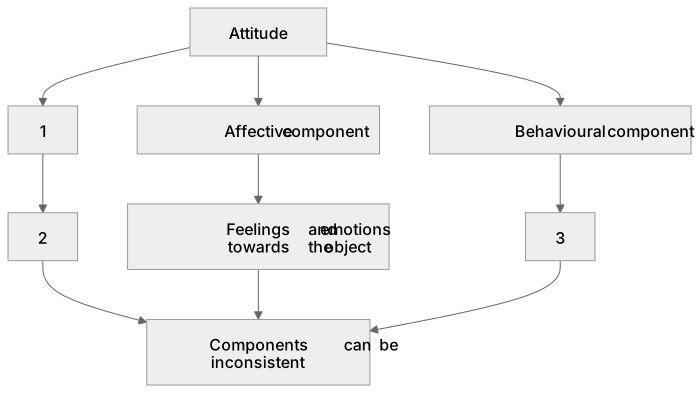
1Box 1
2Box 2
3Box 3
There is more to this lesson
The full lesson goes on to check your understanding and help you earn the marks. Create a free account to carry on, with your progress saved.
A week of Premium from your first lesson · Then the free plan continues · No card, no charge
Test your understanding of Attitudes: Components of an attitude.
Active recall beats re-reading. Take an instant quiz now to test what you’ve learned and lock it into long-term memory.
A week of Premium from your first lesson · Then the free plan continues · No card, no charge