AQA · A-Level · Physical Education
Course version: 7582 · Version from Sept 2016
Attribution theory: Attribution process.
The attribution process explains how a performer assigns a cause to a performance outcome.
Checked against the AQA 7582 specification (opens in a new tab) on .
- Point 1 of 8
- 4 key terms
Study notes
From the checked teaching notes for this specification point.
The idea
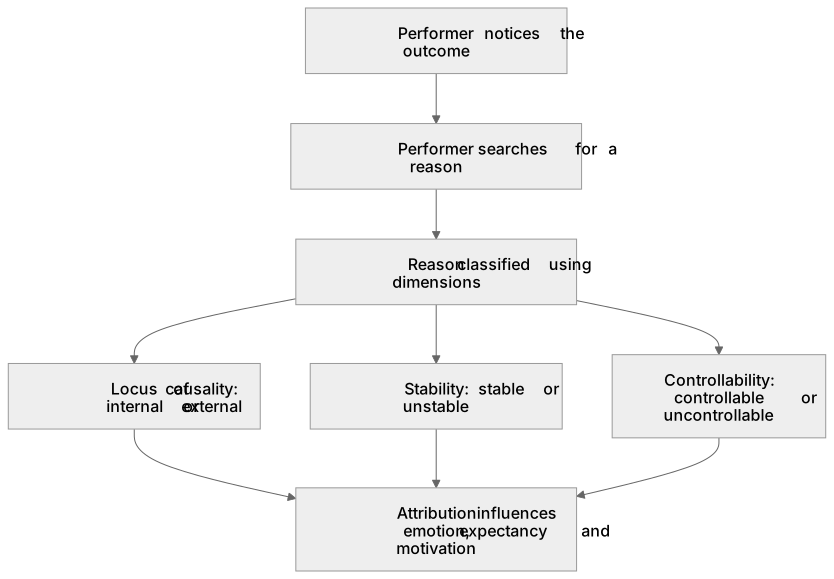
The attribution process explains how a performer assigns a cause to a performance outcome. After noticing an outcome, such as losing a tennis tie-break, the performer seeks a reason, then classifies it using dimensions such as locus of causality (internal or external), stability (stable or unstable) and controllability (controllable or uncontrollable). This classification shapes emotion, expectancy and future motivation. For example, attributing defeat to lack of effort is internal, unstable and controllable, which can protect self-esteem and encourage persistence. Attributing it to poor luck is external, unstable and uncontrollable, which may reduce personal responsibility. The process is therefore interpretive rather than objective: two athletes can explain the same result differently, and that explanation influences subsequent behaviour, effort and emotional response.
What earns the marks
- Attribution is the process of assigning a cause to a performance outcome, such as a win, loss or personal best.
- The performer first identifies or notices the outcome, then searches for a reason for it.
- The reason is classified using dimensions such as locus of causality, stability and controllability.
- Locus of causality distinguishes internal causes, such as effort or ability, from external causes, such as luck, opponent quality or officiating.
- Stability distinguishes causes likely to remain the same, such as natural ability, from causes likely to change, such as effort or tactics.
- Controllability distinguishes causes the performer can influence, such as preparation, from causes beyond their control, such as weather.
- The resulting attribution influences emotion, expectancy of future success and motivation to persist.
Common mistakes and how to put them right
Misunderstanding: attribution is the same as the outcome itself.
Put it right: Attribution is the explanation a performer gives for the outcome, not the result.
Misunderstanding: every attribution is either wholly internal or wholly external.
Put it right: An attribution can be classified on more than one dimension at once, for example internal and unstable.
Misunderstanding: attributions are fixed facts.
Put it right: Attributions are interpretations and can change with new information, reflection or feedback.
Misunderstanding: controllability is the same as locus of causality.
Put it right: A cause can be internal but uncontrollable, such as a sudden injury, or external but controllable, such as seeking better coaching.
Exam tips
- Read the stem carefully to identify whether the question asks for the definition of attribution, a dimension label or an applied example.
- When classifying a cause, name the dimension and justify it with the specific feature of the example, such as effort being internal, unstable and controllable.
- Eliminate options that describe the outcome or an emotion rather than the cause assigned to the outcome.
Try the lesson
The start of the Attribution theory: Attribution process. lesson, made from checked teaching notes for this specification point.
Have a go first
In Weiner's attribution theory, what does the term attribution mean?
Listen
The attribution process explains how a performer assigns a cause to a performance outcome. After noticing an outcome, such as losing a tennis tie-break, the performer seeks a reason, then classifies it using dimensions such as locus of causality (internal or external), stability (stable or unstable) and controllability (controllable or uncontrollable). This classification shapes emotion, expectancy and future motivation. For example, attributing defeat to lack of effort is internal, unstable and controllable, which can protect self-esteem and encourage persistence. Attributing it to poor luck is external, unstable and uncontrollable, which may reduce personal responsibility. The process is therefore interpretive rather than objective: two athletes can explain the same result differently, and that explanation influences subsequent behaviour, effort and emotional response. A strong answer earns marks for these points. Attribution is the process of assigning a cause to a performance outcome, such as a win, loss or personal best. The performer first identifies or notices the outcome, then searches for a reason for it. The reason is classified using dimensions such as locus of causality, stability and controllability. Locus of causality distinguishes internal causes, such as effort or ability, from external causes, such as luck, opponent quality or officiating. A common slip: Misunderstanding: attribution is the same as the outcome itself. Instead, attribution is the explanation a performer gives for the outcome, not the result. Exam tip: Read the stem carefully to identify whether the question asks for the definition of attribution, a dimension label or an applied example.
See it
Key words
Say what each word means before you turn the card.
Attribution
Try answering aloud or in your head before turning the card.
Locus of causality
Try answering aloud or in your head before turning the card.
Stability
Try answering aloud or in your head before turning the card.
Controllability
Try answering aloud or in your head before turning the card.
See every definition
- Attribution
- The process of assigning a cause to a performance outcome, such as a win, loss or personal best.
- Locus of causality
- A dimension that distinguishes internal causes, such as effort or ability, from external causes, such as luck, opponent quality or officiating.
- Stability
- A dimension that distinguishes causes likely to remain the same, such as natural ability, from causes likely to change, such as effort or tactics.
- Controllability
- A dimension that distinguishes causes the performer can influence, such as preparation, from causes beyond their control, such as weather.
Label the diagram
Some boxes have lost their names. Pick the right name for each number.
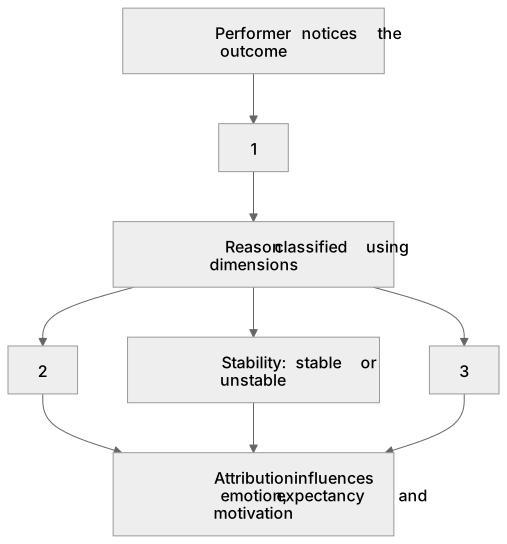
1Box 1
2Box 2
3Box 3
There is more to this lesson
The full lesson goes on to check your understanding and help you earn the marks. Create a free account to carry on, with your progress saved.
A week of Premium from your first lesson · Then the free plan continues · No card, no charge
Test your understanding of Attribution theory: Attribution process.
Active recall beats re-reading. Take an instant quiz now to test what you’ve learned and lock it into long-term memory.
A week of Premium from your first lesson · Then the free plan continues · No card, no charge