AQA · A-Level · Physical Education
Course version: 7582 · Version from Sept 2016
Weiner’s Model and its application to sporting situations.
Full specification wording
Attribution theory: Weiner’s Model and its application to sporting situations.
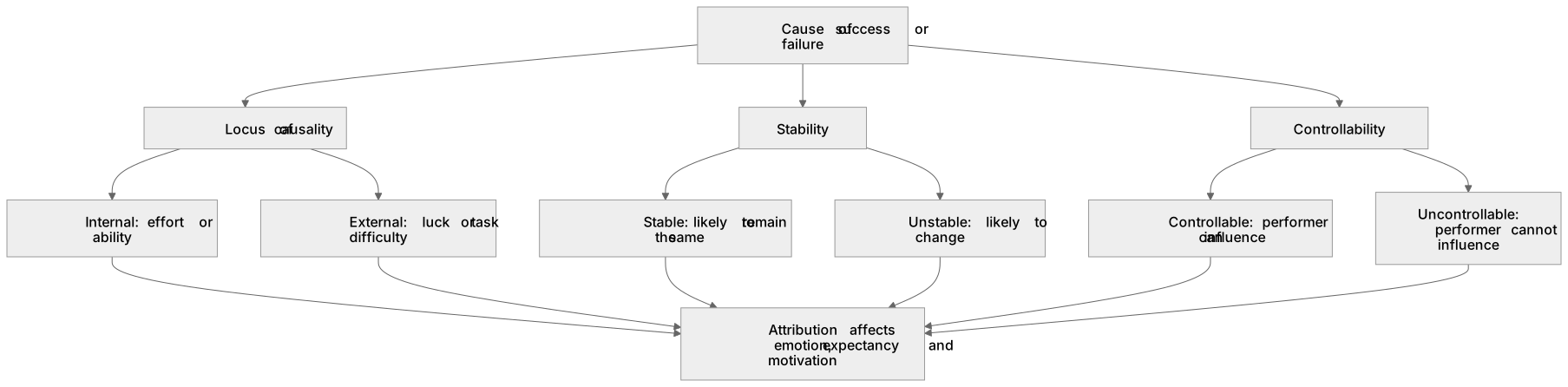
Weiner’s Model classifies the causes performers give for success and failure using dimensions such as locus of causality, stability and controllability.
Checked against the AQA 7582 specification (opens in a new tab) on .
- Point 2 of 8
- 4 key terms
Study notes
From the checked teaching notes for this specification point.
The idea
Weiner’s Model classifies the causes performers give for success and failure using dimensions such as locus of causality, stability and controllability. In sport, a footballer who misses a penalty may attribute it to low ability (internal, stable, uncontrollable), to poor luck (external, unstable, uncontrollable) or to insufficient practice (internal, unstable, controllable). The chosen cause affects emotion, expectancy and motivation. Attributing failure to controllable, unstable causes such as effort or tactics tends to support persistence and constructive adjustment. Attributing failure to stable, uncontrollable causes such as lack of ability can lower expectancy of success and reduce persistence. Coaches can therefore use feedback and reflection to guide attributions towards causes that are accurate, controllable and changeable, while avoiding false reassurance.
What earns the marks
- Weiner’s Model classifies the causes of success and failure using dimensions such as locus of causality, stability and controllability.
- Locus of causality refers to whether the cause is internal to the performer, such as effort or ability, or external, such as luck or task difficulty.
- Stability refers to whether the cause is likely to remain the same over time, such as natural ability, or to change, such as effort or tactics.
- Controllability refers to whether the performer can influence the cause, such as preparation, or cannot, such as weather or an opponent’s brilliance.
- In sporting situations, attributing failure to controllable and unstable causes, such as insufficient effort or poor tactics, can maintain motivation and persistence.
- Attributing failure to stable and uncontrollable causes, such as lack of ability, can reduce expectancy of success and learned persistence.
- Coaches and teachers can shape attributions through feedback, questioning and reflection so that performers focus on changeable and controllable factors.
Common mistakes and how to put them right
Misunderstanding: Weiner’s Model only uses internal and external causes.
Put it right: The model also uses stability and controllability, and a cause can be classified on all three dimensions.
Misunderstanding: attributing failure to lack of ability always increases effort.
Put it right: A stable, uncontrollable ability attribution can lower expectancy and reduce persistence.
Misunderstanding: all external attributions are unhealthy.
Put it right: An external, unstable and uncontrollable cause such as bad luck may protect self-esteem in the short term, though it may not support constructive change.
Misunderstanding: coaches should tell performers that failure was due to effort regardless of the truth.
Put it right: Attributions should be accurate and evidence-based, focusing on genuinely controllable and changeable factors.
Exam tips
- When applying the model, name the dimension and link it to a specific sporting example, such as a sprinter attributing a slow start to poor reaction practice.
- Check that each attribution is classified on the dimension the question asks about, rather than simply labelled internal or external.
- Use the consequence of the attribution, such as persistence or reduced confidence, to show understanding of its application.
Try the lesson
The start of the Attribution theory: Weiner’s Model and its application to sporting situations. lesson, made from checked teaching notes for this specification point.
Have a go first
In Weiner's model, a footballer who attributes a missed penalty to having practised penalties too little that week is making an attribution that is classified as which type?
Listen
Weiner’s Model classifies the causes performers give for success and failure using dimensions such as locus of causality, stability and controllability. In sport, a footballer who misses a penalty may attribute it to low ability (internal, stable, uncontrollable), to poor luck (external, unstable, uncontrollable) or to insufficient practice (internal, unstable, controllable). The chosen cause affects emotion, expectancy and motivation. Attributing failure to controllable, unstable causes such as effort or tactics tends to support persistence and constructive adjustment. Attributing failure to stable, uncontrollable causes such as lack of ability can lower expectancy of success and reduce persistence. Coaches can therefore use feedback and reflection to guide attributions towards causes that are accurate, controllable and changeable, while avoiding false reassurance. A strong answer earns marks for these points. Weiner’s Model classifies the causes of success and failure using dimensions such as locus of causality, stability and controllability. Locus of causality refers to whether the cause is internal to the performer, such as effort or ability, or external, such as luck or task difficulty. Stability refers to whether the cause is likely to remain the same over time, such as natural ability, or to change, such as effort or tactics. Controllability refers to whether the performer can influence the cause, such as preparation, or cannot, such as weather or an opponent’s brilliance. A common slip: Misunderstanding: Weiner’s Model only uses internal and external causes. Instead, the model also uses stability and controllability, and a cause can be classified on all three dimensions. Exam tip: When applying the model, name the dimension and link it to a specific sporting example, such as a sprinter attributing a slow start to poor reaction practice.
See it
Key words
Say what each word means before you turn the card.
Weiner’s dimensional classification of causes
Try answering aloud or in your head before turning the card.
Application to success and failure in sport
Try answering aloud or in your head before turning the card.
Attribution, emotion and expectancy
Try answering aloud or in your head before turning the card.
Coach and teacher influence on attributions
Try answering aloud or in your head before turning the card.
See every definition
- Weiner’s dimensional classification of causes
- Classifies the causes performers give for success and failure using dimensions such as locus of causality, stability and controllability.
- Application to success and failure in sport
- In sport, a performer may attribute failure to low ability, poor luck or insufficient practice, and the chosen cause affects emotion, expectancy and motivation.
- Attribution, emotion and expectancy
- Attributing failure to stable, uncontrollable causes such as lack of ability can lower expectancy of success and reduce persistence.
- Coach and teacher influence on attributions
- Coaches can use feedback and reflection to guide attributions towards causes that are accurate, controllable and changeable, while avoiding false reassurance.
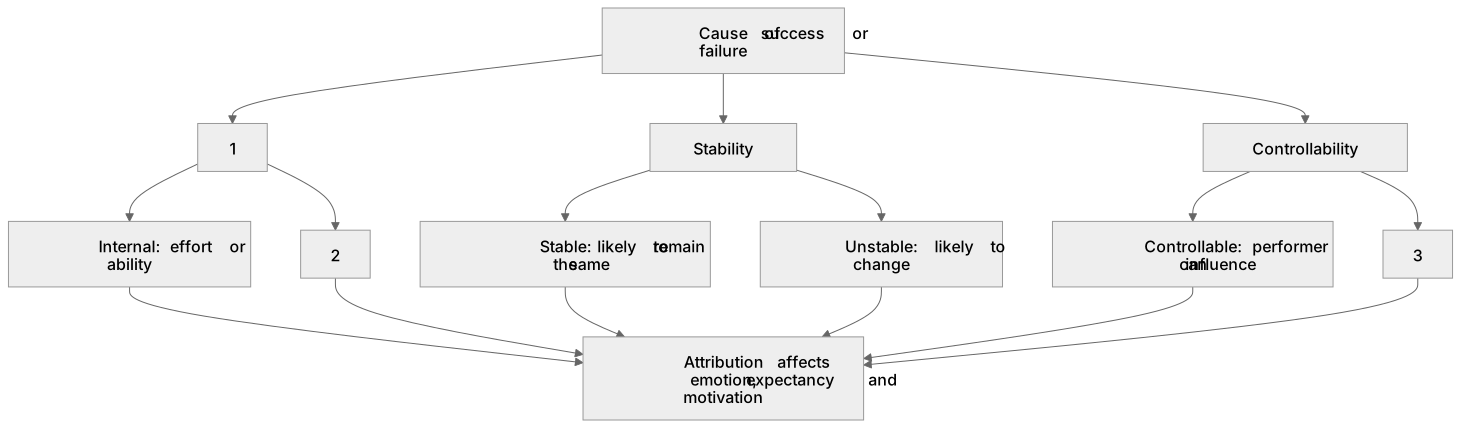
Label the diagram
Some boxes have lost their names. Pick the right name for each number.
1Box 1
2Box 2
3Box 3
There is more to this lesson
The full lesson goes on to check your understanding and help you earn the marks. Create a free account to carry on, with your progress saved.
A week of Premium from your first lesson · Then the free plan continues · No card, no charge
Test your understanding of Attribution theory: Weiner’s Model and its application to sporting situations.
Active recall beats re-reading. Take an instant quiz now to test what you’ve learned and lock it into long-term memory.
A week of Premium from your first lesson · Then the free plan continues · No card, no charge