AQA · A-Level · Physical Education
Course version: 7582 · Version from Sept 2016
Attribution theory: Learned helplessness.
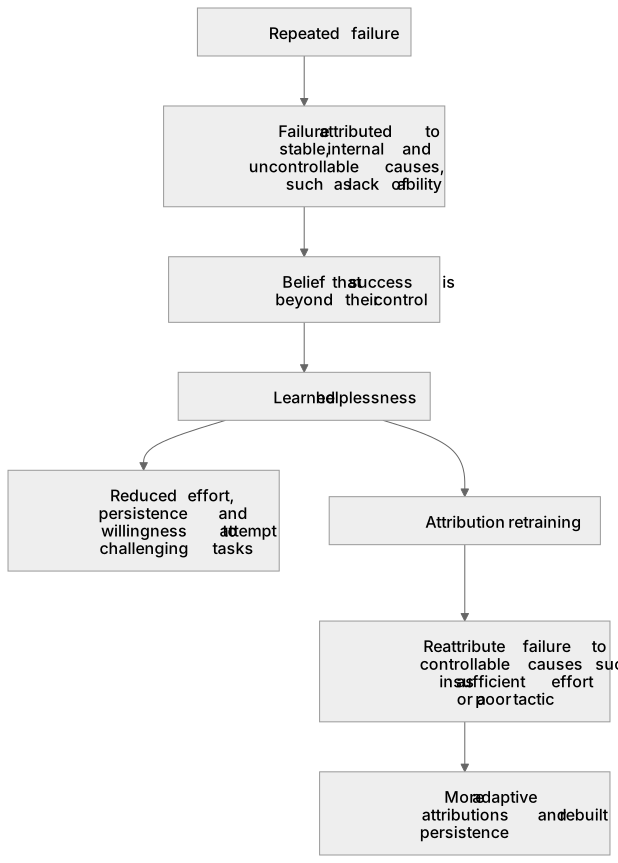
Learned helplessness is a state in which a performer, after repeated failure, comes to believe that success is beyond their control and stops trying.
Checked against the AQA 7582 specification (opens in a new tab) on .
- Point 6 of 8
- 3 key terms
Study notes
From the checked teaching notes for this specification point.
The idea
Learned helplessness is a state in which a performer, after repeated failure, comes to believe that success is beyond their control and stops trying. In AQA A-level PE attribution theory, it develops when failure is attributed to stable, internal and uncontrollable causes such as lack of ability. A tennis player who loses several matches may decide they are simply not good enough and give up before the next match, even when improvement is possible. The opposite pattern, learned optimism, involves attributing failure to controllable and temporary causes such as insufficient effort or a poor tactic. Multiple-choice questions test the definition, the attribution pattern that causes it and strategies such as attribution retraining that can reduce it.
What earns the marks
- Defines learned helplessness as a belief that failure is inevitable and beyond personal control.
- Identifies the attribution pattern: stable, internal and uncontrollable causes, especially lack of ability.
- Explains the behavioural consequence: reduced effort, persistence and willingness to attempt challenging tasks.
- Contrasts learned helplessness with adaptive attributions to controllable causes such as effort or strategy.
- Links learned helplessness to attribution theory's categories: ability, effort, task difficulty and luck.
- States that attribution retraining can help a performer move from helplessness to more adaptive attributions.
Common mistakes and how to put them right
Misunderstanding: learned helplessness is the same as low self-esteem.
Put it right: It is a specific belief that outcomes are uncontrollable, which then reduces effort and persistence.
Misunderstanding: learned helplessness happens after a single failure.
Put it right: It develops after repeated failure attributed to stable, uncontrollable causes.
Misunderstanding: learned helplessness is caused by attributing failure to lack of effort.
Put it right: Effort is controllable, so that attribution usually protects motivation; helplessness is linked to uncontrollable causes such as lack of ability.
Misunderstanding: learned helplessness cannot be changed.
Put it right: Attribution retraining can help performers reattribute failure to controllable causes and rebuild persistence.
Exam tips
- Look for the key phrase 'no matter what I do' or 'nothing I do makes a difference' in the question stem, which signals learned helplessness.
- Check whether the attribution in an option is stable and uncontrollable; that pattern is the hallmark of learned helplessness.
- Do not choose options that describe a single emotional reaction such as disappointment; learned helplessness is a persistent belief affecting future effort.
Try the lesson
The start of the Attribution theory: Learned helplessness. lesson, made from checked teaching notes for this specification point.
Have a go first
In attribution theory, what does the term learned helplessness describe?
Listen
Learned helplessness is a state in which a performer, after repeated failure, comes to believe that success is beyond their control and stops trying. In AQA A-level PE attribution theory, it develops when failure is attributed to stable, internal and uncontrollable causes such as lack of ability. A tennis player who loses several matches may decide they are simply not good enough and give up before the next match, even when improvement is possible. The opposite pattern, learned optimism, involves attributing failure to controllable and temporary causes such as insufficient effort or a poor tactic. Multiple-choice questions test the definition, the attribution pattern that causes it and strategies such as attribution retraining that can reduce it. A strong answer earns marks for these points. Defines learned helplessness as a belief that failure is inevitable and beyond personal control. Identifies the attribution pattern: stable, internal and uncontrollable causes, especially lack of ability. Explains the behavioural consequence: reduced effort, persistence and willingness to attempt challenging tasks. Contrasts learned helplessness with adaptive attributions to controllable causes such as effort or strategy. A common slip: Misunderstanding: learned helplessness is the same as low self-esteem. Instead, it is a specific belief that outcomes are uncontrollable, which then reduces effort and persistence. Exam tip: Look for the key phrase 'no matter what I do' or 'nothing I do makes a difference' in the question stem, which signals learned helplessness.
See it
Key words
Say what each word means before you turn the card.
Learned helplessness
Try answering aloud or in your head before turning the card.
Learned optimism
Try answering aloud or in your head before turning the card.
Attribution retraining
Try answering aloud or in your head before turning the card.
See every definition
- Learned helplessness
- A state in which a performer, after repeated failure, comes to believe that success is beyond their control and stops trying.
- Learned optimism
- Attributing failure to controllable and temporary causes such as insufficient effort or a poor tactic.
- Attribution retraining
- A strategy that can help a performer move from helplessness to more adaptive attributions.
Label the diagram
Some boxes have lost their names. Pick the right name for each number.
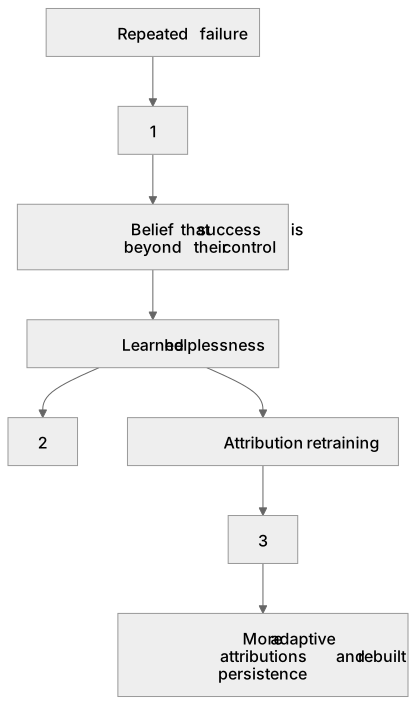
1Box 1
2Box 2
3Box 3
There is more to this lesson
The full lesson goes on to check your understanding and help you earn the marks. Create a free account to carry on, with your progress saved.
A week of Premium from your first lesson · Then the free plan continues · No card, no charge
Test your understanding of Attribution theory: Learned helplessness.
Active recall beats re-reading. Take an instant quiz now to test what you’ve learned and lock it into long-term memory.
A week of Premium from your first lesson · Then the free plan continues · No card, no charge