AQA · A-Level · Physical Education
Course version: 7582 · Version from Sept 2016
Attribution theory: Attribution retraining.
Attribution retraining is a cognitive intervention that helps a performer replace unhelpful explanations for failure with more adaptive ones.
Checked against the AQA 7582 specification (opens in a new tab) on .
- Point 5 of 8
- 4 key terms
Study notes
From the checked teaching notes for this specification point.
The idea
Attribution retraining is a cognitive intervention that helps a performer replace unhelpful explanations for failure with more adaptive ones. In AQA A-level PE, attribution theory explains how performers attribute success and failure to causes such as ability, effort, task difficulty and luck. Retraining targets maladaptive patterns, especially attributing failure to stable, internal and uncontrollable causes like lack of ability. A coach might guide a gymnast who falls on a beam to attribute the fall to insufficient practice or a specific technique error rather than to being 'no good'. Over time, the performer learns to link failure with controllable effort or strategy, which protects motivation and persistence. Retraining is assessed through multiple-choice questions that test definition, purpose and the distinction between adaptive and maladaptive attributions.
What earns the marks
- Defines attribution retraining as changing the causes a performer uses to explain success and failure.
- Identifies the purpose: to replace maladaptive attributions with more adaptive, usually controllable, ones.
- Links retraining to attribution theory's categories: ability, effort, task difficulty and luck.
- Explains that maladaptive attributions often involve stable, internal and uncontrollable causes such as lack of ability.
- Explains that adaptive attributions often involve controllable causes such as effort or strategy.
- States a benefit: improved persistence, motivation and willingness to try again after failure.
Common mistakes and how to put them right
Misunderstanding: attribution retraining is the same as positive reinforcement.
Put it right: It changes the performer's explanation of why an outcome happened, not just the reward given.
Misunderstanding: retraining only works for success.
Put it right: It is mainly used to change how a performer explains failure so that failure does not destroy motivation.
Misunderstanding: attributing failure to lack of ability is always helpful because it is honest.
Put it right: Stable, uncontrollable ability attributions tend to reduce persistence; controllable effort or strategy attributions are more adaptive.
Misunderstanding: retraining means ignoring the real cause of failure.
Put it right: It means identifying a controllable cause, such as poor technique or insufficient practice, and using that as the basis for improvement.
Exam tips
- Read the question stem carefully to identify whether it asks for the definition, the purpose or an example of attribution retraining.
- Eliminate options that describe unrelated concepts such as goal setting, mental rehearsal or positive reinforcement.
- When two options seem similar, choose the one that mentions changing the cause attributed to failure rather than changing the outcome itself.
Try the lesson
The start of the Attribution theory: Attribution retraining. lesson, made from checked teaching notes for this specification point.
Have a go first
What is the primary aim of attribution retraining for a performer who habitually blames failure on a lack of natural ability?
Listen
Attribution retraining is a cognitive intervention that helps a performer replace unhelpful explanations for failure with more adaptive ones. In AQA A-level PE, attribution theory explains how performers attribute success and failure to causes such as ability, effort, task difficulty and luck. Retraining targets maladaptive patterns, especially attributing failure to stable, internal and uncontrollable causes like lack of ability. A coach might guide a gymnast who falls on a beam to attribute the fall to insufficient practice or a specific technique error rather than to being 'no good'. Over time, the performer learns to link failure with controllable effort or strategy, which protects motivation and persistence. Retraining is assessed through multiple-choice questions that test definition, purpose and the distinction between adaptive and maladaptive attributions. A strong answer earns marks for these points. Defines attribution retraining as changing the causes a performer uses to explain success and failure. Identifies the purpose: to replace maladaptive attributions with more adaptive, usually controllable, ones. Links retraining to attribution theory's categories: ability, effort, task difficulty and luck. Explains that maladaptive attributions often involve stable, internal and uncontrollable causes such as lack of ability. A common slip: Misunderstanding: attribution retraining is the same as positive reinforcement. Instead, it changes the performer's explanation of why an outcome happened, not just the reward given. Exam tip: Read the question stem carefully to identify whether it asks for the definition, the purpose or an example of attribution retraining.
See it
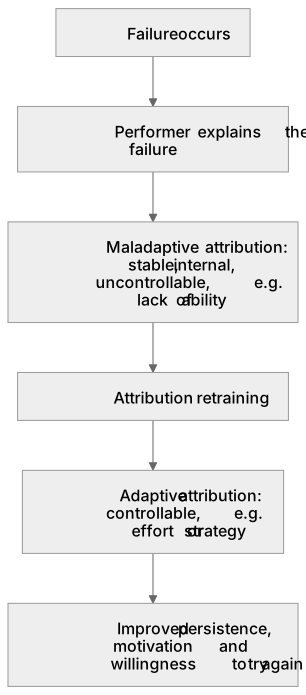
Put it in order
Put these steps in the order they happen.
- 1. Maladaptive attribution: stable, internal, uncontrollable, e.g. lack of ability
- 2. Performer explains the failure
- 3. Failure occurs
- 4. Improved persistence, motivation and willingness to try again
- 5. Adaptive attribution: controllable, e.g. effort or strategy
- 6. Attribution retraining
Key words
Say what each word means before you turn the card.
Attribution retraining
Try answering aloud or in your head before turning the card.
Attribution theory
Try answering aloud or in your head before turning the card.
Maladaptive attributions
Try answering aloud or in your head before turning the card.
Adaptive attributions
Try answering aloud or in your head before turning the card.
See every definition
- Attribution retraining
- A cognitive intervention that helps a performer replace unhelpful explanations for failure with more adaptive ones.
- Attribution theory
- Explains how performers attribute success and failure to causes such as ability, effort, task difficulty and luck.
- Maladaptive attributions
- Explanations for failure that often involve stable, internal and uncontrollable causes such as lack of ability.
- Adaptive attributions
- Explanations for failure that often involve controllable causes such as effort or strategy.
Label the diagram
Some boxes have lost their names. Pick the right name for each number.
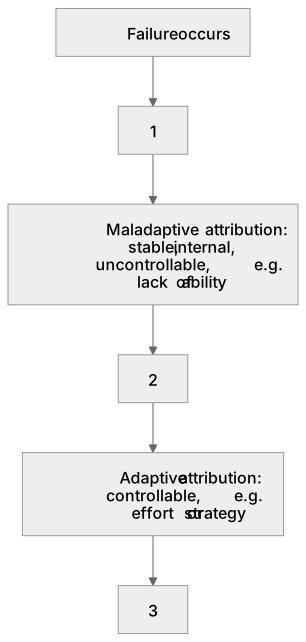
1Box 1
2Box 2
3Box 3
There is more to this lesson
The full lesson goes on to check your understanding and help you earn the marks. Create a free account to carry on, with your progress saved.
A week of Premium from your first lesson · Then the free plan continues · No card, no charge
Test your understanding of Attribution theory: Attribution retraining.
Active recall beats re-reading. Take an instant quiz now to test what you’ve learned and lock it into long-term memory.
A week of Premium from your first lesson · Then the free plan continues · No card, no charge