AQA · A-Level · Physical Education
Course version: 7582 · Version from Sept 2016
Biomechanical principles: Centre of mass.
The centre of mass is the point at which the whole mass of a body or object is considered to be concentrated, and it is the point about which the body balances in all directions.
Checked against the AQA 7582 specification (opens in a new tab) on .
- Point 5 of 7
- 4 key terms
Study notes
From the checked teaching notes for this specification point.
The idea
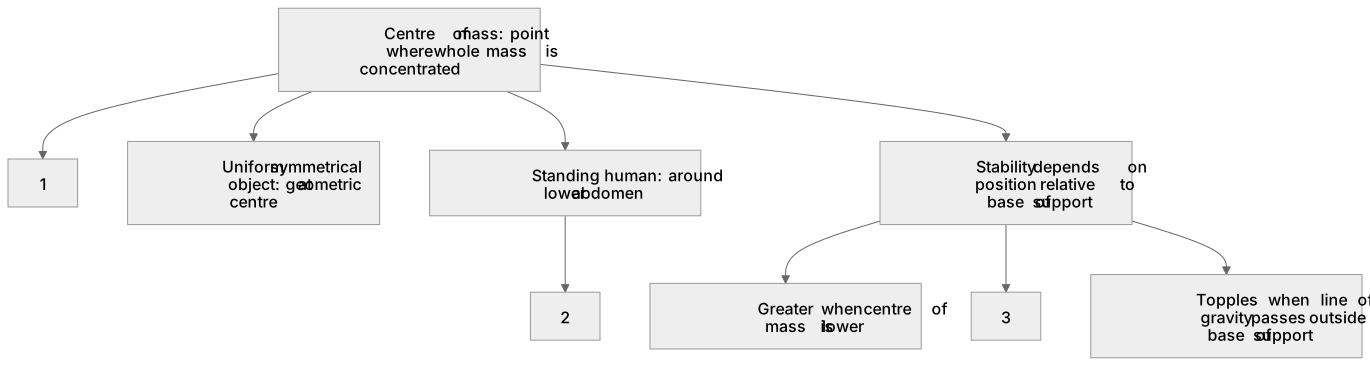
The centre of mass is the point at which the whole mass of a body or object is considered to be concentrated, and it is the point about which the body balances in all directions. In a uniform object such as a symmetrical ball, the centre of mass lies at its geometric centre. In a human performer, the centre of mass lies around the lower abdomen when standing upright, but it shifts when body parts move, for example when a gymnast raises both arms or tucks the knees. The centre of mass is important in biomechanics because stability depends on its position relative to the base of support: stability is greater when the centre of mass is lower and when the line of gravity falls within a wide base of support. A body topples when the line of gravity passes outside the base of support.
What earns the marks
- The centre of mass is the point at which the whole mass of a body or object is considered to be concentrated.
- In a uniform symmetrical object, the centre of mass is at its geometric centre.
- In a standing human, the centre of mass lies around the lower abdomen and shifts as body parts move.
- Stability depends on the position of the centre of mass relative to the base of support.
- Stability is greater when the centre of mass is lower and the base of support is wider.
- A body topples when the line of gravity passes outside the base of support.
Common mistakes and how to put them right
Assuming the centre of mass is always at the body's physical centre.
Put it right: In a human it lies around the lower abdomen when standing and shifts when limbs or the trunk move.
Confusing the centre of mass with the base of support.
Put it right: The centre of mass is a point related to mass distribution, whereas the base of support is the area beneath the body in contact with the ground.
Believing a lower centre of mass always reduces stability.
Put it right: A lower centre of mass generally increases stability, especially when combined with a wider base of support.
Thinking a body topples only when it moves quickly.
Put it right: A body topples when the line of gravity falls outside the base of support, regardless of speed.
Exam tips
- When asked about stability, refer to both the height of the centre of mass and the width of the base of support, because these are the two key factors.
- Use a sporting example such as a gymnast's tuck or a rugby player's crouched stance to show how the centre of mass shifts.
- Check whether the question asks about the centre of mass itself or about the line of gravity, because the two are related but not identical.
Try the lesson
The start of the Biomechanical principles: Centre of mass. lesson, made from checked teaching notes for this specification point.
Have a go first
Which statement best describes the centre of mass of a gymnast standing upright in a symmetrical position?
Listen
The centre of mass is the point at which the whole mass of a body or object is considered to be concentrated, and it is the point about which the body balances in all directions. In a uniform object such as a symmetrical ball, the centre of mass lies at its geometric centre. In a human performer, the centre of mass lies around the lower abdomen when standing upright, but it shifts when body parts move, for example when a gymnast raises both arms or tucks the knees. The centre of mass is important in biomechanics because stability depends on its position relative to the base of support: stability is greater when the centre of mass is lower and when the line of gravity falls within a wide base of support. A body topples when the line of gravity passes outside the base of support. A strong answer earns marks for these points. The centre of mass is the point at which the whole mass of a body or object is considered to be concentrated. In a uniform symmetrical object, the centre of mass is at its geometric centre. In a standing human, the centre of mass lies around the lower abdomen and shifts as body parts move. Stability depends on the position of the centre of mass relative to the base of support. A common slip: Assuming the centre of mass is always at the body's physical centre. Instead, in a human it lies around the lower abdomen when standing and shifts when limbs or the trunk move. Exam tip: When asked about stability, refer to both the height of the centre of mass and the width of the base of support, because these are the two key factors.
See it

Key words
Say what each word means before you turn the card.
Centre of mass
Try answering aloud or in your head before turning the card.
Centre of mass in uniform and non-uniform bodies
Try answering aloud or in your head before turning the card.
Relationship between centre of mass and stability
Try answering aloud or in your head before turning the card.
Line of gravity and the base of support
Try answering aloud or in your head before turning the card.
See every definition
- Centre of mass
- The point at which the whole mass of a body or object is considered to be concentrated, and the point about which the body balances in all directions.
- Centre of mass in uniform and non-uniform bodies
- In a uniform object such as a symmetrical ball it lies at its geometric centre, whereas in a human performer it lies around the lower abdomen when standing upright but shifts when body parts move.
- Relationship between centre of mass and stability
- Stability depends on its position relative to the base of support, being greater when the centre of mass is lower and when the line of gravity falls within a wide base of support.
- Line of gravity and the base of support
- A body topples when the line of gravity passes outside the base of support.
Label the diagram
Some boxes have lost their names. Pick the right name for each number.
1Box 1
2Box 2
3Box 3
There is more to this lesson
The full lesson goes on to check your understanding and help you earn the marks. Create a free account to carry on, with your progress saved.
A week of Premium from your first lesson · Then the free plan continues · No card, no charge
Test your understanding of Biomechanical principles: Centre of mass.
Active recall beats re-reading. Take an instant quiz now to test what you’ve learned and lock it into long-term memory.
A week of Premium from your first lesson · Then the free plan continues · No card, no charge