AQA · A-Level · Physical Education
Course version: 7582 · Version from Sept 2016
Biomechanical principles: Factors affecting stability.
Stability describes how resistant a body is to being displaced from its balanced position, and it depends on four interacting mechanical factors: the height of the centre of mass, the area of the…
Checked against the AQA 7582 specification (opens in a new tab) on .
- Point 6 of 7
- 4 key terms
Study notes
From the checked teaching notes for this specification point.
The idea
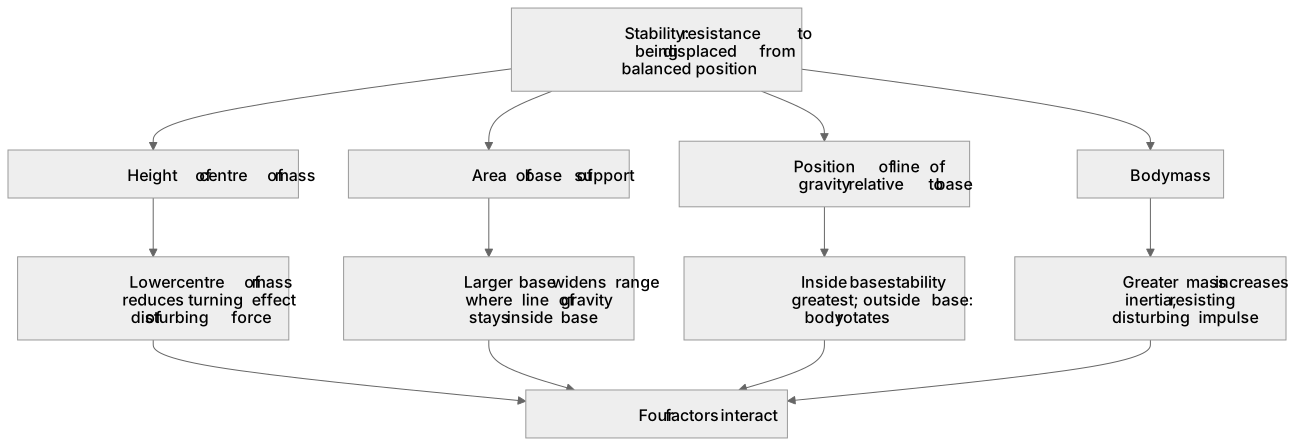
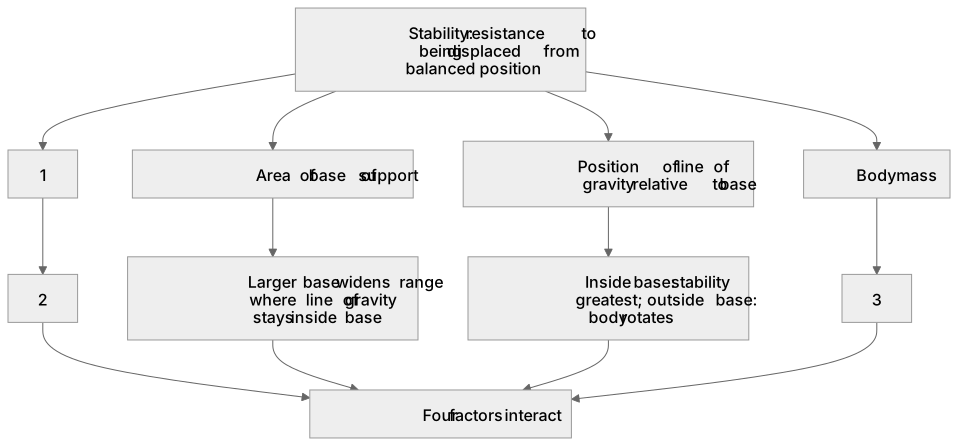
Stability describes how resistant a body is to being displaced from its balanced position, and it depends on four interacting mechanical factors: the height of the centre of mass, the area of the base of support, the position of the line of gravity relative to that base, and the body mass. A lower centre of mass reduces the turning effect of any disturbing force, so a crouched skier is harder to topple than an upright one. A larger base of support widens the range of positions in which the line of gravity still falls inside the base, so a wrestler spreads the feet. If the line of gravity passes outside the base, a restoring moment cannot be generated and the body rotates. Greater body mass increases inertia, so a heavier performer resists a given disturbing impulse more than a lighter one.
What earns the marks
- Stability is the resistance of a body to being displaced from its balanced position.
- Lowering the height of the centre of mass reduces the moment produced by a disturbing force about the edge of the base, increasing stability.
- Increasing the area of the base of support widens the range of positions in which the line of gravity remains within the base, increasing stability.
- Stability is greatest when the line of gravity falls within the base of support; if it passes outside the base, the body rotates and balance is lost.
- Greater body mass increases inertia, so a larger disturbing impulse is needed to produce the same change in motion, increasing resistance to displacement.
- The four factors interact: for example, a low centre of mass combined with a wide base gives more stability than either factor alone.
Common mistakes and how to put them right
Thinking that a higher centre of mass increases stability.
Put it right: Raising the centre of mass increases the moment arm of a disturbing force about the base edge, so stability decreases.
Believing that body mass alone guarantees balance.
Put it right: Mass increases inertia and resistance to a disturbing impulse, but if the line of gravity falls outside the base of support the performer still topples.
Assuming a wide base always means maximum stability.
Put it right: The base must be wide in the direction of the expected disturbing force, and the line of gravity must remain inside it.
Confusing centre of mass with centre of gravity or treating them as unrelated.
Put it right: In a uniform gravitational field they coincide, and the line of gravity acts vertically through the centre of mass.
Exam tips
- Read the stem carefully and identify which single factor is being changed before selecting an option; distractors often describe a different factor.
- For each option, ask whether it lowers the centre of mass, widens the base, keeps the line of gravity inside the base, or increases mass, and reject options that do the opposite.
- Use sporting examples such as a crouched start in sprinting or a wide stance in rugby to test each option against a concrete situation.
Try the lesson
The start of the Biomechanical principles: Factors affecting stability. lesson, made from checked teaching notes for this specification point.
Have a go first
Which change would make a performer standing still more stable?
Listen
Stability describes how resistant a body is to being displaced from its balanced position, and it depends on four interacting mechanical factors: the height of the centre of mass, the area of the base of support, the position of the line of gravity relative to that base, and the body mass. A lower centre of mass reduces the turning effect of any disturbing force, so a crouched skier is harder to topple than an upright one. A larger base of support widens the range of positions in which the line of gravity still falls inside the base, so a wrestler spreads the feet. If the line of gravity passes outside the base, a restoring moment cannot be generated and the body rotates. Greater body mass increases inertia, so a heavier performer resists a given disturbing impulse more than a lighter one. A strong answer earns marks for these points. Stability is the resistance of a body to being displaced from its balanced position. Lowering the height of the centre of mass reduces the moment produced by a disturbing force about the edge of the base, increasing stability. Increasing the area of the base of support widens the range of positions in which the line of gravity remains within the base, increasing stability. Stability is greatest when the line of gravity falls within the base of support; if it passes outside the base, the body rotates and balance is lost. A common slip: Thinking that a higher centre of mass increases stability. Instead, raising the centre of mass increases the moment arm of a disturbing force about the base edge, so stability decreases. Exam tip: Read the stem carefully and identify which single factor is being changed before selecting an option; distractors often describe a different factor.
See it
Key words
Say what each word means before you turn the card.
Stability
Try answering aloud or in your head before turning the card.
Centre of mass and line of gravity
Try answering aloud or in your head before turning the card.
Base of support and toppling
Try answering aloud or in your head before turning the card.
Inertia and body mass
Try answering aloud or in your head before turning the card.
See every definition
- Stability
- Describes how resistant a body is to being displaced from its balanced position, and it depends on four interacting mechanical factors.
- Centre of mass and line of gravity
- A lower centre of mass reduces the turning effect of any disturbing force, and if the line of gravity passes outside the base, a restoring moment cannot be generated and the body rotates.
- Base of support and toppling
- A larger base of support widens the range of positions in which the line of gravity still falls inside the base, so a wrestler spreads the feet.
- Inertia and body mass
- Greater body mass increases inertia, so a heavier performer resists a given disturbing impulse more than a lighter one.
Label the diagram
Some boxes have lost their names. Pick the right name for each number.
1Box 1
2Box 2
3Box 3
There is more to this lesson
The full lesson goes on to check your understanding and help you earn the marks. Create a free account to carry on, with your progress saved.
A week of Premium from your first lesson · Then the free plan continues · No card, no charge
Test your understanding of Biomechanical principles: Factors affecting stability.
Active recall beats re-reading. Take an instant quiz now to test what you’ve learned and lock it into long-term memory.
A week of Premium from your first lesson · Then the free plan continues · No card, no charge