AQA · A-Level · Physical Education
Course version: 7582 · Version from Sept 2016
Height of centre of mass, area of base of support, position of line of…
Full specification wording
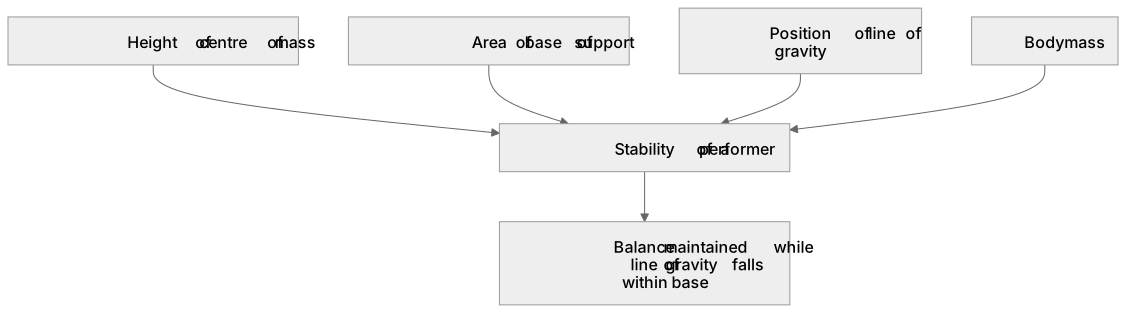
Biomechanical principles: Height of centre of mass, area of base of support, position of line of gravity and body mass.
These four quantities determine how stable a performer is.
Checked against the AQA 7582 specification (opens in a new tab) on .
- Point 7 of 7
- 3 key terms
Study notes
From the checked teaching notes for this specification point.
The idea
These four quantities determine how stable a performer is. The height of the centre of mass sets how far above the base the body's mass acts: a lower centre of mass increases stability because a greater angle of tilt is required before the line of gravity falls outside the base. The area of the base of support is the region bounded by the points of contact with the ground; a larger area allows the line of gravity to move further before leaving the base. The position of the line of gravity, which acts vertically downwards through the centre of mass, must fall within the base for balance to be maintained. Body mass contributes inertia, so a heavier performer requires a larger impulse to be displaced. In a rugby scrum, a low, wide stance with mass concentrated forward keeps the line of gravity inside the base.
What earns the marks
- The height of the centre of mass is the vertical distance of the centre of mass above the base of support.
- A lower centre of mass increases stability because the body must be tilted through a greater angle before the line of gravity falls outside the base of support.
- The area of the base of support is the region enclosed by the contact points with the ground; a larger area increases the range of positions in which the line of gravity remains inside the base.
- The line of gravity acts vertically downwards through the centre of mass; balance is maintained while it falls within the base of support.
- Body mass determines inertia; a greater mass means a given disturbing impulse produces a smaller change in motion, so the performer is harder to displace.
- The four factors combine: for example, a gymnast on a beam uses a low centre of mass, a narrow but carefully aligned base, a controlled line of gravity and body mass to maintain balance.
Common mistakes and how to put them right
Confusing the centre of mass with the geometric centre of the body.
Put it right: The centre of mass depends on the distribution of mass, so it shifts when limbs move or when equipment is carried.
Thinking that the line of gravity must pass through the centre of the base.
Put it right: It only needs to fall anywhere within the area of the base of support for balance to be maintained.
Believing that a larger body mass always improves stability.
Put it right: Mass increases inertia and resistance to displacement, but a high centre of mass or a line of gravity outside the base can still cause toppling.
Treating the base of support as only the feet.
Put it right: Any body part in contact with the ground, such as a hand in a gymnastics support, contributes to the base of support.
Exam tips
- For each option, decide which of the four factors it changes and whether that change increases or decreases stability.
- Sketch a simple stick figure with the base and the line of gravity to check whether an option keeps the line inside the base.
- Eliminate options that describe a factor not mentioned in the stem, as these are common distractors.
Try the lesson
The start of the Biomechanical principles: Height of centre of mass, area of base of support, position of line of gravity and body mass. lesson, made from checked teaching notes for this specification point.
Have a go first
A gymnast holds a balanced handstand on the floor. Which change would make the position more stable?
Listen
These four quantities determine how stable a performer is. The height of the centre of mass sets how far above the base the body's mass acts: a lower centre of mass increases stability because a greater angle of tilt is required before the line of gravity falls outside the base. The area of the base of support is the region bounded by the points of contact with the ground; a larger area allows the line of gravity to move further before leaving the base. The position of the line of gravity, which acts vertically downwards through the centre of mass, must fall within the base for balance to be maintained. Body mass contributes inertia, so a heavier performer requires a larger impulse to be displaced. In a rugby scrum, a low, wide stance with mass concentrated forward keeps the line of gravity inside the base. A strong answer earns marks for these points. The height of the centre of mass is the vertical distance of the centre of mass above the base of support. A lower centre of mass increases stability because the body must be tilted through a greater angle before the line of gravity falls outside the base of support. The area of the base of support is the region enclosed by the contact points with the ground; a larger area increases the range of positions in which the line of gravity remains inside the base. The line of gravity acts vertically downwards through the centre of mass; balance is maintained while it falls within the base of support. A common slip: Confusing the centre of mass with the geometric centre of the body. Instead, the centre of mass depends on the distribution of mass, so it shifts when limbs move or when equipment is carried. Exam tip: For each option, decide which of the four factors it changes and whether that change increases or decreases stability.
See it
Key words
Say what each word means before you turn the card.
Base of support and contact area
Try answering aloud or in your head before turning the card.
Line of gravity and balance
Try answering aloud or in your head before turning the card.
Body mass and inertia
Try answering aloud or in your head before turning the card.
See every definition
- Base of support and contact area
- The region enclosed by the contact points with the ground; a larger area increases the range of positions in which the line of gravity remains inside the base.
- Line of gravity and balance
- It acts vertically downwards through the centre of mass, and balance is maintained while it falls within the base of support.
- Body mass and inertia
- Body mass determines inertia; a greater mass means a given disturbing impulse produces a smaller change in motion, so the performer is harder to displace.
Label the diagram
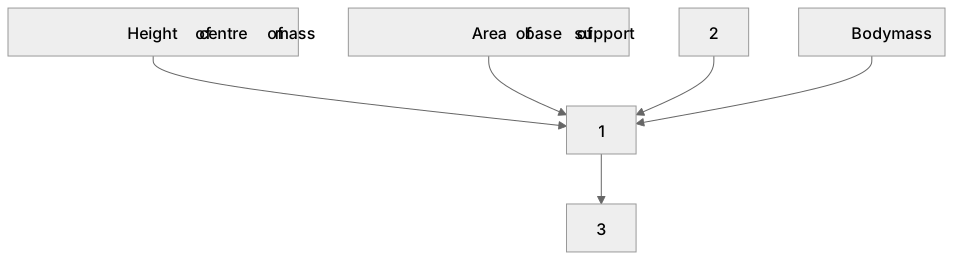
Some boxes have lost their names. Pick the right name for each number.
1Box 1
2Box 2
3Box 3
There is more to this lesson
The full lesson goes on to check your understanding and help you earn the marks. Create a free account to carry on, with your progress saved.
A week of Premium from your first lesson · Then the free plan continues · No card, no charge
Test your understanding of Biomechanical principles: Height of centre of mass, area of base of support, position of line of gravity and body mass.
Active recall beats re-reading. Take an instant quiz now to test what you’ve learned and lock it into long-term memory.
A week of Premium from your first lesson · Then the free plan continues · No card, no charge