AQA · A-Level · Physical Education
Course version: 7582 · Version from Sept 2016
Cardiovascular system: Mechanisms.
In this section, "mechanisms" means the physiological processes by which the cardiovascular system responds to exercise and maintains blood flow.
Checked against the AQA 7582 specification (opens in a new tab) on .
- Point 18 of 25
- 4 key terms
Study notes
From the checked teaching notes for this specification point.
The idea
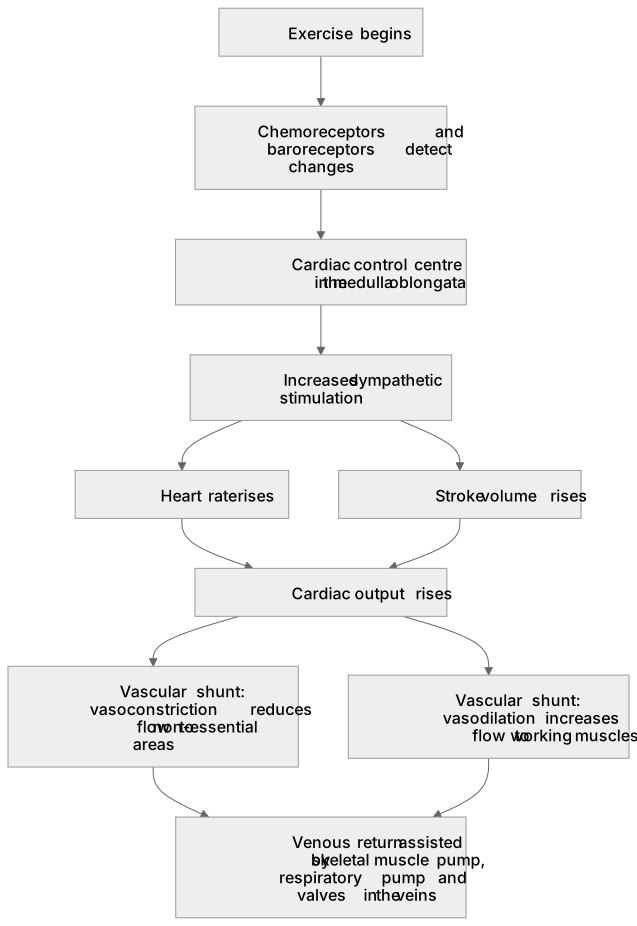
In this section, "mechanisms" means the physiological processes by which the cardiovascular system responds to exercise and maintains blood flow. You need to know how heart rate, stroke volume and cardiac output interact, how the vascular shunt redirects blood from non-essential areas to working muscles, and how venous return is assisted by the skeletal muscle pump, the respiratory pump and valves in the veins. A useful method is to trace one pathway: during exercise, chemoreceptors and baroreceptors detect changes, the cardiac control centre in the medulla oblongata increases sympathetic stimulation, so heart rate and stroke volume rise, raising cardiac output. Cardiac output equals heart rate multiplied by stroke volume, so if heart rate is 150 beats per minute and stroke volume is 100 cm³, cardiac output is 15 000 cm³ per minute, or 15 dm³ per minute.
What earns the marks
- Cardiac output is the product of heart rate and stroke volume, so changes in either variable alter the volume of blood pumped per minute.
- The cardiac control centre in the medulla oblongata regulates heart rate through the sympathetic and parasympathetic nervous systems.
- Chemoreceptors detect changes in blood carbon dioxide and pH, while baroreceptors detect changes in blood pressure, and both feed information back to the control centre.
- The vascular shunt redirects blood flow: vasoconstriction reduces flow to non-essential areas such as the digestive system, while vasodilation increases flow to working muscles.
- Venous return is assisted by the skeletal muscle pump, the respiratory pump and one-way valves in the veins, which prevent backflow.
Common mistakes and how to put them right
Thinking cardiac output is only heart rate.
Put it right: Cardiac output is heart rate multiplied by stroke volume, so both must be considered.
Confusing vasodilation with vasoconstriction.
Put it right: Vasodilation widens vessels to increase blood flow to working muscles, while vasoconstriction narrows vessels to reduce flow elsewhere.
Believing blood is redirected by the heart alone.
Put it right: The vascular shunt depends on arterioles changing diameter under nervous and local control.
Assuming venous return relies only on the heart.
Put it right: The skeletal muscle pump, respiratory pump and venous valves all assist return of blood to the right atrium.
Exam tips
- Learn the cardiac output equation and practise substituting values with correct units, for example cm³ per minute or dm³ per minute.
- Link each receptor to the variable it detects: chemoreceptors to carbon dioxide and pH, baroreceptors to blood pressure.
- Use precise directional language such as "vasodilation increases blood flow to working muscles" rather than vague phrases like "blood goes to the muscles".
Try the lesson
The start of the Cardiovascular system: Mechanisms. lesson, made from checked teaching notes for this specification point.
Have a go first
During exercise, which mechanism assists venous return by compressing the veins in the legs when muscles contract?
Listen
In this section, "mechanisms" means the physiological processes by which the cardiovascular system responds to exercise and maintains blood flow. You need to know how heart rate, stroke volume and cardiac output interact, how the vascular shunt redirects blood from non-essential areas to working muscles, and how venous return is assisted by the skeletal muscle pump, the respiratory pump and valves in the veins. A useful method is to trace one pathway: during exercise, chemoreceptors and baroreceptors detect changes, the cardiac control centre in the medulla oblongata increases sympathetic stimulation, so heart rate and stroke volume rise, raising cardiac output. Cardiac output equals heart rate multiplied by stroke volume, so if heart rate is 150 beats per minute and stroke volume is 100 cm³, cardiac output is 15 000 cm³ per minute, or 15 dm³ per minute. A strong answer earns marks for these points. Cardiac output is the product of heart rate and stroke volume, so changes in either variable alter the volume of blood pumped per minute. The cardiac control centre in the medulla oblongata regulates heart rate through the sympathetic and parasympathetic nervous systems. Chemoreceptors detect changes in blood carbon dioxide and pH, while baroreceptors detect changes in blood pressure, and both feed information back to the control centre. The vascular shunt redirects blood flow: vasoconstriction reduces flow to non-essential areas such as the digestive system, while vasodilation increases flow to working muscles. A common slip: Thinking cardiac output is only heart rate. Instead, cardiac output is heart rate multiplied by stroke volume, so both must be considered. Exam tip: Learn the cardiac output equation and practise substituting values with correct units, for example cm³ per minute or dm³ per minute.
See it
Key words
Say what each word means before you turn the card.
Cardiac output
Try answering aloud or in your head before turning the card.
Cardiac control centre
Try answering aloud or in your head before turning the card.
Vascular shunt
Try answering aloud or in your head before turning the card.
Venous return
Try answering aloud or in your head before turning the card.
See every definition
- Cardiac output
- The product of heart rate and stroke volume, so changes in either variable alter the volume of blood pumped per minute.
- Cardiac control centre
- Located in the medulla oblongata, it regulates heart rate through the sympathetic and parasympathetic nervous systems.
- Vascular shunt
- Redirects blood flow, with vasoconstriction reducing flow to non-essential areas such as the digestive system and vasodilation increasing flow to working muscles.
- Venous return
- Assisted by the skeletal muscle pump, the respiratory pump and one-way valves in the veins, which prevent backflow.
Label the diagram
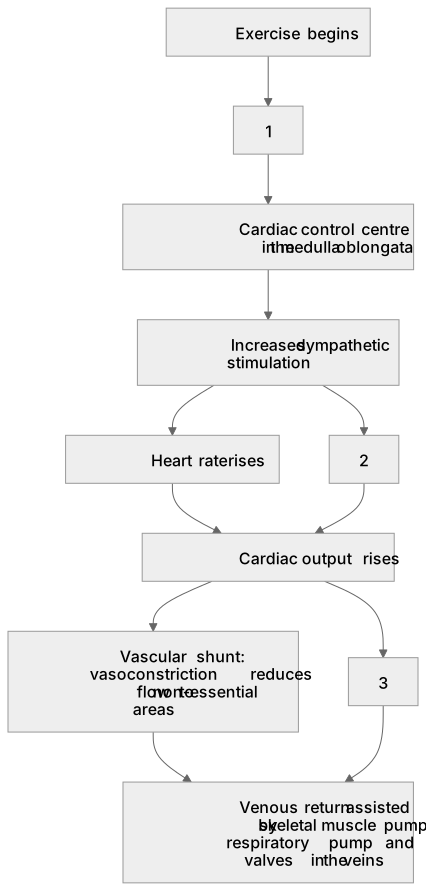
Some boxes have lost their names. Pick the right name for each number.
1Box 1
2Box 2
3Box 3
There is more to this lesson
The full lesson goes on to check your understanding and help you earn the marks. Create a free account to carry on, with your progress saved.
A week of Premium from your first lesson · Then the free plan continues · No card, no charge
Test your understanding of Cardiovascular system: Mechanisms.
Active recall beats re-reading. Take an instant quiz now to test what you’ve learned and lock it into long-term memory.
A week of Premium from your first lesson · Then the free plan continues · No card, no charge