AQA · A-Level · Physical Education
Course version: 7582 · Version from Sept 2016
Cardiovascular system: Venous return.
Venous return is the volume of blood flowing back to the heart through the veins per minute.
Checked against the AQA 7582 specification (opens in a new tab) on .
- Point 17 of 25
- 4 key terms
Study notes
From the checked teaching notes for this specification point.
The idea
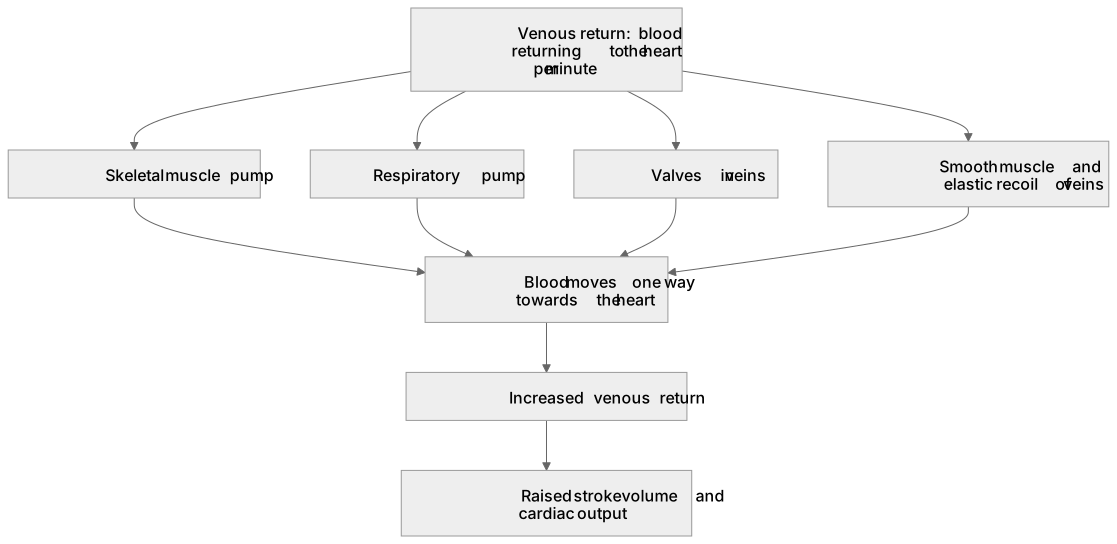
Venous return is the volume of blood flowing back to the heart through the veins per minute. It matters because cardiac output depends on it: the heart can only pump out what it receives, so stroke volume and cardiac output rise when venous return increases. Four mechanisms assist return against gravity: the skeletal muscle pump, where contracting muscles squeeze veins and valves keep blood moving one way; the respiratory pump, where pressure changes during breathing draw blood towards the thorax; valves in veins, which prevent backflow; and the smooth muscle and elastic recoil of veins, which maintain tone and help push blood onward. A useful method is to trace blood from the working legs back to the right atrium and name the mechanism acting at each stage.
What earns the marks
- Venous return is the volume of blood returning to the heart per minute.
- The skeletal muscle pump: contracting muscles compress veins, and valves ensure one-way flow.
- The respiratory pump: pressure changes in the thorax and abdomen during breathing assist flow towards the heart.
- Valves in veins prevent the backflow of blood.
- Smooth muscle and elastic recoil in vein walls maintain venous tone and help propel blood.
- Increased venous return raises stroke volume and cardiac output via the Frank-Starling mechanism.
Common mistakes and how to put them right
Thinking veins have no role in circulation because they are low pressure.
Put it right: Their valves, muscle pump and respiratory pump are essential to venous return.
Confusing venous return with cardiac output.
Put it right: Venous return is blood coming back to the heart, while cardiac output is blood pumped out.
Believing the skeletal muscle pump works when muscles relax.
Put it right: It is muscle contraction that compresses the veins.
Assuming valves push blood.
Put it right: Valves only prevent backflow; the pressure gradient and pumps provide the movement.
Exam tips
- Name each mechanism and then state exactly how it moves blood towards the heart.
- Use the term 'one-way flow' when describing the role of valves.
- Link venous return to stroke volume and cardiac output to show why it matters during exercise.
- Apply each mechanism to a sporting example, such as the leg muscles during running or breathing during cycling.
Try the lesson
The start of the Cardiovascular system: Venous return. lesson, made from checked teaching notes for this specification point.
Have a go first
Which two skeletal muscle actions together help return blood to the heart during exercise?
Listen
Venous return is the volume of blood flowing back to the heart through the veins per minute. It matters because cardiac output depends on it: the heart can only pump out what it receives, so stroke volume and cardiac output rise when venous return increases. Four mechanisms assist return against gravity: the skeletal muscle pump, where contracting muscles squeeze veins and valves keep blood moving one way; the respiratory pump, where pressure changes during breathing draw blood towards the thorax; valves in veins, which prevent backflow; and the smooth muscle and elastic recoil of veins, which maintain tone and help push blood onward. A useful method is to trace blood from the working legs back to the right atrium and name the mechanism acting at each stage. A strong answer earns marks for these points. Venous return is the volume of blood returning to the heart per minute. The skeletal muscle pump: contracting muscles compress veins, and valves ensure one-way flow. The respiratory pump: pressure changes in the thorax and abdomen during breathing assist flow towards the heart. Valves in veins prevent the backflow of blood. Exam tip: Name each mechanism and then state exactly how it moves blood towards the heart.
See it
Key words
Say what each word means before you turn the card.
Venous return
Try answering aloud or in your head before turning the card.
Skeletal muscle pump
Try answering aloud or in your head before turning the card.
Respiratory pump
Try answering aloud or in your head before turning the card.
Cardiac output
Try answering aloud or in your head before turning the card.
See every definition
- Venous return
- The volume of blood flowing back to the heart through the veins per minute.
- Skeletal muscle pump
- Contracting muscles squeeze veins and valves keep blood moving one way.
- Respiratory pump
- Pressure changes during breathing draw blood towards the thorax.
- Cardiac output
- Blood pumped out by the heart, which depends on venous return because the heart can only pump out what it receives.
Label the diagram
Some boxes have lost their names. Pick the right name for each number.
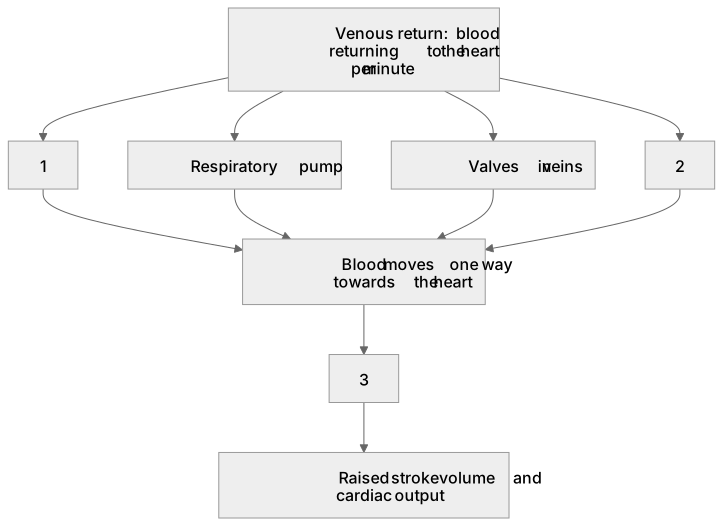
1Box 1
2Box 2
3Box 3
There is more to this lesson
The full lesson goes on to check your understanding and help you earn the marks. Create a free account to carry on, with your progress saved.
A week of Premium from your first lesson · Then the free plan continues · No card, no charge
Test your understanding of Cardiovascular system: Venous return.
Active recall beats re-reading. Take an instant quiz now to test what you’ve learned and lock it into long-term memory.
A week of Premium from your first lesson · Then the free plan continues · No card, no charge