AQA · A-Level · Physical Education
Course version: 7582 · Version from Sept 2016
Redistribution of blood (vascular shunting vasoconstriction, vasodilation).
Full specification wording
Cardiovascular system: Redistribution of blood (vascular shunting vasoconstriction, vasodilation).
Vascular shunting redirects blood flow during exercise.
Checked against the AQA 7582 specification (opens in a new tab) on .
- Point 6 of 25
- 4 key terms
Study notes
From the checked teaching notes for this specification point.
The idea
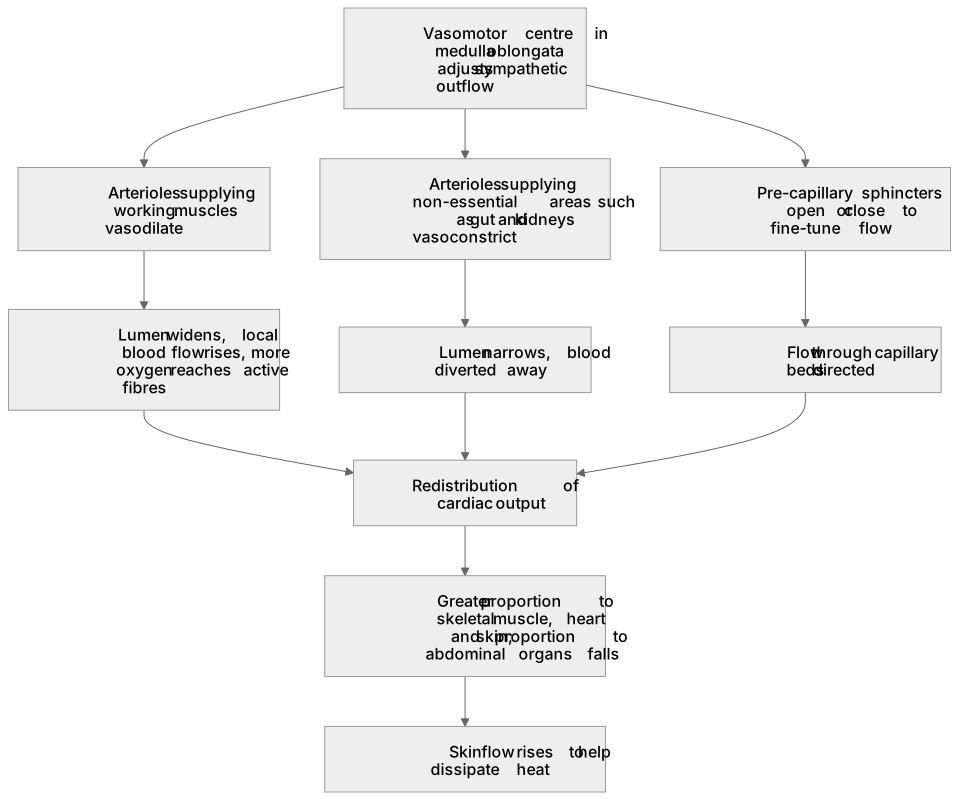
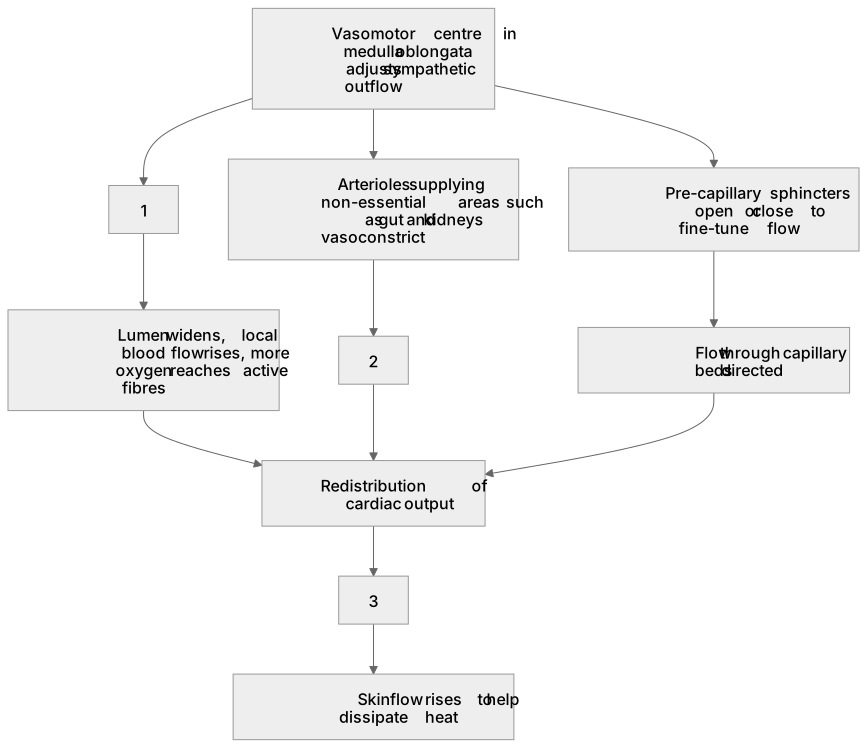
Vascular shunting redirects blood flow during exercise. Chemoreceptors and baroreceptors detect changes in blood gases and pressure, and the vasomotor centre in the medulla oblongata adjusts sympathetic outflow. Arterioles supplying working muscles vasodilate, widening their lumen so local blood flow rises and more oxygen reaches active fibres. Arterioles supplying non-essential areas such as the gut and kidneys vasoconstrict, narrowing their lumen so blood is diverted to where demand is greatest. Pre-capillary sphincters also open or close to fine-tune flow through capillary beds. The result is a redistribution of cardiac output: a greater proportion goes to skeletal muscle, the heart and skin, while the proportion to abdominal organs falls. Skin flow rises to help dissipate heat. This is not a change in total cardiac output alone but a change in its distribution.
What earns the marks
- Vascular shunting is the redistribution of blood flow to areas of greatest demand during exercise.
- Vasodilation widens arterioles supplying working muscles, increasing local blood flow and oxygen delivery.
- Vasoconstriction narrows arterioles supplying non-essential organs such as the gut and kidneys, diverting blood away.
- The vasomotor centre in the medulla oblongata controls sympathetic outflow to arterioles.
- Pre-capillary sphincters open or close to direct blood through specific capillary beds.
- Skin blood flow increases to aid heat loss, while the proportion of cardiac output to skeletal muscle rises.
Common mistakes and how to put them right
Thinking vasoconstriction occurs in working muscles.
Put it right by stating that working muscles vasodilate and non-essential organs vasoconstrict.
Confusing vasodilation with increased heart rate.
Put it right by explaining that vasodilation changes vessel diameter and local flow, not the rate of contraction.
Believing blood is created or destroyed during shunting.
Put it right by stating that the same cardiac output is redistributed, not increased in total by shunting alone.
Ignoring the role of the vasomotor centre.
Put it right by naming the medulla oblongata as the control centre for sympathetic outflow.
Exam tips
- Link each vessel change to its purpose: more oxygen to muscles, heat loss at the skin, blood diverted from the gut.
- Use precise terms such as arterioles, lumen and vasomotor centre rather than vague words like tubes or brain.
Try the lesson
The start of the Cardiovascular system: Redistribution of blood (vascular shunting vasoconstriction, vasodilation). lesson, made from checked teaching notes for this specification point.
Have a go first
During strenuous exercise, which change occurs in the arterioles supplying the working skeletal muscles?
Listen
Vascular shunting redirects blood flow during exercise. Chemoreceptors and baroreceptors detect changes in blood gases and pressure, and the vasomotor centre in the medulla oblongata adjusts sympathetic outflow. Arterioles supplying working muscles vasodilate, widening their lumen so local blood flow rises and more oxygen reaches active fibres. Arterioles supplying non-essential areas such as the gut and kidneys vasoconstrict, narrowing their lumen so blood is diverted to where demand is greatest. Pre-capillary sphincters also open or close to fine-tune flow through capillary beds. The result is a redistribution of cardiac output: a greater proportion goes to skeletal muscle, the heart and skin, while the proportion to abdominal organs falls. Skin flow rises to help dissipate heat. This is not a change in total cardiac output alone but a change in its distribution. A strong answer earns marks for these points. Vascular shunting is the redistribution of blood flow to areas of greatest demand during exercise. Vasodilation widens arterioles supplying working muscles, increasing local blood flow and oxygen delivery. Vasoconstriction narrows arterioles supplying non-essential organs such as the gut and kidneys, diverting blood away. The vasomotor centre in the medulla oblongata controls sympathetic outflow to arterioles. A common slip: Thinking vasoconstriction occurs in working muscles. Instead, stating that working muscles vasodilate and non-essential organs vasoconstrict. Exam tip: Link each vessel change to its purpose: more oxygen to muscles, heat loss at the skin, blood diverted from the gut.
See it
Key words
Say what each word means before you turn the card.
Vascular shunting
Try answering aloud or in your head before turning the card.
Vasodilation
Try answering aloud or in your head before turning the card.
Vasoconstriction
Try answering aloud or in your head before turning the card.
Vasomotor centre
Try answering aloud or in your head before turning the card.
See every definition
- Vascular shunting
- The redistribution of blood flow to areas of greatest demand during exercise, achieved through vasoconstriction and vasodilation.
- Vasodilation
- Widening of arterioles supplying working muscles, increasing local blood flow and oxygen delivery.
- Vasoconstriction
- Narrowing of arterioles supplying non-essential organs such as the gut and kidneys, diverting blood away.
- Vasomotor centre
- The centre in the medulla oblongata that controls sympathetic outflow to arterioles.
Label the diagram
Some boxes have lost their names. Pick the right name for each number.
1Box 1
2Box 2
3Box 3
There is more to this lesson
The full lesson goes on to check your understanding and help you earn the marks. Create a free account to carry on, with your progress saved.
A week of Premium from your first lesson · Then the free plan continues · No card, no charge
Test your understanding of Cardiovascular system: Redistribution of blood (vascular shunting vasoconstriction, vasodilation).
Active recall beats re-reading. Take an instant quiz now to test what you’ve learned and lock it into long-term memory.
A week of Premium from your first lesson · Then the free plan continues · No card, no charge