AQA · A-Level · Physical Education
Course version: 7582 · Version from Sept 2016
Cardiovascular system: Cardiac conduction system.
The cardiac conduction system coordinates each heartbeat.
Checked against the AQA 7582 specification (opens in a new tab) on .
- Point 7 of 25
- 4 key terms
Study notes
From the checked teaching notes for this specification point.
The idea
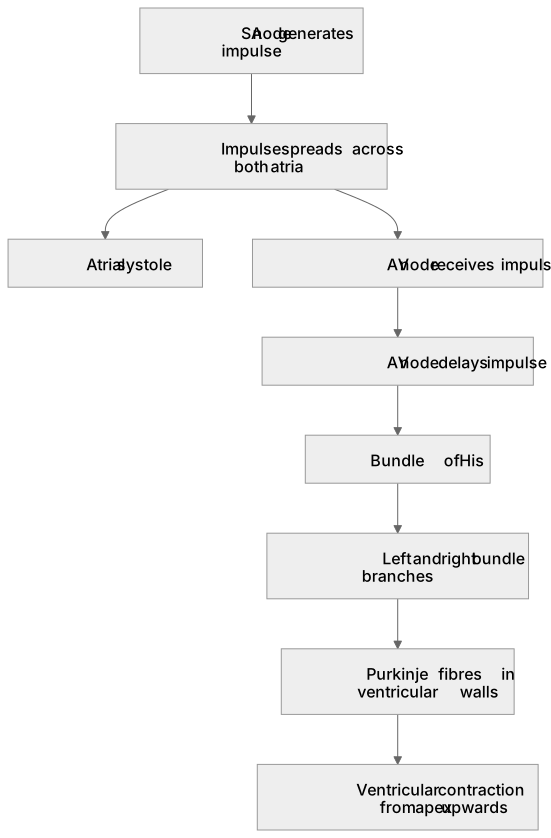
The cardiac conduction system coordinates each heartbeat. The sinoatrial node (SA node) in the right atrium acts as the pacemaker, generating an electrical impulse that spreads across both atria, causing atrial systole. The impulse reaches the atrioventricular node (AV node), which delays it briefly so the atria can finish emptying before the ventricles contract. The impulse then travels down the bundle of His, through the left and right bundle branches, and into the Purkinje fibres embedded in the ventricular walls. This network causes the ventricles to contract from the apex upwards, forcing blood into the aorta and pulmonary artery. The sequence ensures atria contract before ventricles, and the delay at the AV node prevents simultaneous contraction. Sympathetic and parasympathetic nerves modify the rate set by the SA node.
What earns the marks
- The sinoatrial node (SA node) initiates the impulse and acts as the pacemaker.
- The impulse spreads through the atria, causing atrial systole.
- The atrioventricular node (AV node) delays the impulse to allow atrial emptying before ventricular contraction.
- The impulse travels down the bundle of His and bundle branches to the Purkinje fibres.
- Purkinje fibres stimulate ventricular contraction from the apex upwards.
- The sequence ensures atria contract before ventricles, and autonomic nerves modify heart rate.
Common mistakes and how to put them right
Thinking the AV node is the pacemaker.
Put it right by stating the SA node sets the rhythm and the AV node delays the impulse.
Believing the impulse passes directly from atria to ventricles without a delay.
Put it right by explaining the AV nodal delay allows complete atrial emptying.
Confusing the bundle of His with the AV node.
Put it right by describing the bundle of His as the pathway from the AV node into the ventricular septum.
Stating that Purkinje fibres initiate the heartbeat.
Put it right by saying they conduct the impulse to ventricular muscle, which then contracts.
Exam tips
- Match each structure to its function rather than just its name.
- Remember the AV nodal delay is essential for efficient ventricular filling.
Try the lesson
The start of the Cardiovascular system: Cardiac conduction system. lesson, made from checked teaching notes for this specification point.
Have a go first
In the cardiac conduction system, which structure delays the electrical impulse before it passes into the ventricles?
Listen
The cardiac conduction system coordinates each heartbeat. The sinoatrial node (SA node) in the right atrium acts as the pacemaker, generating an electrical impulse that spreads across both atria, causing atrial systole. The impulse reaches the atrioventricular node (AV node), which delays it briefly so the atria can finish emptying before the ventricles contract. The impulse then travels down the bundle of His, through the left and right bundle branches, and into the Purkinje fibres embedded in the ventricular walls. This network causes the ventricles to contract from the apex upwards, forcing blood into the aorta and pulmonary artery. The sequence ensures atria contract before ventricles, and the delay at the AV node prevents simultaneous contraction. Sympathetic and parasympathetic nerves modify the rate set by the SA node. A strong answer earns marks for these points. The sinoatrial node (SA node) initiates the impulse and acts as the pacemaker. The impulse spreads through the atria, causing atrial systole. The atrioventricular node (AV node) delays the impulse to allow atrial emptying before ventricular contraction. The impulse travels down the bundle of His and bundle branches to the Purkinje fibres. A common slip: Thinking the AV node is the pacemaker. Instead, stating the SA node sets the rhythm and the AV node delays the impulse. Exam tip: Match each structure to its function rather than just its name.
See it
Key words
Say what each word means before you turn the card.
Pacemaker activity
Try answering aloud or in your head before turning the card.
Atrioventricular delay
Try answering aloud or in your head before turning the card.
Ventricular conduction pathways
Try answering aloud or in your head before turning the card.
Autonomic modulation of heart rate
Try answering aloud or in your head before turning the card.
See every definition
- Pacemaker activity
- The sinoatrial node in the right atrium generates an electrical impulse that spreads across both atria, causing atrial systole.
- Atrioventricular delay
- The atrioventricular node delays the impulse briefly so the atria can finish emptying before the ventricles contract.
- Ventricular conduction pathways
- The impulse travels down the bundle of His, through the left and right bundle branches, and into the Purkinje fibres embedded in the ventricular walls.
- Autonomic modulation of heart rate
- Sympathetic and parasympathetic nerves modify the rate set by the sinoatrial node.
Label the diagram
Some boxes have lost their names. Pick the right name for each number.
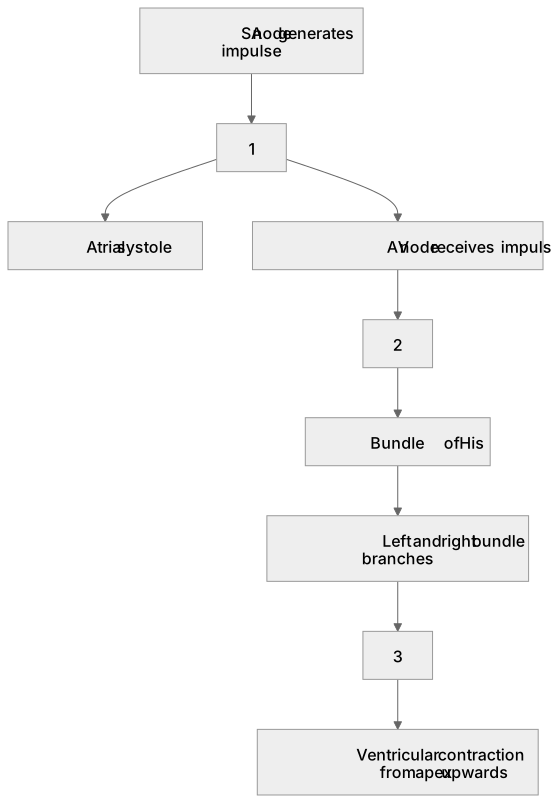
1Box 1
2Box 2
3Box 3
There is more to this lesson
The full lesson goes on to check your understanding and help you earn the marks. Create a free account to carry on, with your progress saved.
A week of Premium from your first lesson · Then the free plan continues · No card, no charge
Test your understanding of Cardiovascular system: Cardiac conduction system.
Active recall beats re-reading. Take an instant quiz now to test what you’ve learned and lock it into long-term memory.
A week of Premium from your first lesson · Then the free plan continues · No card, no charge