AQA · A-Level · Physical Education
Course version: 7582 · Version from Sept 2016
Cardiovascular system: Starling’s law of the heart.
Starling's law describes how the heart matches its output to the blood returning to it.
Checked against the AQA 7582 specification (opens in a new tab) on .
- Point 20 of 25
- 4 key terms
Study notes
From the checked teaching notes for this specification point.
The idea
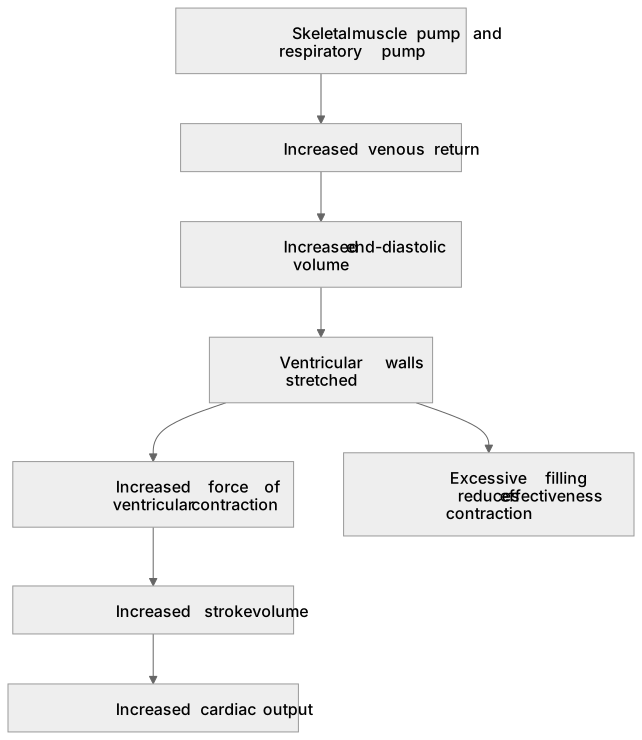
Starling's law describes how the heart matches its output to the blood returning to it. Increased venous return stretches the ventricular walls, raising the volume of blood in the ventricle at the end of diastole. This greater stretch increases the force of ventricular contraction, so stroke volume rises and, because cardiac output equals heart rate multiplied by stroke volume, cardiac output rises too. During exercise, the skeletal muscle pump and respiratory pump increase venous return, so stroke volume increases. The relationship is not unlimited: excessive filling eventually reduces the effectiveness of contraction.
What earns the marks
- Starling's law links the degree of stretch of ventricular muscle to the force of contraction.
- Greater venous return increases end-diastolic volume and stretches the ventricular walls.
- Increased stretch raises the force of ventricular contraction, increasing stroke volume.
- Cardiac output equals heart rate multiplied by stroke volume, so a rise in stroke volume raises cardiac output.
- The skeletal muscle pump and respiratory pump increase venous return during exercise.
- The relationship has a limit: excessive filling can reduce the effectiveness of contraction.
Common mistakes and how to put them right
Thinking Starling's law increases heart rate.
Put it right: It changes the force of contraction and stroke volume, while heart rate is influenced separately.
Believing stroke volume can rise indefinitely.
Put it right: Excessive ventricular filling eventually reduces the effectiveness of contraction.
Confusing venous return with cardiac output.
Put it right: Venous return is the blood returning to the heart, whereas cardiac output is the volume the heart pumps out per minute.
Assuming the law applies to atria only.
Put it right: The key stretch and force relationship is described for ventricular muscle.
Exam tips
- State the chain explicitly: venous return increases, end-diastolic volume increases, ventricular stretch increases, force of contraction increases, stroke volume increases.
- Use the equation cardiac output equals heart rate multiplied by stroke volume to explain why cardiac output rises.
- Link the law to exercise by naming the skeletal muscle pump and respiratory pump as mechanisms that raise venous return.
Try the lesson
The start of the Cardiovascular system: Starling’s law of the heart. lesson, made from checked teaching notes for this specification point.
Have a go first
According to Starling's law of the heart, what happens to the force of ventricular contraction when the ventricles are filled with a greater volume of blood?
Listen
Starling's law describes how the heart matches its output to the blood returning to it. Increased venous return stretches the ventricular walls, raising the volume of blood in the ventricle at the end of diastole. This greater stretch increases the force of ventricular contraction, so stroke volume rises and, because cardiac output equals heart rate multiplied by stroke volume, cardiac output rises too. During exercise, the skeletal muscle pump and respiratory pump increase venous return, so stroke volume increases. The relationship is not unlimited: excessive filling eventually reduces the effectiveness of contraction. A strong answer earns marks for these points. Starling's law links the degree of stretch of ventricular muscle to the force of contraction. Greater venous return increases end-diastolic volume and stretches the ventricular walls. Increased stretch raises the force of ventricular contraction, increasing stroke volume. Cardiac output equals heart rate multiplied by stroke volume, so a rise in stroke volume raises cardiac output. Exam tip: State the chain explicitly: venous return increases, end-diastolic volume increases, ventricular stretch increases, force of contraction increases, stroke volume increases.
See it
Key words
Say what each word means before you turn the card.
Venous return and ventricular filling
Try answering aloud or in your head before turning the card.
Force of contraction and stroke volume
Try answering aloud or in your head before turning the card.
Cardiac output equation
Try answering aloud or in your head before turning the card.
Exercise-induced changes in cardiac function
Try answering aloud or in your head before turning the card.
See every definition
- Venous return and ventricular filling
- Blood returning to the heart stretches the ventricular walls, raising the volume of blood in the ventricle at the end of diastole.
- Force of contraction and stroke volume
- Greater stretch increases the force of ventricular contraction, so stroke volume rises.
- Cardiac output equation
- Cardiac output equals heart rate multiplied by stroke volume, so a rise in stroke volume raises cardiac output.
- Exercise-induced changes in cardiac function
- During exercise, the skeletal muscle pump and respiratory pump increase venous return, so stroke volume increases.
Label the diagram
Some boxes have lost their names. Pick the right name for each number.
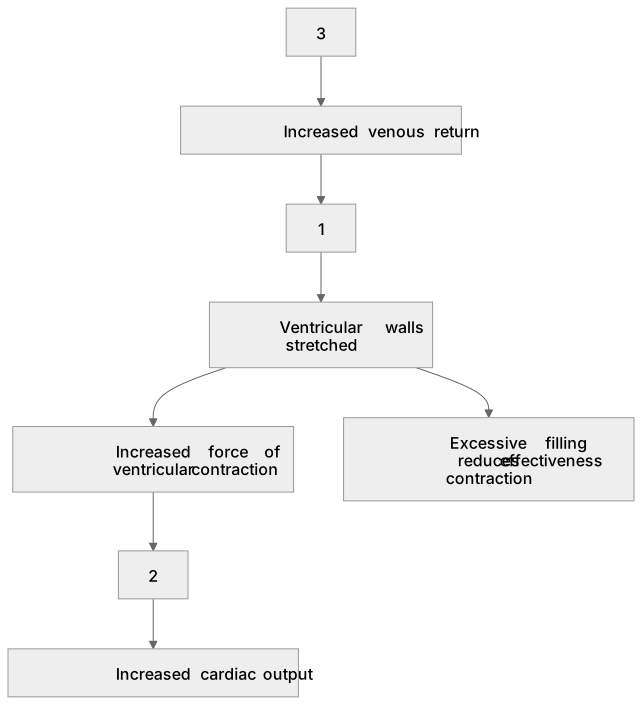
1Box 1
2Box 2
3Box 3
There is more to this lesson
The full lesson goes on to check your understanding and help you earn the marks. Create a free account to carry on, with your progress saved.
A week of Premium from your first lesson · Then the free plan continues · No card, no charge
Test your understanding of Cardiovascular system: Starling’s law of the heart.
Active recall beats re-reading. Take an instant quiz now to test what you’ve learned and lock it into long-term memory.
A week of Premium from your first lesson · Then the free plan continues · No card, no charge